


 Top Rated Course

We may not have the course you’re looking for. If you enquire or give us a call on 01344203999 and speak to our training experts, we may still be able to help with your training requirements.
How to Write a Conclusion? Structure, Steps and Styles
Charlotte Wilson 16 July 2026Writing a conclusion is the process of crafting the final paragraph that summarises key ideas and brings the content to a clear, meaningful ending. It reinforces the main points clearly and leaves a lasting positive impression. A strong conclusion helps readers take away valuable key insights and feel a sense of closure.

Training Outcomes Within Your Budget!
We ensure quality, budget-alignment, and timely delivery by our expert instructors.
Table of Contents

The writing process is not just about presenting ideas; it’s about leaving your readers with a sense of clarity and purpose. Every piece of content deserves a strong ending that ties everything together.
Knowing How to Write a Conclusion effectively ensures your main points are reinforced and your message resonates. In this blog, we will explore practical tips and strategies to craft conclusions that leave a lasting impact.
Table of Contents
1) What is a Conclusion?
2) Why is a Conclusion Important?
3) What is the Structure of a Conclusion?
4) What Your Conclusion Should Not Include?
5) How to Write a Conclusion?
6) Common Mistakes to Avoid in Conclusions
7) Different Conclusion Styles
8) How Long Should a Conclusion Be?
9) Conclusion
What is a Conclusion?
A conclusion is the final paragraph that ties your ideas together and gives your writing a sense of closure. It summarises the key points and ensures readers leave with a clear understanding of your message.
A good conclusion does not introduce new information but reinforces the main ideas. It shapes how readers interpret the content and leaves a lasting impression that makes your work feel complete.

Why is a Conclusion Important?
Beyond marking the end of a piece, a conclusion helps readers understand the significance of what they have read. Here are the key benefits of an effective conclusion:
a) Reinforces the Main Idea: Reminds readers of your central points without repeating them word-for-word
b) Highlights the Topic’s Significance: Shows why the discussion or argument matters
c) Creates a Lasting Impression: Leaves readers with a memorable final thought
d) Meets Professional Expectations: Demonstrates clarity, completeness, and credibility
e) Guides Writing and Revision: Helps structure your work and align the final draft
What is the Structure of a Conclusion?
A strong conclusion ties your writing together and reinforces the main points. Each component plays a specific role in leaving readers with a clear understanding of your argument.
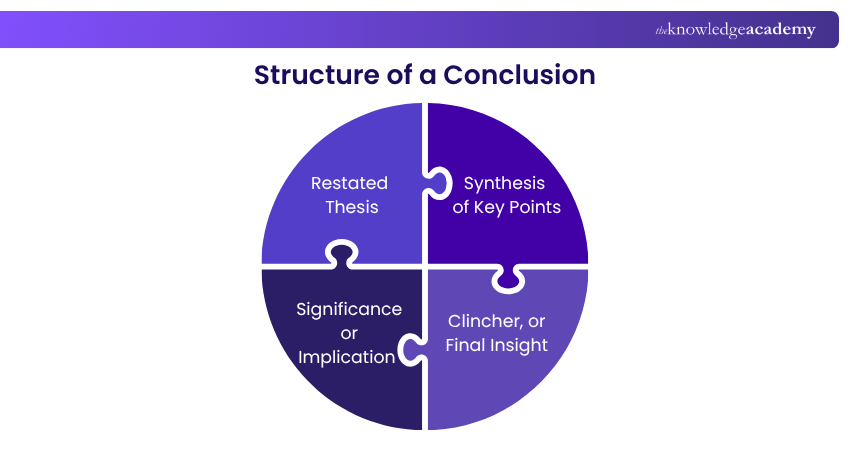
1) Restated Thesis
Restating the thesis reminds readers of your main argument in fresh language without copying previous sentences.
Example: The rise of remote work demonstrates that flexible schedules can improve productivity while supporting employee well-being.
2) Synthesis of Key Points
Synthesis shows how the main ideas work together rather than listing them again. In one to three sentences, connect patterns, contrasts, or cause-and-effect relationships.
Example: By combining flexible hours, reduced commute times, and better work-life balance, remote work policies enhance both efficiency and employee satisfaction.
3) Significance or Implication
Explain why your argument matters and what broader impact or consequences it may have.
Example: Understanding these benefits can help organisations create policies that support both performance and employee health.
4) Clincher, or Final Insight
End with a memorable sentence that reinforces your main message and leaves a lasting impression.
Example: As companies adapt to modern work trends, embracing flexibility may be the key to long-term success.
What Your Conclusion Should not Include?
These are common mistakes to avoid in a conclusion:
a) Avoid phrases like “in conclusion”
b) Do not introduce new evidence
c) Avoid repeating sentences word-for-word
d) Skip overly long summaries
e) Avoid uncertain or apologetic language
How to Write a Conclusion?
Writing a conclusion goes beyond just writing a piece of the blog or article; it's the reflection of the writer’s intent and lasting impact, particularly when adhering to a proper Report Writing Format. Here’s a structured overview of How to Write a Conclusion based on best writing practices:
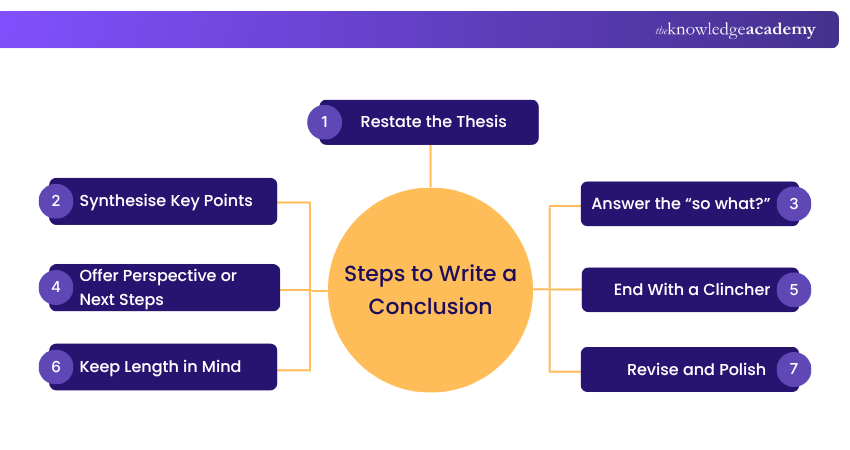
Step 1. Restate the Thesis
Paraphrase your thesis in fresh wording to remind readers of your main claim without repeating it exactly.
Step 2. Synthesise Key Points
Show how your main ideas connect and support your argument instead of simply listing them again.
Step 3. Answer the “so what?”
Explain why your argument matters beyond your paper and what meaning it holds for readers.
Step 4. Offer Perspective or Next Steps
Provide broader insight, recommendations, or suggestions for what comes next without adding new evidence.
Step 5. End With a Clincher
Close with a confident final sentence that leaves readers with a memorable takeaway.
Step 6. Keep Length in Mind
Keep your conclusion focused and proportionate; short essays typically use one paragraph, while longer pieces may need two.
Step 7. Revise and Polish
Reread your conclusion after drafting the full piece, tighten phrasing, and adjust tone to align with the rest of your writing.
Common Mistakes to Avoid in Conclusions
A strong conclusion leaves a lasting impact by reinforcing your key message without letting the effectiveness diminish. However, certain mistakes can weaken your conclusion and overwhelm readers. Here are the typical mistakes to avoid in conclusion:
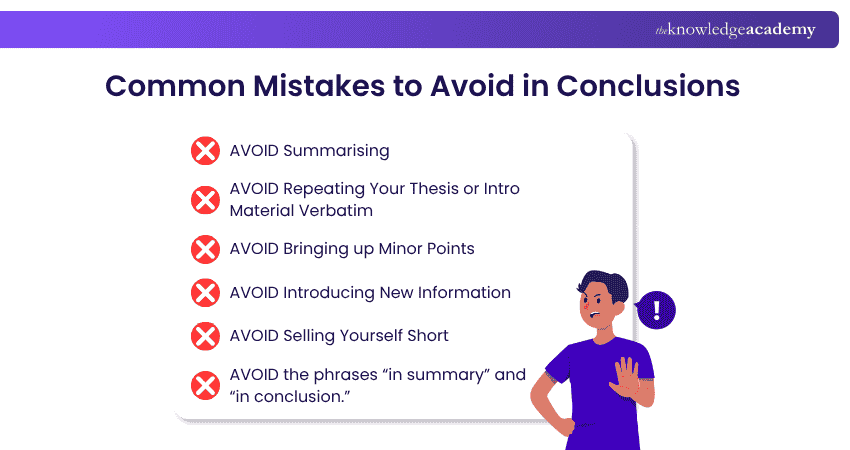
1) AVOID Summarising
Your conclusion should do more than restate your main points. Simply summarising can make the ending feel repetitive and dull. Focus on giving readers a fresh perspective instead.
2) AVOID Repeating Your Thesis or Intro Material Verbatim
Copying your thesis or introduction word-for-word weakens your conclusion. Restate your ideas in new language that reinforces your argument. This keeps the ending engaging and strong.
3) AVOID Bringing up Minor Points
Focusing on trivial or minor details distracts from your main argument. Highlight only the key ideas that support your overall message. This keeps the conclusion concise and impactful.
4) AVOID Introducing New Information
The conclusion is not the place for fresh evidence or ideas. Introducing new information can confuse readers and make your argument feel incomplete. Stick to reinforcing what’s already been discussed.
5) AVOID Selling Yourself Short
Avoid uncertain or apologetic language in your conclusion. Confident wording strengthens your argument and leaves readers with a clear sense of your position. Make your closing statements assertive and credible.
6) AVOID the phrases “in summary” and “in conclusion.”
Overused phrases like “in summary” or “in conclusion” feel mechanical and unnecessary. Let your writing naturally signal the ending. A smooth, confident closing is far more effective
Build skills for independent career success with Personal Development Courses now!
Different Conclusion Styles
Different conclusion types serve various purposes, depending on your writing tone and intent. Here are three different conclusion styles you should know:
1) Summarisation
This is the most traditional approach, where you briefly illustrate your thesis and key arguments. This is the most traditional approach, where you briefly illustrate your thesis and key arguments. It is an effective way for academic and analytical writing by ensuring clarity, promoting Analytical Thinking, and helping reinforce the main points without introducing new information.
2) Editorialisation
An editorial conclusion provides a personal insight, opinion, or a topic’s reflection. This style is often used in persuasive or opinion-based pieces to encourage readers in the subject’s Critical Thinking.
3) Externalisation
External conclusions connect the topic to a broader context, such as future implications or real-world applications. This technique is commonly used in research and business writing to highlight relevance beyond the immediate discussion.
How Long Should a Conclusion Be?
The length of a conclusion can vary depending on the type of document or piece of writing. Here are some general guidelines:
1) Essays and Short Papers: For a typical essay or short paper (around 1,000-2,000 words), a conclusion is usually one paragraph long, roughly 5-7 sentences. It should succinctly summarise the main points and restate the thesis in a new way.
2) Research Papers and Thesis: In longer research papers or theses, the conclusion might be a bit longer, spanning 1-2 pages. It should not only summarise the key findings but also discuss their implications, suggest future research, and provide a final thought or call to action.
3) Reports and Business Documents: For reports and business documents, the conclusion can vary in length depending on the complexity of the content. It should effectively summarise the main findings, provide recommendations, and outline next steps. Typically, it can be a few paragraphs long.
4) Articles and Blog Posts: In articles and blog posts, the conclusion is usually brief, around 1-2 paragraphs. It should wrap up the main points and leave the reader with a final takeaway or call to action.
Conclusion
We hope this blog helped you feel more confident about shaping effective endings. A strong conclusion supports your message and leaves a lasting impression. By understanding How to Write a Conclusion, you can guide readers to a clear and satisfying finish. Keep practising and your writing will only get stronger.
Turn data into clear, concise Reports with our Report Writing Course - Join today!
Frequently Asked Questions
What is the Difference Between a Summary and a Conclusion?

A summary briefly restates on the main points of a piece of writing, focusing on the key ideas. A conclusion provides closure by reinforcing the final message and leaving the reader with a clear takeaway.
How can Students Improve Their Conclusion Writing Skills?
Students can improve their conclusion writing skills by practising concise summaries of their main points and reviewing strong examples from reliable sources. Regular writing exercises and constructive feedback also help them learn how to end their work with clarity and impact.

Charlotte Wilson


Soft Skills and Business Training Manager
Charlotte Wilson is an expert in soft skills development, with over 14 years of experience helping individuals and teams improve communication, productivity and emotional intelligence in the workplace. Her training content is focused on enhancing interpersonal effectiveness and fostering positive, collaborative environments across all levels of an organisation.
View Detail

 If you wish to make any changes to your course, please


