




We may not have the course you’re looking for. If you enquire or give us a call on 01344203999 and speak to our training experts, we may still be able to help with your training requirements.
What are Cloud Run Functions: Google Cloud Functions Explained
ByVishnu SankarLast updated on: 05 October 2026
Cloud Run functions provide a serverless way to run event-driven or HTTP-triggered code without managing infrastructure. It automatically scales based on demand, supports multiple programming languages, and integrates with other Google Cloud services to build efficient and scalable applications.
What You’ll Discover
1.Understand how Cloud Run functions work2. Explore HTTP and CloudEvents function types3. Compare current and 1st gen functions4. Learn key features and practical benefits5. Discover common serverless application use cases6. Follow steps to deploy a function
Imagine writing code that wakes up only when needed, does its job flawlessly, and then vanishes, no servers, no maintenance, no stress Cloud Run functions is the current name for Google Cloud’s functions offering. Cloud Functions (2nd gen) is now called Cloud Run functions, while Cloud Functions (1st gen) is now Cloud Run functions (1st gen). It’s efficiency and simplicity rolled into one smart cloud tool.
Whether you’re processing images, sending real-time notifications, or managing APIs, Cloud Run Functions automates it all with ease. Think of it as your always-ready cloud computing, scalable, and cost-efficient. In this blog, we’ll uncover how it works, why developers love it, and where it can supercharge your projects.
What are Cloud Run Functions?
Cloud Run functions is a serverless compute service that lets developers deploy single-purpose functions without managing the underlying server or runtime environment. Functions can respond to HTTP requests or supported cloud events. It allows developers to run individual units of code known as functions in response to specific actions without the need to manage servers or infrastructure.
This serverless architecture eliminates the burden of server provisioning, scaling, and maintenance. The term "serverless" may be misleading, as it doesn't mean there are no servers involved. Instead, it means developers do not directly deal with the server management aspects. Google Cloud abstracts the underlying infrastructure and handles provisioning, scaling and platform management.

Key Features of Cloud Run Functions
Let’s have a look at the key features of Cloud Run functions
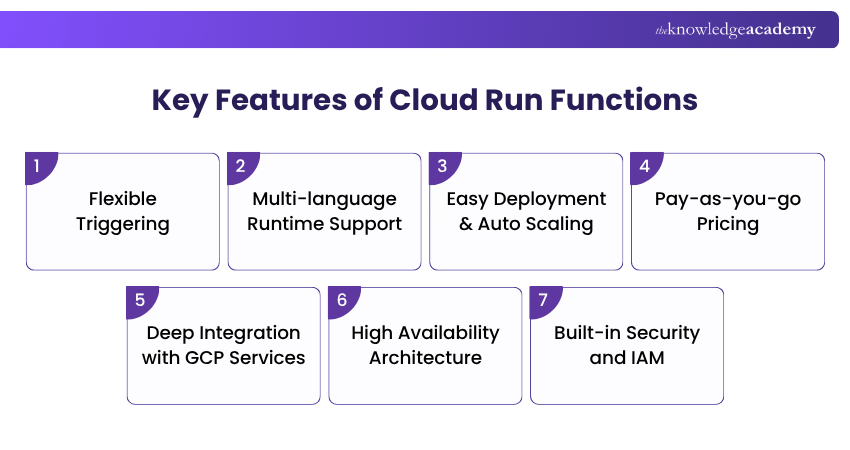
1) Flexible Triggering
Cloud Run functions can respond to HTTP(S) requests or event-driven triggers through Eventarc. Cloud Run functions can be invoked through HTTP requests or Eventarc-supported events, including events from services such as Pub/Sub, Cloud Storage and Firestore.
2) Multi-language Runtime Support
Cloud Run Functions can be written using various programming languages, including Node.js, Python, PHP, Go, .NET, Ruby, and Java. But check the latest documentation for compatibility.
3) Easy Deployment & Auto Scaling
It is easy to deploy functions on Cloud Run. You can deploy Cloud Run functions through the Google Cloud console or the Google Cloud CLI (Command Line Interface), and integrate deployment into CI/CD workflows where needed. This ensures the app functions automatically scale based on demand, subject to configured limits and platform quotas.
4) Pay-as-you-go Pricing
Cloud Run functions use usage-based pricing. Costs depend on the resources consumed by deployed functions and related services, subject to the current Cloud Run pricing model and free-tier allowances.
5) Deep Integration with GCP Services
Cloud Run Functions is part of the Google Cloud Platform (GCP) and works well with other GCP services. It can connect with tools like Cloud Pub/Sub and Cloud Firestore, allowing developers to create more advanced and complete solutions using these services.
6) High Availability Architecture
Cloud Run functions run on regional Cloud Run infrastructure designed for redundancy across zones within the selected region, helping improve service availability. This cross-zone redundancy ensures greater availability and minimises downtime.
7) Built-in Security and IAM
Cloud Run functions support HTTPS and integrate with Google Cloud IAM to control access and invocation permissions. Functions can require authenticated access or, where appropriate, be configured for public invocation. Service accounts can also be used to control access to other Google Cloud resources.
Types of Cloud Run Functions
Cloud Run Functions are categorised into two distinct types: HTTP Functions and CloudEvents Functions. Let's have a detailed look at these types:
1) HTTP Functions: HTTP functions run when they receive an HTTP request. They are suitable for APIs, webhooks, backend services, and other applications that need to respond directly to web requests. Key characteristics of HTTP functions include:
a) Triggered through HTTP or HTTPS requests.
b) Can process request data and return an HTTP response.
c) Commonly used for APIs, webhooks, and application backends.
2) CloudEvents Functions:
CloudEvents functions are event-driven functions that execute when supported events occur within Google Cloud services. They use the CloudEvents standard to receive structured information about the triggering event. Key characteristics of CloudEvents functions include:
a) Respond to events rather than direct HTTP requests.
b) Work with supported event sources through Eventarc.
c) Useful for tasks such as processing Cloud Storage events, Pub/Sub messages, and automated workflows.
Which Trigger Fits?
Choose your scenario:API or webhook → HTTP FunctionCloud Storage event → CloudEvents FunctionPub/Sub message → CloudEvents FunctionDirect web request → HTTP Function
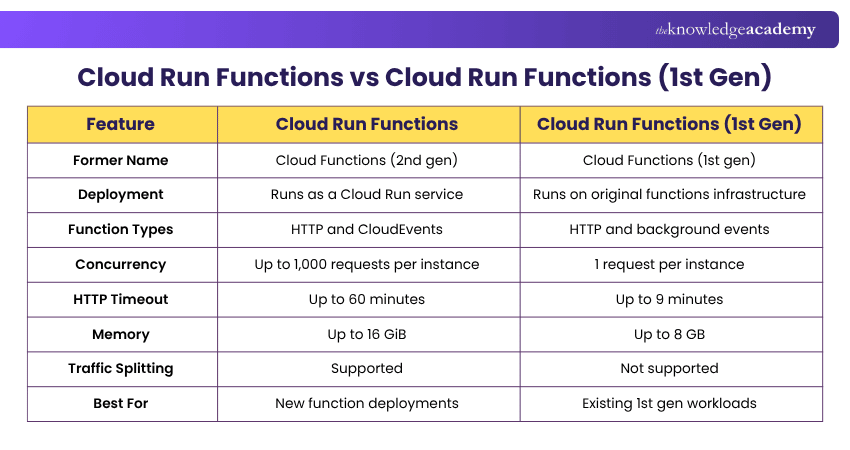
Cloud Run Functions vs Cloud Run Functions (1st Gen)
Cloud Run functions, formerly called Cloud Functions (2nd gen), are the current Cloud Run-based functions offering. Cloud Run functions (1st gen), formerly Cloud Functions (1st gen), remain supported for existing workloads.
Benefits of Using Cloud Run Functions
There are many advantages to Cloud Run Function which aligns with modern needs of enterprises exploring cloud computing. Some of those benefits are:
1) Enhance developer productivity by simplifying developer experience for managing the operational infrastructure.
2) Usage-based pricing helps organisations pay according to the resources and execution of their functions.
3) The open-source Functions Framework supports local development and portable function patterns across supported environments.
4) Seamlessly integrate with the other Google Cloud services, like Google Cloud Pub/Sub, Firestore, BigQuery, Google Cloud Scheduler, etc.
5) The serverless model can reduce infrastructure-management effort and support faster deployment of event-driven application components.
Build scalable serverless applications with our Application Development With Cloud Run Training - Join now!
What are Common Use Cases of Cloud Run Functions?
Cloud Run Functions handle tasks like file processing, data transformation, webhook handling, IoT data processing, and API backends without server management. These are the common use cases of Google Cloud:
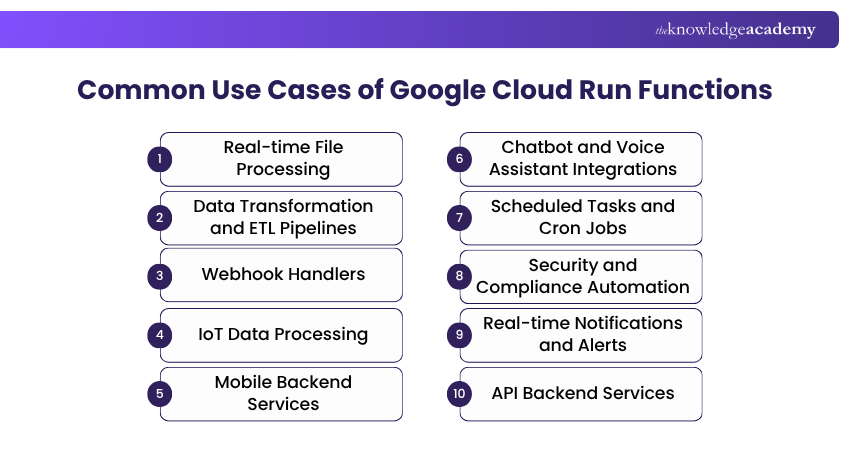
1) Real-time File Processing
Automatically process files uploaded to Google Cloud Storage, such as generating thumbnails, converting formats, or extracting metadata.
2) Data Transformation and ETL Pipelines
Transform and move data between systems by responding to events from sources like Cloud Pub/Sub or Cloud Storage.
Strengthen cloud data processing skills with our Data Engineering With Google Cloud Platform Course.
3) Webhook Handlers
Respond to HTTP requests from third-party services, enabling integrations with platforms like Stripe, Twilio, or GitHub.
4) IoT Data Processing
Handle data from IoT devices by processing telemetry data in real-time as it arrives via Cloud pub/sub.
5) Mobile Backend Services
Serve as lightweight backends for mobile applications, supporting backend tasks such as notifications, data synchronisation, API logic or integration with authentication services.
6) Chatbot and Voice Assistant Integrations
Power conversational interfaces by integrating with services like Dialogflow to handle user intents and provide responses.
7) Scheduled Tasks and Cron Jobs
Perform routine tasks like database cleanups or report generation by scheduling functions using Cloud scheduler.
8) Security and Compliance Automation
Monitor and respond to security-related events, process audit-log events or trigger automated remediation workflows.
9) Real-time Notifications and Alerts
Send notifications or reminders in response to specific actions, such as threshold breaches or system errors.
10) API Backend Services
Implement RESTful APIs to handle client requests, process data, and return responses without managing server infrastructure.
Trainer’s Tip: Start with a small HTTP function before adding event triggers. This makes it easier to test your code, permissions, and dependencies independently.
How to Deploy a Simple Cloud Run Function?
Cloud Run functions can be deployed directly from source code using the Google Cloud console. The current workflow uses Cloud Run → Write a function. Follow these steps to deploy a simple Cloud Run function from source code using the Google Cloud console.
1) Set Up Your Google Cloud Project
Sign in to the Google Cloud console, create or select a project, and ensure billing is enabled. Ensure the APIs required for your chosen deployment and trigger are enabled. These can include Cloud Run, Cloud Build, Artifact Registry and, for event-driven functions, Eventarc and the relevant event-provider API.
2) Open Cloud Run
Open Cloud Run in the Google Cloud console and select Write a function. Enter a service name to begin configuring the function.
3) Configure the Function
Choose the required runtime version, configure authentication based on whether the function should be private or public and add an Eventarc trigger if event-driven execution is required.
4) Write the Function Code
Open the Source tab and write or edit the function code using your selected runtime. Ensure the entry point and dependencies are configured correctly.
5) Save and Redeploy
Select Save and redeploy to build and deploy the function. Cloud Build builds the function source into a container image, which is stored in Artifact Registry and then deployed to Cloud Run.
6) Test the Function
For an HTTP function, use the generated Cloud Run service URL to invoke and test the function. If authentication is enabled, include the required credentials when sending the request.

Vishnu Sankar is a Senior Content Writer with 5+ years of experience across content development, software development, web development and system administration. His technical background and professional training support his expertise in IT and Tech, while his extensive research and writing experience covers Project Management and Health and Safety.
View Detail

 If you wish to make any changes to your course, please


