




We may not have the course you’re looking for. If you enquire or give us a call on 01344203999 and speak to our training experts, we may still be able to help with your training requirements.
Features of Report Writing: Key Characteristics Explained
ByAishwarya UnniLast updated on: 02 October 2026
Features of report writing explores key elements like clarity, accuracy, objectivity, structure, visual presentation and evidence. These features support effective communication by presenting information clearly, substantiating claims with credible evidence and helping readers understand the report's findings.

Ever read a report twice and still wondered, “So… what’s the actual point?”
That is usually not an information problem. It is a communication problem.
A strong report does more than collect facts. It guides the reader through them clearly, supports important points with evidence and makes the main message easy to find. Understanding the core features of report writing makes it easier to see what separates a useful report from one that simply presents information.
What are the Key Features of Report Writing?
What separates an effective report from a collection of facts? The difference lies in how information is selected, organised, supported and presented. The following features of report writing help transform raw information into a document that readers can understand and use.
1) Clear Purpose
Every report should have a defined reason for being written. Its purpose might be to investigate an issue, present findings, evaluate performance, document progress, or recommend a course of action.
A clear purpose keeps the content focused and helps determine what information should be included. Before writing, it is useful to ask: What should the reader understand or be able to do after reading this report?
2) Clarity and Conciseness
A report should communicate information clearly without including unnecessary detail. Sentences should be easy to follow, terminology should be appropriate for the audience, and each section should contribute meaningfully to the report's purpose.
Conciseness does not necessarily mean making a report short. A technical or research report can be lengthy while still being concise if its content is relevant, focused and free from unnecessary repetition.

3) Accuracy
Accuracy means ensuring that the information presented in a report is correct and accurately reflects the available evidence. Facts, figures, calculations, dates, names and other details should be checked carefully before the report is finalised.
Sources should also be represented and referenced accurately, and any interpretation of the evidence should reflect what the information actually supports.
4) Objectivity
Effective report writing clearly distinguishes factual evidence from interpretation, inference and unsupported personal opinion.
Objectivity does not mean avoiding analysis, judgement or recommendations. Where these are required, they should be clearly supported by the evidence presented and should consider relevant alternative explanations or viewpoints where appropriate.
Quick Clarification: Report features describe the qualities that make a report effective, such as clarity, accuracy and objectivity. Report structure refers to the sections used to organise the information, which can vary depending on the report's purpose and type.
5) Logical Structure
A well-structured report guides the reader naturally from one section to the next.
There is no single structure that applies to every report. Depending on its purpose and type, a report may include sections such as an introduction, methodology, findings, analysis, conclusion, recommendations, references and appendices.
Headings and subheadings help divide complex information into manageable sections and allow readers to locate specific information quickly.
6) Audience Awareness
A report should be written with its intended reader in mind. Audience awareness influences the level of detail, terminology, explanation and presentation required.
For example, a technical report written for specialists may use terminology that would need further explanation in a report prepared for senior managers or a general audience.
Understanding the audience helps the writer decide not only what information to include, but also how to communicate it effectively.
Strengthen professional communication and create clear, impactful documents with our Business Writing Training – Register Today!
7) Relevant and Reliable Evidence
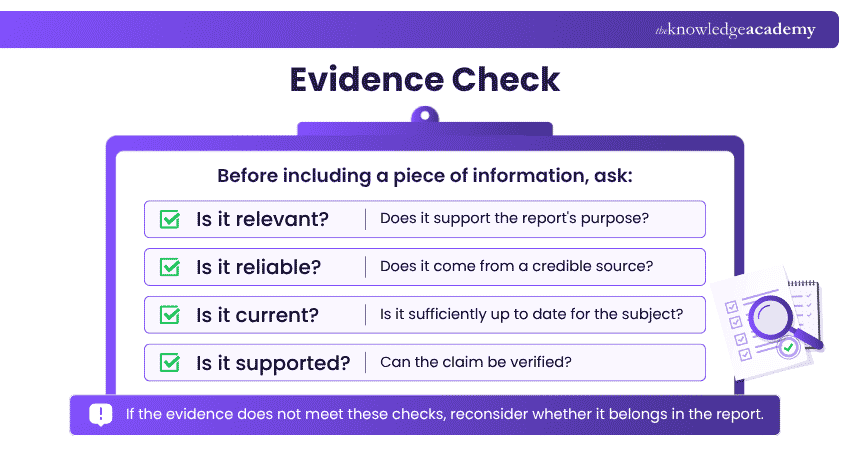
Claims, findings and conclusions become more credible when they are supported by appropriate evidence.
Depending on the report, this evidence may include research findings, survey results, observations, organisational records, statistics or other reliable sources.
Evidence should also be relevant to the report's purpose. More information does not automatically make a report stronger; the right evidence does.
8) Consistency
Consistency gives a report a professional and organised appearance. Terminology, headings, numbering, formatting, abbreviations, units and referencing conventions should be applied consistently throughout the document.
The same concept should also be described consistently unless there is a clear reason to use different terminology.
9) Appropriate Tone and Language
The tone and language of a report should suit its audience, purpose and context.
A technical report for specialists may use industry-specific terminology, while a report intended for a broader audience may require simpler explanations.
Reports generally benefit from precise, professional and direct language, with the level of formality adapted to the reader and situation.
10) Effective Presentation
How information is presented can influence how easily readers understand and navigate a report.
Headings, spacing, tables, charts, bullet points and other visual elements can help organise complex information and highlight important findings. Tables and figures should be clearly labelled and referred to where relevant in the surrounding text.
Visual aids should always serve a clear purpose. A chart should reveal a pattern, a table should organise comparable information, and formatting should guide the reader rather than simply decorate the report.
How to Apply These Features When Writing a Report?
Knowing the features is useful. Applying them consistently is what improves the finished document.
A simple way to do this is to divide report writing into three stages.
1) Before Writing: Define the Report
Before drafting, clarify four things:
1) Purpose: What does the report need to achieve?
2) Audience: Who will read it?
3) Scope: What information belongs within the report?
4) Evidence: What information and sources are required to support its findings?
Once these are clear, decide on an appropriate structure.
Planning first reduces the risk of collecting large amounts of information that never contributes to the final report.
2) While Writing: Build a Clear Evidence Trail
As you draft, build each section around one clear purpose.
Introduce the relevant information, explain what the evidence shows and connect the findings back to the report's overall objective.
Make sure that factual evidence, observations and interpretation are clearly distinguished, and that each section contributes something new rather than repeating information already covered.
A useful rule is:
One section, one clear purpose.
3) After Writing: Review it as a Reader
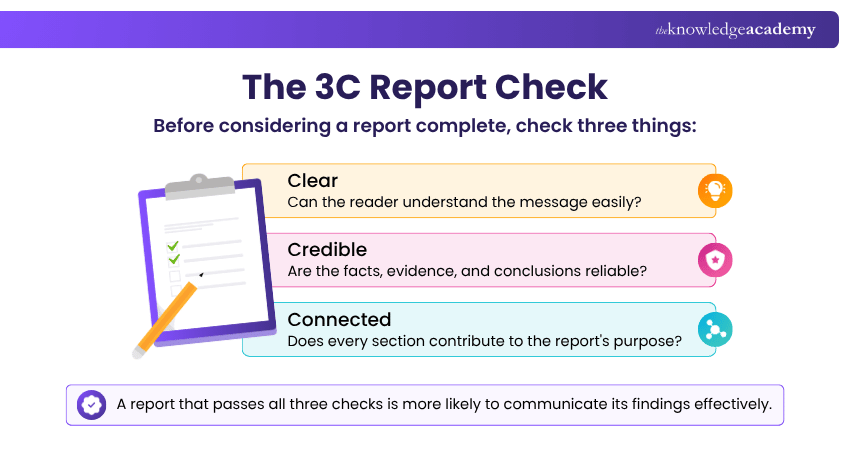
Once the draft is finished, review the report from the reader's perspective rather than the writer's.
Check whether the reader can:
1) Understand the purpose quickly
2) Locate important findings
3) Follow the reasoning
4) Identify the supporting evidence
5) Understand tables and charts
6) Distinguish findings from conclusions
7) See how recommendations were reached
Also proofread for grammar, accuracy, consistency and formatting.
A final reader-focused review can reveal problems that are easy to miss while drafting.
The features of report writing work together to make information easier to understand and more useful to the reader.
A strong report brings these features together rather than treating them separately. Clear purpose, reliable evidence, and logical structure help readers understand the information and trust what it supports.
The best test of a report is simple: Can the reader quickly understand what matters, why it matters and what the evidence supports?
When the answer is yes, the report is doing its job effectively.
Strengthen your academic writing skills and learn to communicate ideas with greater clarity through our Academic Writing Training – Register Now!

Aishwarya Unni is a Copywriter with 2+ years of experience in reporting, web content, blogs, email marketing, and case studies. Her journalism background, combined with her research and writing experience across Business Skills and Human Resources, helps her create clear, engaging content for different audiences.
View Detail

 If you wish to make any changes to your course, please


