


 Top Rated Course

We may not have the course you’re looking for. If you enquire or give us a call on 01344203999 and speak to our training experts, we may still be able to help with your training requirements.
What is Edge Computing? Boost Your Network Performance Today
The Knowledge Academy 16 July 2026Edge Computing is a method of processing data closer to its source like devices or local servers. This reduces latency, improves speed, and enables real-time decision-making. It’s especially useful in applications where fast responses are critical, such as autonomous vehicles, healthcare, and smart devices. It also helps with security, bandwidth efficiency, and regulatory compliance.

Training Outcomes Within Your Budget!
We ensure quality, budget-alignment, and timely delivery by our expert instructors.
Table of Contents
Edge, cloud, fog, these may sound like weather talk, but these terms are reshaping technology. Here comes the urge to know more about What is Edge Computing? It is leading a quiet revolution by bringing processing power closer to where data is born. As the world demands faster responses and smarter tech, Edge Computing steps in to deliver.
Learning the basic concepts will help you to understand the beauty of What is Edge Computing. It’s fast, efficient, and surprisingly vital to modern tech. Read this blog to know how we break down Edge Computing’s definition, benefits, real-life use cases, and how it compares to cloud and fog computing. Let's find out the new backbone of real-time digital systems!
Table of Contents
1) What is Edge Computing?
2) Importance of Edge Computing
3) How Does Edge Computing Work?
4) Edge Computing Use Cases
5) Benefits of Edge Computing
6) Challenges of Edge Computing
7) Edge vs Cloud vs fog Computing
8) Edge Computing Implementation
9) Conclusion
What is Edge Computing?
Traditionally, when a device collects data, it sends that information to the cloud for processing. This process works well in many cases, but it can cause delays, consume high bandwidth, and raise concerns about privacy or data sovereignty. That’s where Edge Computing changes the game.
Edge Computing is a distributed computing model that brings data processing and storage closer to the source of data generation. Some of them are sensors, IoT devices, smartphones, or local servers. This model is especially vital for applications where real-time decision-making is critical.
Key Takeaways:
1) Processes data close to the source
2) Reduces latency and improves speed
3) Lowers bandwidth usage
4) Enhances data privacy and control
5) Supports real-time decision-making
6) Ideal for IoT, vehicles, and smart devices
Importance of Edge Computing
Edge Computing is becoming increasingly important as the digital world demands faster, smarter, and more efficient ways to process data. Here are some of the key importances:

1) Reduces Latency
In many modern applications like autonomous driving, healthcare monitoring, or industrial automation, even a few milliseconds of delay can be critical. Edge Computing processes data locally, allowing for real-time responses without waiting for cloud servers.
2) Supports Real-time Applications
Whether it’s a robot in a factory or a smart traffic light system, some actions need to happen instantly. Edge Computing ensures that time-sensitive data is processed right where it’s generated.
3) Minimises Bandwidth Use
Sending large volumes of data back and forth between devices and the cloud can strain network bandwidth. Edge Computing filters and processes data locally, reducing the amount of information that needs to be transmitted.
4) Improves Reliability
In areas with unstable or limited internet connectivity like remote farms, ships, or developing regions. Edge Computing allows systems to continue functioning even when offline or with minimal cloud access.
5) Enhances Data Privacy and Security
Processing sensitive information like health or personal data locally minimises the risk of exposure during transmission. This also supports compliance with data protection laws like GDPR, which require certain data to stay within specific regions.
6) Optimises Cloud Resources
By handling simpler or repetitive tasks at the edge, only essential data is sent to the cloud. This not only saves cloud processing power and costs but also makes the entire system more efficient.
While Others Google It, You’ll Master It - Start Conda Training Now!
How Does Edge Computing Work?
Edge Computing changes how and where data gets processed. Instead of sending all information to a centralised cloud server far away, Edge Computing processes data near the source of data generation. This results in faster responses, reduced bandwidth usage, and better real-time decision-making. Key areas:
1) Devices like sensors or smartphones collect data
2) Edge nodes like routers, local servers, or gateways process this data nearby
3) Only relevant or summarised data is sent to the cloud, saving time and resources
For example: In a smart factory, edge devices might monitor temperature or machine vibration. If a reading exceeds a safe level, the system can trigger a shutdown immediately without waiting for cloud instructions.
Edge Computing Use Cases
Edge Computing is everywhere, often without us noticing. Here are some real-world use cases:
1) Autonomous Vehicles: Cars use Edge Computing to analyse surroundings and make split-second decisions. Waiting for cloud input? Not an option.
2) Retail: Smart shelves and checkout-free stores like Amazon Go rely on edge to track customer behavior and product stock in real-time.
3) Healthcare: Wearable devices and hospital monitors use edge tech to alert doctors to irregular vitals instantly.
4) Manufacturing: Predictive maintenance tools in factories catch machine issues before they fail.
5) Agriculture: Sensors in fields monitor moisture, temperature, and crop health, enabling farmers to act quickly.
Benefits of Edge Computing
Edge Computing offers a wide range of advantages that are reshaping how businesses and technologies operate. Let’s discuss three of its most significant benefits:

Autonomy
One of the biggest advantages of Edge Computing is its ability to function independently of constant internet connectivity. Edge devices are capable of processing data and executing decisions locally, even in remote or disconnected environments. Areas to focus:
1) Reliability In Remote Areas: In locations like oil rigs, rural farms, or ships at sea, internet connections can be weak or nonexistent. Edge Computing enables critical operations to continue without disruption.
2) Real-time Responsiveness: Autonomous vehicles and industrial robots rely on immediate reactions. They can’t afford the delay of sending data to a distant cloud and waiting for a response.
3) Resilience: If the cloud goes down or the internet connection is lost, edge systems can still operate, ensuring business continuity.
For Example: A smart drone surveying crops can adjust its flight path based on sensor feedback, even with no internet.
Go Beyond Basics and Master LTE Fundamentals Training that redefines the world!
Edge Security
Contrary to the belief that more devices equal more risk, Edge Computing can enhance data security, if implemented correctly.
How edge boosts security:
1) Reduces Data Exposure: Sensitive data is processed and stored locally, which minimises the need to transmit it across networks, reducing the risk of interception.
2) Fewer Central Points of Failure: Distributed data processing means that even if one node is compromised, the entire system isn’t necessarily affected.
3) Customised Controls: Security protocols can be fine-tuned at the device level based on specific use cases or environments.
For Example: In healthcare, wearable monitors can analyse patient vitals locally and share only critical alerts with doctors, reducing the exposure of sensitive medical data.
Data Sovereignty
With increasing global awareness around data ownership, privacy, and regulatory compliance, Edge Computing offers a practical solution to data sovereignty challenges. Key areas:
1) Compliance With Local Laws: Regulations like GDPR, HIPAA, or India's data protection bill often require certain data to stay within the country or region where it’s collected.
2) User Control: Individuals and organisations have more oversight of where and how their data is handled.
3) Faster Compliance Auditing: Since data doesn’t always leave the premises, it's easier to track and manage in audits or legal reviews.
For Example: A bank operating in Europe can process customer transaction data on local servers to comply with GDPR while still using cloud analytics for broader trends.
Challenges of Edge Computing
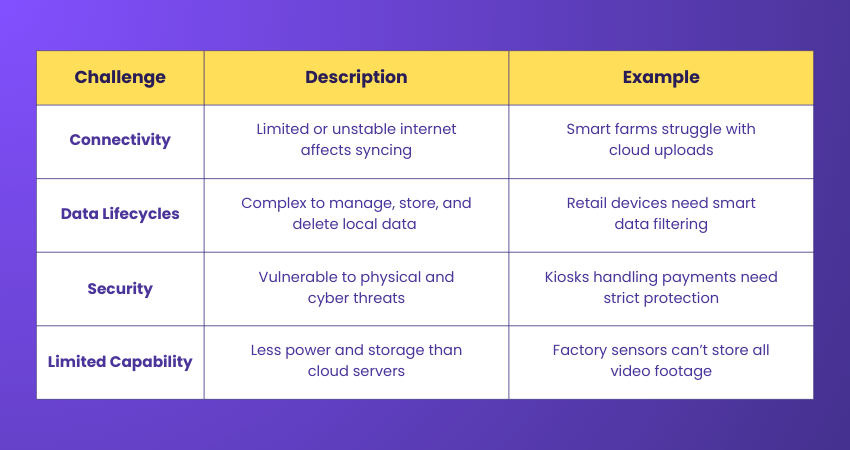
Implementing and managing edge solutions presents a unique set of technical and operational challenges. Understanding these roadblocks is essential for building robust, scalable, and secure edge environments. Here are some of the challenges explained:
Connectivity
Edge Computing is often praised for its ability to function with limited internet, but connectivity is still a challenge. It is difficult especially when syncing with the cloud or managing edge devices remotely.
Key Issues:
1) Inconsistent network access in remote or mobile environments can make it hard to update or control edge devices.
2) Delayed cloud sync can lead to inconsistent data across systems.
3) Dependence on intermittent backhaul connectivity for tasks like backups, updates, and reporting.
For Example: A smart farm may struggle to upload collected data to the cloud due to weak rural internet, delaying centralised insights or analytics.
Data Lifecycles
With data being processed locally, managing the full lifecycle of that data, from creation to deletion. Mostly it can become complex and fragmented.
Key Issues:
1) Not all data needs long-term storage, but deciding which data to send to the cloud can be tricky.
2) Edge nodes may store different versions of data, making consistency a challenge.
3) Without centralised visibility, lifecycle policies may vary across edge locations.
For Example: In retail, edge devices might record customer foot traffic, but only summary data is useful for long-term storage. It figures out what to delete and when it is crucial.
Where curiosity meets code-Shape the future with our Virtual Reality (VR) Training today!
Security
Each edge device is a potential entry point for cyberattacks, especially since they are often deployed in physically accessible or unmonitored locations.
Key Issues:
1) Edge nodes in public or unguarded spaces can be vulnerable to unauthorised access.
2) With many devices to manage, keeping firmware and security patches up to date is a major task.
3) Even local data, if intercepted, can compromise privacy and compliance.
For Example: A public transport kiosk collecting payment info must be encrypted and monitored closely to avoid breaches.
Limited Capability
Edge devices are typically small and purpose-built, meaning they don’t have the same processing power or storage capacity as cloud servers.
Key Issues:
1) Limited processing resources can restrict the complexity of tasks performed on-site.
2) Storage constraints mean only certain amounts of data can be retained locally.
3) Dependence on specialised hardware makes upgrades or changes more difficult and costly.
For Example: A camera on a factory floor might detect faulty products in real-time but can’t store high-resolution footage of every item due to limited local storage.
Edge vs Cloud vs Fog Computing
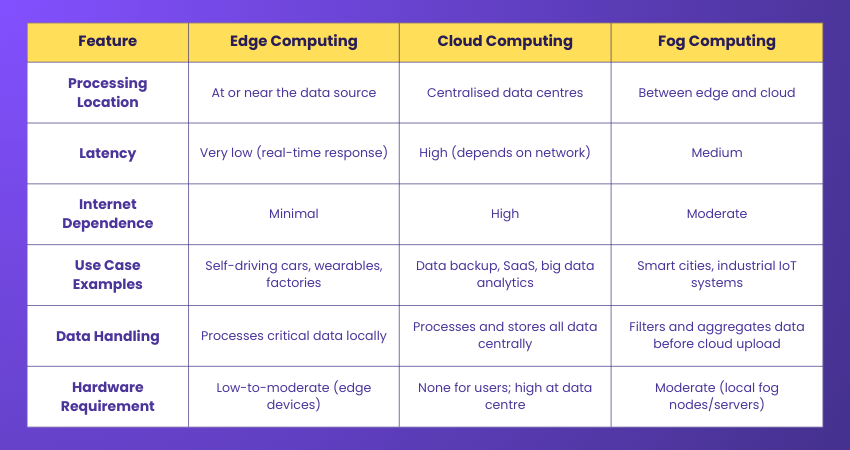
While all three, edge, cloud, and fog computing deal with how and where data is processed, they each serve different roles in the data ecosystem.
Cloud Computing refers to centralised data processing in remote data centres. It is typically owned by providers like AWS, Microsoft Azure, or Google Cloud. It’s ideal for large-scale storage, complex analytics, and services that don’t require real-time responses.
Edge Computing, on the other hand, pushes processing to the very point where data is generated like sensors, smart devices, or local servers. It’s perfect for applications needing instant decision-making, low latency, and offline functionality.
Fog Computing sits between edge and cloud. It adds an intermediate layer that extends cloud capabilities closer to the edge but still retains more processing power than devices alone. It’s useful for environments like smart cities or IoT ecosystems.
Edge Computing Implementation
Implementing Edge Computing involves planning, choosing the right tools, and aligning with your business goals. Here’s a simplified step-by-step overview:
1) Define Use Cases: Identify where low latency, autonomy, or data privacy is essential like manufacturing, retail, healthcare.
2) Choose Edge Hardware: Deploy sensors, gateways, or local servers based on your environment and data needs.
3) Set Up Edge Software: Install platforms for local analytics, automation, and device management.
4) Integrate with the Cloud: Use a hybrid model to process real-time data at the edge, send summaries to the cloud.
5) Secure the Devices: Implement Data Encryption, access control, and remote patching to protect data and endpoints.
6) Monitor Performance: Track device health, network usage, and system uptime for optimisation.
7) Scale in Phases: Start small, analyse results, and gradually expand your edge infrastructure.
Conclusion
Learning What is Edge Computing can be a transformative technology reshaping how we process, analyse, and respond to data. As the digital world becomes more decentralised, this Computing will be at the forefront. It quietly powers the smart, responsive technologies of tomorrow. Whether you're a business leader, developer, or tech enthusiast, understanding these concepts is key to staying ahead in an increasingly real-time world.
Stay ahead with cutting-Edge Technology that matters. Register for 5G Wireless Training today!
Frequently Asked Questions
Is Netflix Edge Computing?

Netflix does not use Edge Computing in the traditional sense. Instead, it uses a Content Delivery Network (CDN) called Open Connect to cache content closer to users for faster streaming. While this reduces latency like Edge Computing, it doesn't involve local data processing or real-time decision-making at the device level.
Who Invented Edge Computing?
Edge Computing evolved over time, but its roots trace back to the late 1990s when content delivery networks (CDNs) began caching data closer to users. Akamai Technologies played a key role in this. The modern concept of Edge Computing, involving real-time local data processing, gained momentum in the 2010s with IoT advancements.

The Knowledge Academy


Global Training Provider
The Knowledge Academy is a world-leading provider of professional training courses, offering globally recognised qualifications across a wide range of subjects. With expert trainers, up-to-date course material, and flexible learning options, we aim to empower professionals and organisations to achieve their goals through continuous learning.


 If you wish to make any changes to your course, please


