




We may not have the course you’re looking for. If you enquire or give us a call on 01344203999 and speak to our training experts, we may still be able to help with your training requirements.
Decision Tree Analysis: Techniques for Better Decision-making
ByLily TurnerLast updated on: 13 October 2026
Decision Tree Analysis is a structured technique for comparing choices, uncertainties, probabilities, and potential outcomes. It simplifies complex decisions, supports risk assessment, and helps decision-makers evaluate alternatives systematically for more informed strategic decisions.

At a Glance
1.Decision Trees visually organise complex choices2. Chance nodes represent uncertain future events3. Probabilities help quantify possible outcomes4. Expected values support systematic option comparison5. Sensitivity analysis tests changing assumptions
Ever feel like your decisions are tangled up in a web of endless options? Then, Decision Tree Analysis might be your solution. Decision Tree Analysis breaks complex choices into clear visual pathways, helping decision-makers compare options, uncertainties and possible outcomes systematically. Let’s dive into how Decision Trees can turn tough choices into simple answers.
Understanding Decision Tree Analysis
Decision Tree Analysis is a structured technique for evaluating decisions under uncertainty. It represents choices, chance events and possible outcomes in a visual sequence, allowing decision-makers to incorporate probabilities, costs, benefits and other relevant values when comparing alternatives.

Key Components of a Decision Tree
A Decision Tree uses several visual elements to show how choices and uncertain events can lead to different outcomes. Understanding these components makes it easier to build and interpret the tree effectively.
1) Decision Nodes: Represent points where a choice must be made and are commonly shown as squares.
2) Chance Nodes: Represent uncertain events or circumstances outside the decision-maker's direct control and are commonly shown as circles.
3) Branches: Branches connect nodes and represent available decisions, events or resulting paths.
4) Probabilities: Show the likelihood of different outcomes occurring after a chance event.
5) Terminal Nodes: Mark the end of a decision path and represent the final outcome, payoff, cost, or consequence.
Decision Tree Analysis Techniques
Decision tree analysis uses several techniques to compare alternatives and understand the possible consequences of each choice. These techniques help decision-makers evaluate uncertainty, quantify potential outcomes, and select options that align with their objectives.
1) Probability Assessment
Probability assessment involves estimating the likelihood of each possible outcome associated with a chance event. These probabilities help show how likely different scenarios are and support a more structured evaluation of uncertainty.
2) Expected Value Analysis
Expected value analysis compares possible outcomes by considering both their probability and value. Each outcome value is multiplied by its probability, and the results are combined to estimate the expected value of a decision option.
3) Rollback Analysis
Rollback analysis evaluates a completed Decision Tree from right to left. Expected values are calculated at chance nodes, while decision nodes are evaluated using the chosen decision criterion to identify the preferred path.
4) Scenario Comparison
Scenario comparison examines how different choices can lead to different outcomes. By viewing alternative paths side by side, decision-makers can compare potential benefits, costs, risks, and consequences before making a choice.
5) Sensitivity Analysis
Sensitivity analysis examines how changes in assumptions, probabilities, or outcome values could affect the preferred decision. It helps determine whether a recommendation remains reliable when uncertain inputs change.
6) Risk Assessment
Decision trees can support risk assessment by visually connecting uncertain events with their probabilities and potential consequences. This helps decision-makers identify high-risk paths and compare them with alternatives offering a more acceptable balance between risk and reward.
Which Option Would You Choose?
Option A: 70% chance of £10,000 and 30% chance of £2,000Option B: Guaranteed £8,000Quick Check: Which has the higher expected value?Answer: Option A = £7,600, while Option B = £8,000.Based only on expected monetary value, Option B would rank higher.
Build stronger risk management skills and make informed decisions with our MoR® Foundation V3 Course - Register now!
Steps to Create a Decision Tree
Creating a decision tree involves organising a decision into a clear visual structure before applying analytical techniques. The following steps help ensure that all relevant choices, uncertainties, and outcomes are represented logically.
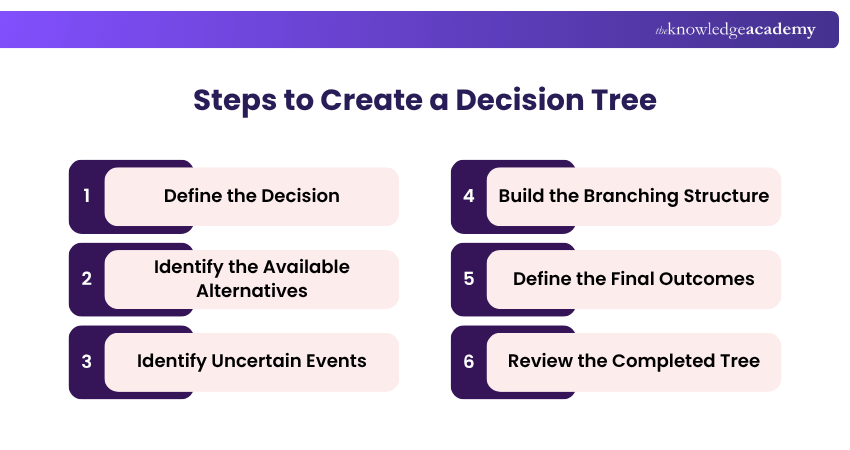
1) Define the Decision
Start by clearly stating the decision or problem you need to address. Establish the objective so that every branch of the tree remains focused on the same decision.
2) Identify the Available Alternatives
List the realistic options available to the decision-maker. These alternatives form the initial branches and provide the possible directions the decision can take.
3) Identify Uncertain Events
Consider events or conditions that could influence each alternative but are not fully under your control. Add these at the appropriate points in the tree to reflect how circumstances could affect the decision.
4) Build the Branching Structure
Connect decision points, uncertain events, and possible paths in a logical sequence. Continue expanding each branch until no further meaningful decisions or events need to be represented.
5) Define the Final Outcomes
End each pathway with a clear result or consequence. Outcomes can represent factors such as profit, cost, time, operational impact, or another measure relevant to the decision.
6) Review the Completed Tree
Check that all important alternatives, events, and outcomes have been included and that each pathway is logically connected. Once the structure is complete, the appropriate decision tree analysis techniques can be applied to evaluate the options.
Bonus Tip: Record where your probability and outcome estimates came from. Documenting the assumptions behind a decision tree makes it easier to review the analysis when new evidence or circumstances change.
Why Use a Decision Tree?
Decision trees can be useful because they provide a structured and visual way to analyse choices and uncertainty. Here’s why they are so effective:
1) Visualise Complex Decisions
Decision trees organise choices and possible outcomes into a clear visual structure, making complicated decisions easier to understand.
2) Evaluate Risk and Uncertainty
Probabilities and possible consequences can be mapped explicitly, helping decision-makers understand where uncertainty exists.
3) Compare Alternatives Systematically
Different options can be evaluated using consistent criteria such as expected value, cost, risk, or strategic importance.
Strengthen your approach to complex challenges with our Problem Solving Course - Sign up today!
Advantages and Disadvantages of Decision Tree Analysis
Decision tree analysis has many advantages but also some limitations:
Advantages:
a) Simplicity: Simple decision trees can be easy to understand and interpret, including for non-technical stakeholders.
b) Versatility: Decision trees can incorporate factors such as costs, benefits, probabilities, risks, and qualitative considerations.
c) Transparency: Decision trees make the modelled choices, assumptions and possible outcomes visible, helping make the reasoning behind a decision easier to review and explain.
Disadvantages:
a) Dependence on Estimates: Results can be affected by inaccurate probabilities, costs, or outcome values.
b) Increasing Complexity: Trees can become difficult to interpret when too many choices and uncertain events are included.
c) Simplified Representation: Some real-world factors, dependencies, and qualitative considerations can be difficult to represent accurately within a tree.

Lily Turner transforms complex data concepts into structured resources for aspiring and established data professionals. Her writing demonstrates how analytical methods and emerging technologies can be used to investigate problems, generate insights and support informed decisions.
View Detail

 If you wish to make any changes to your course, please


