




We may not have the course you’re looking for. If you enquire or give us a call on 01344203999 and speak to our training experts, we may still be able to help with your training requirements.
Data Points: Definition, Types, Roles and Examples
ByThe Knowledge AcademyLast updated on: 12 October 2026
A data point is a single recorded value, measurement, category, or observation within a dataset. This blog explains different types of data points, how they are analysed and represented, and how they support research, business, technology, and decision-making. It serves as the building block in data analysis, helping identify patterns and support decision-making in business, research, and AI. Data points turn raw data into insights.
The Main Idea
1. A data point represents a single recorded value or observation.2. Data points can contain numerical or categorical information.3. Multiple data points form datasets that support analysis.4. Statistical methods and visualisations help identify trends and patterns.5. Accurate and consistent data points support reliable decision-making.
Think of a puzzle, where each individual piece contributes to the bigger picture. Data points work in a similar way: each recorded value or observation contributes to a larger dataset that can be analysed for patterns and relationships. Data points appear in many contexts, from tracking personal goals and business performance to supporting research and healthcare analysis.
Data points are important because they form the basic observations used in datasets and analysis. Whether it's a step count or a customer review, each helps uncover patterns, make predictions and solve problems.
What is a Data Point?
A data point is a single recorded value, measurement, category, or observation associated with a variable or subject. It represents a specific value related to a unique subject. For instance, in a survey about people's favourite vehicles, each person's response, such as “Bike”, “Car”, or “Train”, can be treated as a data point for the variable “favourite vehicle”. These are used to make informed decisions, perform analyses and predict future trends. Each data point forms part of a larger dataset.
It’s important to learn the difference between data points, data attributes and datasets. A data point represents an individual value or observation. A data attribute describes the characteristic being recorded, while a dataset is an organised collection of related data. Consider this example of a school recording students' exam scores:
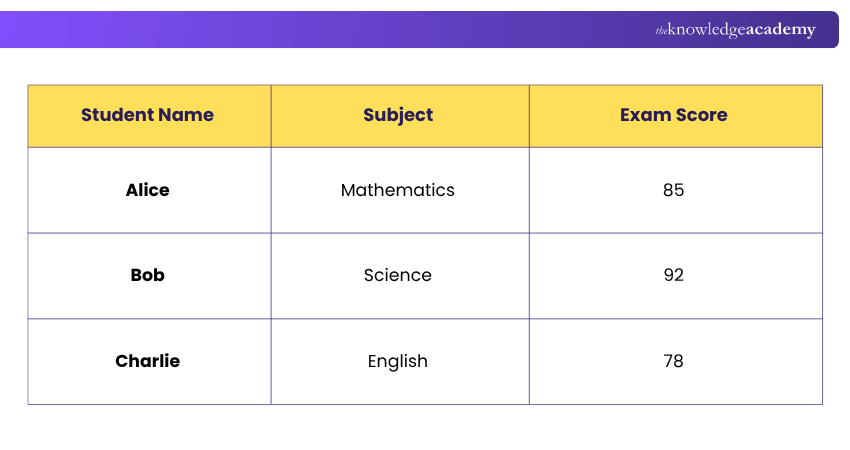
Here's how the three concepts differ:
1) Data Point: The value 85 represents Alice's exam score in Mathematics.
2) Data Attribute: Exam score is the characteristic being measured or recorded.
3) Dataset: The entire table containing students' names, subjects and exam scores forms a dataset.

Types of Data Points
Data points can be classified based on the type of information they represent. The two broad categories are quantitative and qualitative data. These can be further divided into more specific types.
1) Quantitative Data Points
Quantitative data points represent numerical quantities that can be counted or measured. They are commonly used in mathematical calculations, statistical analysis and performance measurement.
Examples:
a) Age of an employee
b) Monthly sales revenue
c) Number of products sold
d) Temperature readings
Discrete and continuous data are two common forms of quantitative data.
a) Discrete Data Points: Discrete data represents countable values that take distinct values, such as the number of employees or products sold.
b) Continuous Data Points: These represent measurements that can take values along a continuous scale within a range. Examples include height, weight, time and temperature.
2) Qualitative Data Points
Qualitative data points represent categories, labels or descriptive information rather than numerical quantities. They help classify observations into groups and are commonly used in surveys, market research and customer feedback analysis.
Examples:
a) Favourite colour
b) Product category
c) Customer satisfaction level
d) Type of vehicle
Nominal and ordinal data represent different kinds of categorical information.
a) Nominal Data Points: These represent categories without a natural order. Examples include blood groups, colours and product categories.
b) Ordinal Data Points: These represent categories with a meaningful order, although the differences between categories are not necessarily equal. Examples include satisfaction levels such as poor, average, good and excellent.
See data differently by learning data visualisation with Python. Join the Data Analysis And Visualisation With Python Course today!
How are Data Points Analysed?
Data points are analysed using different techniques to identify patterns, understand relationships and draw meaningful conclusions. The method used depends on the type of data and the purpose of the analysis.
1) Statistical Analysis
a) Statistical analysis uses mathematical and statistical methods to summarise data, identify patterns, test relationships, and draw conclusions.
b) It helps identify patterns, trends, and connections in the data
c) Common techniques include measures such as the mean, median and standard deviation, as well as methods such as regression analysis.
For example, a company can calculate its average monthly sales to evaluate performance and compare results across different periods.
2) Graphical Analysis
a) Graphical analysis uses charts and graphs to show data points
b) It helps reveal distributions, trends, comparisons, and relationships within the data.
c) Common charts include bar charts, pie charts, histograms, and scatter plots
For example, a company may use a line graph to examine how monthly sales change throughout the year.
3) Trend Analysis
a) Trend analysis examines how values change over time and is commonly used in areas such as business, economics, finance, operations, and forecasting.
b) Trend analysis helps to understand long-term changes and shifts in patterns.
c) It can support planning and forecasting when sufficient historical context is available.
For example, a retailer can examine sales data from previous years to identify seasonal demand and plan inventory accordingly.
Pro Tip
Before analysing data points, check for missing values, duplicates and unusual observations. An unexpectedly high or low value may represent an error or an important event. Investigating these values helps reduce the risk of misleading conclusions.
How are Data Points Represented?
Data points are represented in various ways depending on the type of analysis being conducted. Some common methods include:
1) Tables: They are often displayed in rows and columns to organise values systematically and support comparison. For example, a company may use a table to display monthly revenue, expenses and profits.
2) Charts and Graphs: As discussed before, visual tools like bar charts, line graphs and pie charts help display patterns, comparisons, distributions, or changes in data, depending on the chart type. Bar charts are useful for comparing categories, while line graphs are commonly used to display changes over time.
3) Scatter Plots: Scatter plots represent the relationship between two numerical variables using individual plotted points. For example, a business may use a scatter plot to examine the relationship between advertising expenditure and sales revenue.
4) Histograms: Histograms group numerical observations into intervals to show how values are distributed. For example, a company may use a histogram to understand the distribution of employee ages.
Checklist for Collecting Reliable Data Points
□ Define the purpose of data collection□ Identify the required variables and measurements□ Choose a suitable collection method□ Record relevant units, timestamps and sources□ Check for missing, duplicate or incorrect values□ Store the data in a consistent format
Supercharge your skills in data analysis with Excel with the Data Analysis Training Using MS Excel – Join now!
Applications of Data Points
Data points are used across industries to monitor activities, analyse performance and support evidence-based decisions.
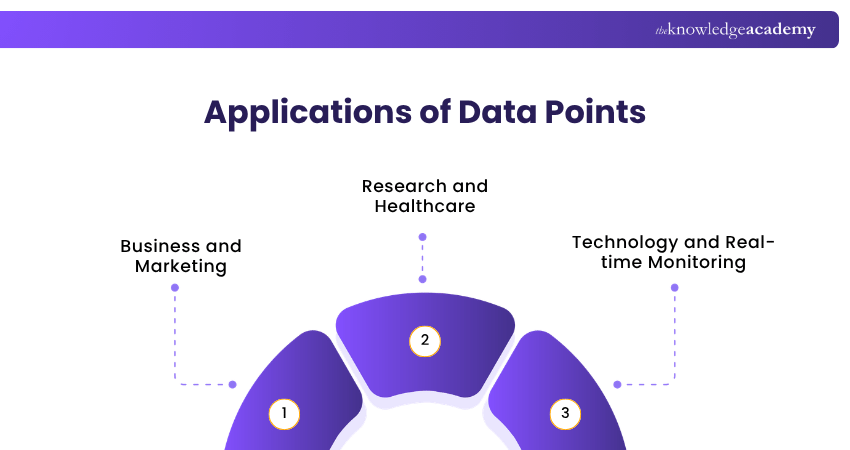
1) Business and Marketing
Businesses collect data points such as sales figures, customer preferences and purchasing behaviour to understand market trends and improve performance. For example, an online retailer may analyse previous purchases to recommend products that customers are likely to find relevant. Marketing teams can also use customer feedback and campaign performance data to evaluate advertising effectiveness.
2) Research and Healthcare
Researchers collect data points to investigate questions, test hypotheses and evaluate results. In healthcare, measurements such as blood pressure, heart rate, temperature and patient age may form part of clinical studies. For example, researchers may analyse blood pressure readings collected over time to investigate changes associated with a treatment.
3) Technology and Real-time Monitoring
Digital systems and connected devices generate data points that can be used to monitor conditions and detect changes. For example, industrial sensors may continuously record machine temperature, pressure or vibration levels.
These observations can help organisations identify unusual conditions and respond to potential equipment problems. Streaming data systems can process incoming observations continuously, supporting timely monitoring and decision-making.
Challenges with Data Point
While data points are valuable, there are several challenges associated with them:
1) Data Silos
a) Data silos occur when different departments or systems within an organisation store data points separately.
b) This separation makes it difficult to access and analyse the data.
c) Data silos can make cross-functional analysis more difficult and limit access to a complete view of information.
d) It reduces collaboration and makes it harder to draw meaningful conclusions across the organisation.
Example: A company’s sales and marketing teams store customer data in separate systems, preventing a full view of customer behaviour.
2) Fragmented Data Issues
a) Fragmented data refers to data scattered across different sources and formats.
b) It can make it difficult to integrate and analyse the data effectively.
c) Fragmented data makes it challenging to obtain a complete view of the information needed.
d) This fragmentation can cause inefficiencies and missed insights.
Example: Customer information is spread across multiple systems, such as sales, marketing, and support, making it hard to get a holistic view.
3) Lack of Integration
a) When data points from different sources are not integrated, it becomes difficult to make sense of the data.
b) Without proper integration, analysis becomes fragmented, and valuable insights may be overlooked.
c) Integration can help combine relevant data from multiple sources into a more consistent and usable view for analysis.
d) It allows for comprehensive analysis and more accurate decision-making.
Example: A company struggles to analyse sales data alongside customer feedback due to a lack of system integration.
4) Complex Data Formats
a) Data points can come in various formats, which may be complex to process.
b) Some data sources, such as streaming sensor or IoT data, may require specialised storage, processing, or analytics tools.
c) These complex formats can slow down analysis and hinder timely insights.
d) The complexity can create barriers to the effective use of data.
Example: Data from smart devices needs real-time processing tools that the company doesn't have in place.
5) Need for Data Standardisation
a) Data standardisation ensures that data from different sources can be compared and analysed effectively.
b) Without standardisation, data from other systems or departments may not be compatible.
c) This can lead to inaccurate conclusions and hinder decisions.
d) Proper standardisation ensures that data follows consistent formats, units, naming conventions, and definitions where appropriate.
Example: Different departments use different units of measurement for sales data, making it difficult to compare performance.
6) Simplifying Data Structures
a) It often has complex structures, especially in large datasets.
b) Simplifying these structures can make data easier to analyse and interpret.
c) Aggregating data points into categories or summarising large datasets can focus analysis on the most relevant information.
d) This simplification speeds up analysis and improves decision-making.
Example: Aggregating daily sales data into monthly totals helps identify broader trends more easily.
Trainer Insight
A single temperature reading of 35°C describes the temperature at a particular time and location. However, several readings collected over days or weeks can reveal patterns and variations. Meaningful analysis often depends on examining data points together with their context.
Take control of big data. Learn R Analytics with our Data Analytics With R – Register today!

The Knowledge Academy develops accessible learning content across Project Management, IT, Cybersecurity, Data Science, Business Analysis, HR, Accounting and Finance, Leadership and Health and Safety. Its resources combine subject research with clear explanations to help professionals build practical knowledge across a wide range of disciplines.
View Detail

 If you wish to make any changes to your course, please


