


 Top Rated Course

We may not have the course you’re looking for. If you enquire or give us a call on 01344203999 and speak to our training experts, we may still be able to help with your training requirements.
Contract Manager Job Description: Roles, Skills and Salary
Hailey Davis 01 September 2026A Contract Manager oversees contract performance, supplier relationships, compliance, risks and commercial outcomes. Explore the Contract Manager Job Description, responsibilities, essential skills, qualifications and salary.

Training Outcomes Within Your Budget!
We ensure quality, budget-alignment, and timely delivery by our expert instructors.
Table of Contents

Key Takeaways
1. Contract Managers oversee performance, compliance, risks, changes and commercial requirements throughout the contract lifecycle.2. Supplier and stakeholder management helps maintain effective relationships and address contractual issues.3. Contract literacy, negotiation, commercial awareness and risk management are important skills for this role.4. Qualifications and experience requirements vary according to industry, contract complexity and seniority.5. Contract Manager salaries vary according to experience, industry, location and level of responsibility.
Contracts can involve complex obligations, deadlines, suppliers and commercial expectations. Keeping these agreements under control requires someone to monitor what has been agreed and how effectively it is being delivered.
This is where a Contract Manager comes in.
In this blog, we'll explore the Contract Manager Job Description, including the role's responsibilities, essential skills, qualifications, salary and a practical job description template.
What is a Contract Manager?
A Contract Manager is a professional responsible for helping an organisation manage contractual agreements throughout their lifecycle. The role focuses on making sure agreements are understood, monitored and managed effectively while supporting supplier relationships, commercial objectives and organisational requirements. The exact scope varies by industry, organisation, contract value and level of seniority.

Responsibilities of a Contract Manager
Contract Manager responsibilities vary depending on the organisation, sector and complexity of the agreements being managed. However, many roles include a combination of the following responsibilities:
1) Managing Contract Performance and Service Levels: Contract Managers monitor whether suppliers meet agreed obligations, KPIs, and Service Level Agreements (SLAs). They identify underperformance and support appropriate corrective action where required.
2) Managing Supplier and Stakeholder Relationships: They maintain regular communication with suppliers and relevant internal stakeholders. This includes coordinating discussions, addressing concerns, and clarifying contractual responsibilities and expectations.
3) Maintaining Contract Documentation: Contract Managers keep agreements, amendments, correspondence, performance records, and other contractual documents accurate and accessible. Good record management supports effective governance throughout the contract lifecycle.
4) Managing Risks and Issues: They identify risks that could affect performance, cost, service quality, or contractual outcomes. Contract Managers also monitor active issues, coordinate responses, and escalate matters when specialist support is needed.
5) Handling Contract Changes: Contract Managers assess proposed variations and help manage formal change-control processes. They document approved changes and support their correct implementation across relevant teams.
6) Supporting Contractual Compliance: They monitor whether suppliers and other parties continue to meet agreed contractual obligations. Where interpretation is required, they may work with legal, commercial, or compliance specialists.
7) Managing Renewals, Extensions and Contract Exit: Contract Managers track key dates and prepare for renewals, extensions, retendering, or termination. They may also coordinate handovers, information transfer, and transition activities during contract exit.
8) Monitoring Commercial Performance: They review information such as expenditure, pricing, contractual commitments, and agreed commercial measures. These insights can support supplier reviews, internal discussions, and future commercial decisions.
Contract Manager Decision Desk
Contract Management frequently requires judgement rather than simply following a checklist. Consider how a Contract Manager could respond to these situations:
Scenario 1: A supplier misses an important KPI for the second consecutive month.Response: Review the evidence, investigate the cause and follow the agreed performance and escalation process.Scenario 2: A stakeholder requests an informal change to the contract scope.Response: Assess the contractual and commercial impact before following the formal change-control process.Scenario 3: A major contract expires in six months.Response: Review performance and begin planning for renewal, retendering or exit according to organisational requirements.
Essential Contract Manager Skills
Contract Managers need a mix of commercial, analytical, organisational, and interpersonal skills to manage agreements effectively. These abilities support clearer decisions, stronger supplier relationships, and better contract outcomes. The following skills are particularly important for professionals working in Contract Management:
1) Understand contractual terms, obligations, responsibilities, and key mechanisms accurately.
2) Negotiate effectively around terms, changes, performance, and commercial outcomes.
3) Communicate contractual information clearly to different stakeholders and audiences.
4) Manage relationships with suppliers, internal teams, and other relevant stakeholders.
5) Identify contractual and operational risks before they affect performance or outcomes.
6) Apply commercial awareness when assessing value, supplier performance, and business priorities.
7) Interpret budgets, costs, expenditure, and other relevant financial information.
8) Solve contractual and performance issues using practical and balanced approaches.
9) Organise multiple agreements, deadlines, obligations, and review activities efficiently.
10) Maintain strong attention to detail when reviewing terms, dates, records, and key information.
Gain practical legal knowledge with Business Contract Law Training and manage agreements with confidence.
Contract Manager Qualifications
Contract Manager qualifications vary depending on the sector, role, and organisation. Relevant academic or professional training can support the knowledge needed to manage contracts effectively. The following qualifications are commonly associated with Contract Management roles:
1) Business or Commercial Qualifications: Degrees or qualifications in Business, Commercial Management, Procurement, or related fields can provide a strong foundation for Contract Management roles.
2) Legal Qualifications: A background in Law can be valuable for understanding contractual terms, obligations, risk, and compliance requirements.
3) Finance Qualifications: Finance-related qualifications can support work involving budgets, expenditure, pricing, and commercial performance.
4) Construction or Sector-specific Qualifications: In industries such as Construction, relevant technical or sector qualifications may be preferred alongside Contract Management experience.
5) Contract Management Training: Professional training in Contract Management can strengthen knowledge of contracts, supplier relationships, negotiation, risk, and commercial decision-making.
6) Procurement Qualifications: Procurement-focused qualifications can be useful for roles involving supplier selection, sourcing, tendering, and ongoing contract oversight.
Contract Manager Salary
In the UK, Contract Manager salaries vary by industry, location, experience, and level of responsibility. According to Indeed data updated on 17 August 2026, the average salary is £53,978 per year, with reported salaries typically ranging from around £37,074 at the lower end to £78,590 at the higher end, making these useful market reference points rather than guaranteed figures.
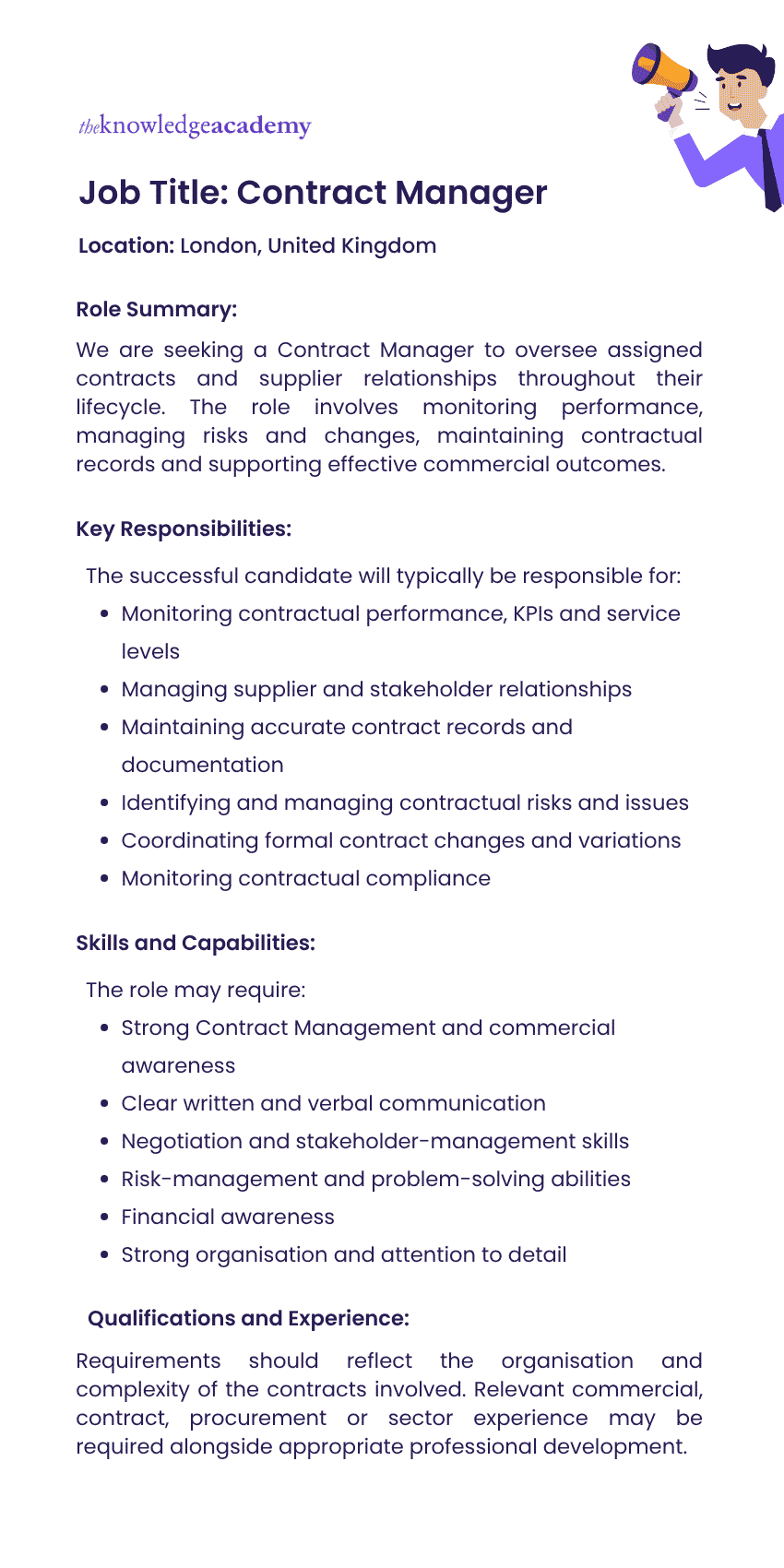
Contract Manager Job Description Template
The following template condenses the responsibilities, skills and experience discussed above into a practical format that employers can adapt to suit their organisation and contracts.
Job Description Quality Check
A useful Contract Manager Job Description should explain what candidates will actually manage. Before publishing one, check whether it answers these questions:
• Does it explain the type or complexity of contracts involved?• Are performance responsibilities clearly defined?• Does it distinguish essential requirements from preferred experience?• Are supplier and stakeholder responsibilities explained?• Does it cover change, risk, renewal or exit where relevant?• Are qualification requirements realistic?• Can candidates understand what successful performance looks like?
Conclusion
A Contract Manager Job Description reflects a role centred on keeping agreements controlled, practical and commercially effective. Understanding these expectations can help jobseekers assess the career clearly, and employers define the role with greater precision. We hope this blog helps you understand what the role involves and what to expect from a career in Contract Management.
Improve performance monitoring and supplier accountability with our Specification and Service Level Agreement Training and manage SLAs effectively.
Frequently Asked Questions
What is the Difference Between a Contract Manager and a Procurement Manager?

A Procurement Manager generally focuses on sourcing goods or services and managing purchasing activities. A Contract Manager usually focuses more closely on agreements, supplier performance and contractual obligations after contracts are established.
What is the Difference Between a Contract Manager and a Contract Administrator?
A Contract Administrator often supports documentation, records, deadlines and contractual processes. A Contract Manager usually has broader responsibility for supplier performance, risks, changes and commercial outcomes.
Does a Contract Manager Need to be a Lawyer?
Not necessarily. Contract Managers need enough contractual knowledge to understand obligations and recognise potential issues. Complex legal matters may still require advice from qualified legal specialists.

Hailey Davis


Compliance Officer
Hailey Davis is an ISO compliance expert with over 10 years of experience in audit, quality management systems (QMS), and regulatory compliance. She has worked with various industries, including manufacturing, healthcare, and technology, ensuring organisations achieve and maintain ISO certifications. Hailey’s content provides practical, actionable insights on navigating compliance challenges and improving business processes.
View Detail

 If you wish to make any changes to your course, please


