


 Top Rated Course

We may not have the course you’re looking for. If you enquire or give us a call on 01344203999 and speak to our training experts, we may still be able to help with your training requirements.
What is CISM: Certification, Benefits, and Requirements
The Knowledge Academy 21 August 2026CISM is a globally recognised certification for professionals managing Information Security governance, risk, programmes and incidents. This blog explains What is CISM, its domains, eligibility requirements, benefits, exam process and career value.
Home
 Resources
IT Security & Data Protection
What is CISM: Certification, Benefits, and Requirements
Resources
IT Security & Data Protection
What is CISM: Certification, Benefits, and Requirements
Resources
IT Security & Data Protection
What is CISM: Certification, Benefits, and Requirements

Training Outcomes Within Your Budget!
We ensure quality, budget-alignment, and timely delivery by our expert instructors.
Table of Contents
Key Takeaways
1. CISM is an Information Security Management certification offered by ISACA.2. It covers governance, risk management, security programmes and incident management.3. Anyone can take the exam, but relevant experience is required for certification.4. CISM can support progression into security management and leadership roles.5. Certification holders must meet ongoing CPE and maintenance requirements.
Picture this: You are in a meeting when a senior leader asks, “Are our security investments actually protecting the business?” The room goes quiet. Technical knowledge may identify the threats, but answering that question requires strategy, risk awareness and leadership.
This is where CISM stands out. It prepares Information Security professionals to connect security decisions with business priorities. Rather than focusing mainly on technical controls, it covers governance, risk management, security programmes and incident management.
So, What is CISM, and could it support your next career move? This blog explores the certification’s domains, requirements, benefits, exam process and career value to help you make an informed decision.
What is Certified Information Security Manager (CISM)?
Certified Information Security Manager (CISM) is a globally recognised certification issued by Information Systems Audit and Control Association (ISACA). It validates a professional’s ability to govern Information Security, manage risks, develop security programmes and oversee incident management.
Understanding What is CISM is particularly useful for experienced professionals who want to move into Information Security Management or leadership. The certification focuses on aligning security strategies with organisational goals rather than concentrating only on technical controls.
CISM Exam Domains
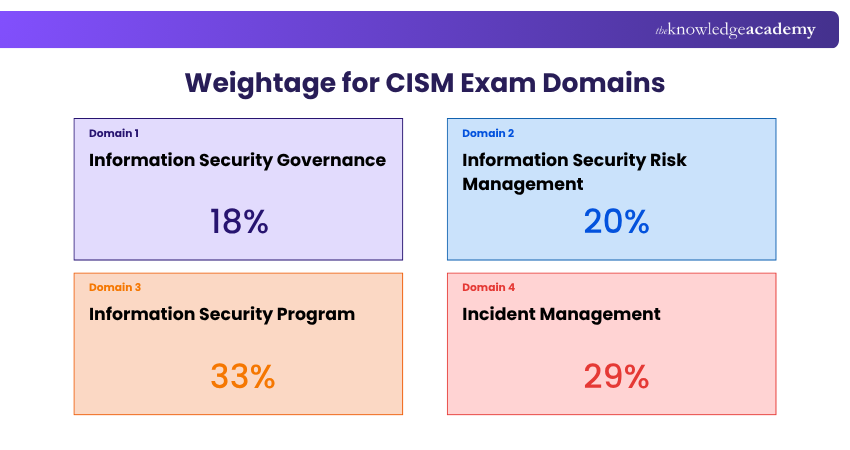
The CISM exam assesses a candidate’s knowledge across four Information Security Management domains. These domains reflect the responsibilities commonly handled by professionals who lead and manage organisational security programmes. Let’s learn about them below:
1) Information Security Governance
This domain covers the development of Information Security strategies that support organisational goals. It includes governance frameworks, policies, roles, legal requirements and communication with senior leaders and other stakeholders.
2) Information Security Risk Management
This domain focuses on identifying, assessing and responding to Information Security risks. It covers threats, vulnerabilities, risk analysis, treatment options, control ownership and reporting risks to relevant decision-makers.
3) Information Security Program
This domain covers the development and management of an Information Security programme. It includes resource planning, asset classification, policies, security controls, employee awareness, third-party management, programme metrics and performance reporting.
4) Incident Management
This domain focuses on preparing for, responding to and recovering from Information Security incidents. It covers response plans, incident classification, investigation, containment, communication, recovery and post-incident reviews.
CISM vs CISSP
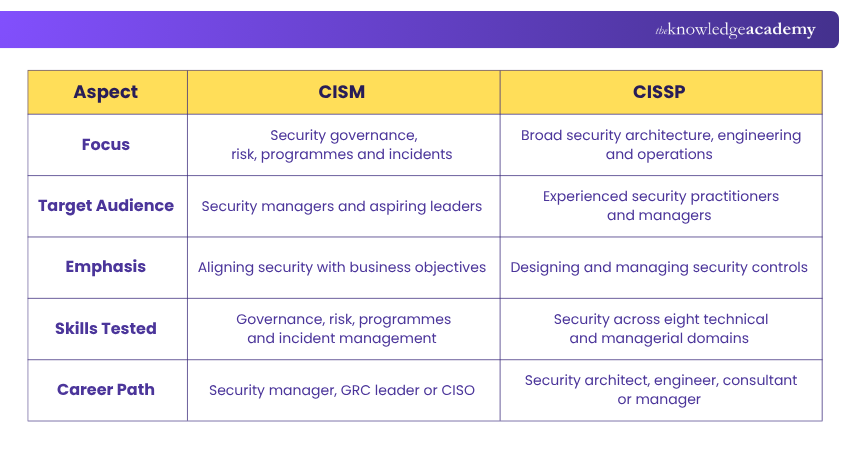
CISM and Certified Information Systems Security Professional (CISSP) are globally recognised Information Security certifications, but their focus differs. CISM emphasises security governance, risk management, programme management and alignment with business goals, making it suitable for professionals pursuing security leadership roles.
In contrast, CISSP covers a broader range of security areas, including architecture, engineering, operations and risk management. It suits professionals seeking technical, architectural or managerial roles. The certifications can complement each other depending on a professional’s responsibilities and career goals. Let's understand their differences in the table below:
CISM Certification Requirements
Anyone interested in Information Security can take the CISM exam. Delegates do not need to meet the work-experience requirement before sitting the exam. However, passing the exam alone does not grant CISM Certification. To become CISM-certified, delegates must:
a) Pass the CISM examination.
b) Have at least five years of professional Information Security Management experience within the CISM job practice areas.
c) Gain experience across at least three of the four CISM domains.
d) Earn the required experience within the ten years before applying.
e) Apply for certification within five years of passing the exam.
f) Submit the certification application and have your experience verified by a supervisor or manager.
g) Adhere to ISACA’s Code of Professional Ethics and Continuing Professional Education policy.
Did You Know?
ISACA introduced the CISM Certification in 2002. Since then, thousands of professionals have obtained the credential, reflecting its global reach in Information Security Management.
Benefits of CISM Certification
CISM Certification provides value to both experienced security professionals and the organisations in which they work. It validates management-level knowledge across governance, risk, security programmes and incident management. Let’s learn about them below:
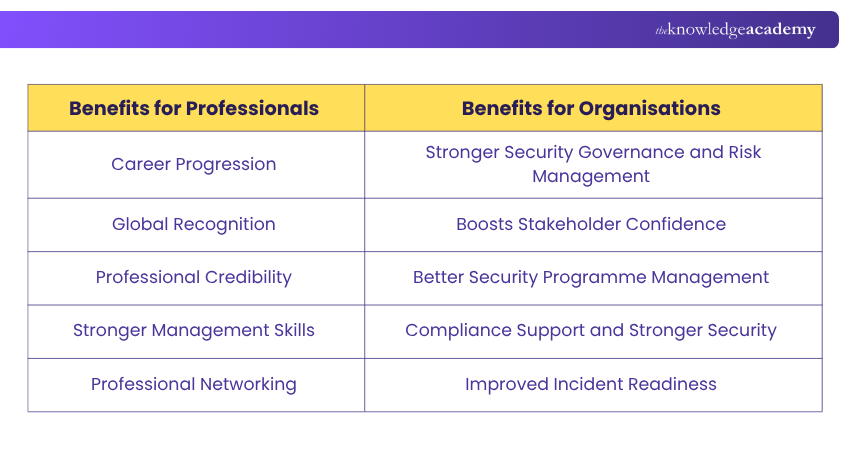
1) Benefits for Professionals
Let’s look at the key benefits for professionals below:
a) Career Progression: CISM can support progression into roles such as Information Security Manager, Security Consultant, Risk Manager, Governance Manager and Chief Information Security Officer. It is suitable for experienced professionals seeking management and leadership responsibilities.
b) Global Recognition: CISM is recognised internationally as an Information Security Management certification. It can help professionals demonstrate their knowledge to employers and clients across industries and geographical locations.
c) Greater Professional Credibility: The certification validates a professional’s understanding of security governance, risk management, programme development and incident management. This can increase confidence among employers, clients and senior stakeholders.
d) Stronger Management Skills: Preparing for CISM strengthens decision-making, risk assessment, programme planning and stakeholder communication. These capabilities help professionals connect technical security concerns with business objectives and organisational priorities.
e) Professional Networking: CISM holders can engage with ISACA chapters, professional communities and industry events. These networks offer opportunities to exchange knowledge, follow industry developments and build relationships with other governance, risk and security professionals.
2) Benefits for Organisations
Let’s look at the key benefits for organisations below:
a) Stronger Information Security Governance: CISM-certified professionals can help organisations develop security strategies, policies and governance structures that support wider business objectives. This encourages a consistent and accountable approach to Information Security.
b) Improved Risk Management: Their knowledge can help organisations identify threats, assess vulnerabilities and prioritise risks according to likelihood and business impact. This supports informed decisions about risk treatment, control selection and resource allocation.
c) Better Security Programme Management: CISM-certified professionals can help develop, implement and evaluate Information Security programmes. They can coordinate resources, establish controls and use suitable metrics to communicate programme performance to stakeholders.
d) Compliance Support: CISM knowledge can help professionals identify security-related legal, regulatory and contractual requirements. They can assess control gaps and support remediation, but employing a CISM-certified professional does not automatically make an organisation compliant.
e) Improved Incident Readiness: CISM-certified professionals can support the development and testing of incident response plans. They can also help coordinate containment, communication, recovery and post-incident reviews to reduce the operational impact of security incidents.
f) Stronger Security Culture: They can promote employee awareness, define responsibilities and encourage timely reporting of suspicious activity. This helps make Information Security a shared organisational responsibility.
g) Stakeholder Confidence: A structured security programme led by knowledgeable professionals can strengthen confidence among clients, partners and stakeholders. It may also demonstrate that the organisation takes the protection of information assets seriously.
Industry Insight
The average annual salary of a Certified Information Security Manager in the UK ranges between £38k and £66k per year.
Maintaining CISM Certification
To maintain CISM Certification, holders must follow ISACA’s Continuing Professional Education policy. They must earn and report at least 20 CPE hours annually and 120 CPE hours within a three-year reporting cycle. Qualifying activities may include conferences, webinars, online learning and relevant training.
CISM holders must also pay the annual maintenance fee, follow ISACA’s Code of Professional Ethics and comply with a CPE audit if selected. Meeting these requirements keeps the certification active and supports continuous professional development.
Pro Tip
Record CPE activities throughout the year and retain supporting evidence. Regular tracking makes annual reporting easier and reduces the risk of missing maintenance requirements near the deadline.
Is CISM Certification Right for You?
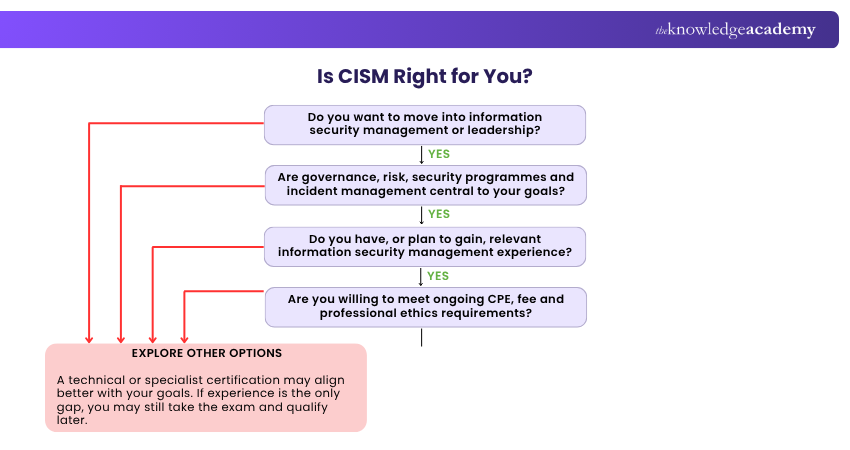
CISM may be right for you if you have Information Security experience and want to progress into governance, risk management, or security programme management. It is especially relevant for professionals pursuing security management and leadership roles.
Before deciding, compare the four CISM domains with your experience and career goals. Remember that earning the certification requires at least five years of relevant experience across three domains. Also consider the time, cost and continuing education involved, as CISM supports career growth but does not guarantee a specific role or salary.
Conclusion
CISM is a valuable certification for professionals who want to lead Information Security programmes and manage cyber risks. It builds expertise in governance, risk management, security programmes and incident response. Now that you understand What is CISM, you can decide whether it matches your experience and career goals.
Learn to shape smarter Information Security programmes by joining the CISM Training today!
Frequently Asked Questions
Can You Take the CISM Exam Online?

Yes, the CISM exam can be taken online through live remote proctoring or in person at an authorised PSI testing centre. Delegates taking it remotely must meet the technical, identification and testing-area requirements set by ISACA.
How Long Does It Take to Prepare for the CISM Exam?
ISACA does not specify a fixed preparation period. The time required depends on your experience, subject knowledge and study schedule. Delegates should review the exam content outline, use current study resources and complete practice questions before booking the exam.
Does CISM Certification Expire?
CISM remains active only when its maintenance requirements are met. Certification holders must report at least 20 CPE hours annually and 120 hours over three years. They must also pay the annual fee and follow ISACA’s professional ethics requirements.
What Happens if You Fail the CISM Exam?
Delegates who fail may retake the CISM exam up to three times within 12 months of their first attempt. They must wait 30 days before the second attempt and 90 days before each subsequent attempt. A full examination fee applies to every retake.

The Knowledge Academy


Global Training Provider
The Knowledge Academy is a world-leading provider of professional training courses, offering globally recognised qualifications across a wide range of subjects. With expert trainers, up-to-date course material, and flexible learning options, we aim to empower professionals and organisations to achieve their goals through continuous learning.


 If you wish to make any changes to your course, please


