




We may not have the course you’re looking for. If you enquire or give us a call on 01344203999 and speak to our training experts, we may still be able to help with your training requirements.
14 Challenges of Sustainability in Business
ByNilotpal SarmahLast updated on: 05 October 2026
This blog explores the major challenges of sustainability in business, from managing costs and navigating regulation to supply chain transparency and long-term strategic planning.
In This Blog
1. Businesses face sustainability challenges related to costs, supply chains, regulations, consumer expectations, and long-term planning.2. Sustainable business practices can involve greener operations, responsible sourcing, cleaner energy, and stronger ESG integration.3. Circular economy principles, regenerative agriculture, and sustainable energy can help reduce environmental pressures and resource use.4. Businesses also need to address social priorities such as diversity, public awareness, youth unemployment, and responsible procurement.5. Overcoming sustainability challenges requires clear priorities, practical transformation strategies, and a long-term business perspective.
Sustainability has become essential for modern businesses, but putting it into practice is rarely straightforward. High costs, complex supply chains, evolving regulations, and shifting consumer expectations all make the transition harder than it looks on paper, and each one needs careful management to protect both profitability and environmental responsibility.
The good news is that these challenges aren't just obstacles. Businesses that understand and address them can turn compliance into a genuine advantage, building a more resilient brand while meeting the expectations of regulators, customers, and employees alike.
Challenges of Sustainability in Business
Integrating sustainability into day-to-day operations is one of the most significant challenges businesses face. Even when the long-term case for going green is clear, the transition itself is rarely simple. Here are some of the key obstacles businesses commonly encounter:
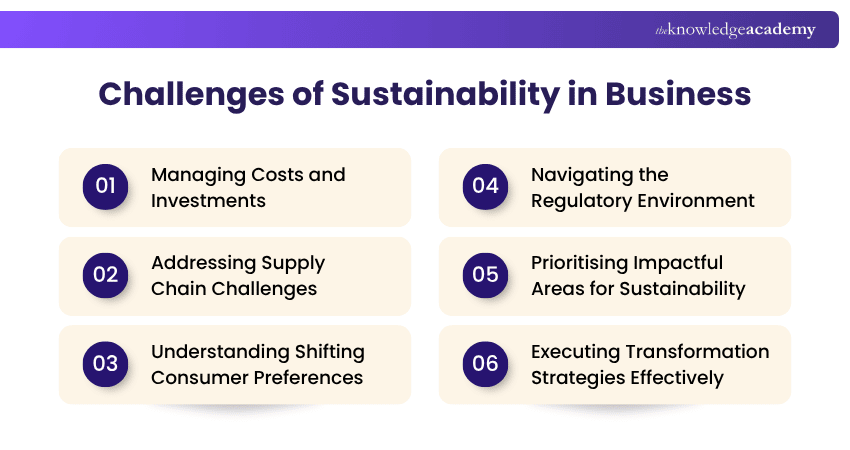
1) Managing Costs and Investments
Businesses often struggle to identify where they can make the most significant impact on sustainability. It’s crucial to prioritise initiatives that can deliver meaningful environmental and social benefits.
Sustainability transformations often require significant investments. Therefore, you must find ways to finance these changes without compromising your financial stability. One option to consider is installing solar panels. The initial purchase and installation costs can be high, but over time they can help improve energy efficiency.

2) Addressing Supply Chain Challenges
Whether you are running a business or setting one up, supply chain management can be difficult. Many businesses can’t always trace where their raw materials come from. It’s particularly hard for small or medium-sized businesses to develop a strong supply chain model if larger suppliers do not respond to their demands or requests.
The biggest challenge ultimately lies in transparency. Finding suppliers willing to disclose their practices, including manufacturing processes, raw materials, waste reduction efforts, and commitment to developing ESG-conscious end products, can be challenging.
3) Understanding Shifting Consumer Preferences
As demand for sustainable products grows, a key challenge emerges: balancing sustainability with competitive pricing. Many consumers hesitate to pay extra for sustainability unless they strongly favour a particular brand. Therefore, to reach a broader market, businesses must develop credible models that prioritise sustainability without relying solely on niche marketing strategies.
4) Navigating the Regulatory Environment
As governments introduce stricter sustainability regulations, businesses face growing pressure to comply with evolving reporting and disclosure requirements. This can include mandatory ESG disclosures, emissions reporting standards, and rules designed to prevent greenwashing, misleading claims that overstate a product or company's environmental credentials.
Keeping up with these requirements is particularly difficult because regulations vary by country and industry, and standards continue to change as governments respond to new environmental and social priorities. Businesses operating across multiple markets often need to track and comply with several overlapping regulatory frameworks at once.
5) Prioritising Impactful Areas for Sustainability
Leadership teams often struggle to prioritise aspects of sustainability. To strengthen their overall approach, organisations should consider environmental, social, and governance initiatives across the business rather than focusing only on isolated efforts. This requires a thorough, organisation-wide transformation that embeds ESG principles across business operations.
Trainer’s Pro Tip
Start with the sustainability areas that have the greatest operational impact, then set measurable targets and review progress regularly. This helps businesses focus resources where they can make the most practical difference.
6) Executing Transformation Strategies Effectively
Turning sustainability commitments into real operational change is difficult in practice. It requires leadership alignment, sustained employee engagement, and consistent execution, three things that are easy to state as goals but hard to maintain over time, especially when short-term business pressures compete for the same attention and resources.
Without strong governance and ongoing tracking, sustainability initiatives can stall or lose momentum once the initial commitment fades. Coordinating this across departments, often without a single team clearly responsible for it, adds another layer of difficulty to keeping transformation efforts on track.
Learn how to develop a continuous improvement plan with our Business Process Improvement Training - Register today!
7) Transitioning to Sustainable Energy Sources
Shifting away from fossil fuels towards cleaner energy sources is a significant operational challenge for many businesses. Renewable infrastructure, such as solar panels or on-site wind generation, often requires substantial upfront investment, and reliable clean energy isn't always accessible or affordable in every region a business operates in.
Businesses should monitor their electricity usage and explore cleaner, more efficient energy models where feasible, while balancing the cost and reliability trade-offs that come with transitioning away from existing energy infrastructure.
8) Shifting to Circular Economy Principles
Moving from a traditional "take, make, dispose" model to a circular one is a significant operational shift, and one that's easier to commit to than to actually implement. It often requires redesigning products, reworking supply chains, and finding partners willing to take back or reprocess materials, changes that can be costly and slow, particularly for smaller businesses without the scale to negotiate new waste-recovery arrangements.
Industries reliant on raw materials, such as food, beverage, and apparel, face this challenge acutely, since keeping materials in use and reducing waste often means rethinking established processes rather than making minor adjustments.
9) Embedding Diversity, Equity, and Inclusion
Making Diversity, Equity, and Inclusion (DEI) a genuine part of how a business operates, not just a stated value, is harder than it sounds. It means embedding it consistently across every function, from hiring and HR to sales, PR, and procurement, rather than treating it as a separate initiative sitting off to the side.
Procurement is often the most overlooked part of this challenge. Rethinking supplier relationships to create opportunities for a wider range of businesses can mean disrupting long-standing vendor relationships, which takes deliberate effort and isn't always a quick or easy change to make.
10) Raising Public Awareness and Education
Sales of environmentally friendly goods and services do not always reflect the effort and investment required to develop them. So, to address this gap, businesses must enhance their understanding of how to evaluate, categorise, and effectively advertise sustainable products and services.
By doing so, they can avoid greenwashing, which involves presenting products as environmentally friendly when they are not, and foster more informed consumer choices. This approach not only promotes transparency but also helps build consumer trust and support positive environmental outcomes.
11) Adopting Regenerative Agriculture Practices
Moving beyond simply reducing environmental harm towards actively restoring natural systems is a significant shift, one that requires long-term investment with results that often take years to materialise. This makes it a difficult case to justify against shorter-term financial priorities, even when the environmental case is clear. Four key strategies illustrate the scale of this challenge:
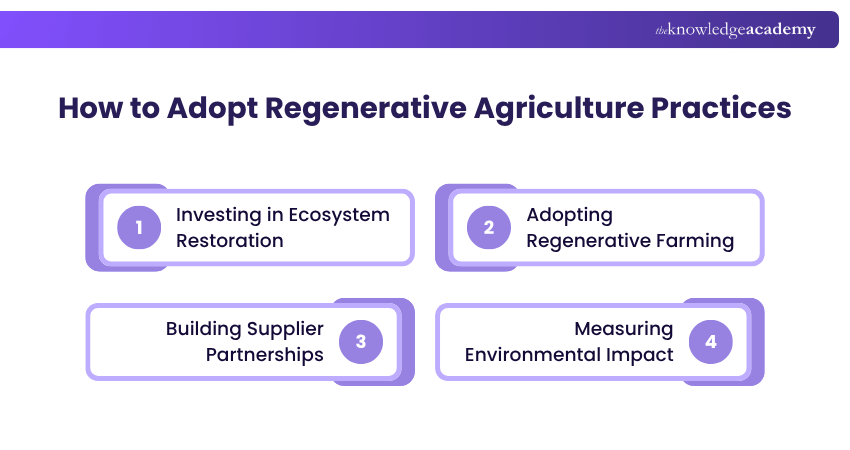
a) Investing in Ecosystem Restoration: Restoring ecosystems within and beyond a company's own value chain goes well beyond simply avoiding deforestation, and requires sustained funding without an immediate financial return.
b) Adopting Regenerative Farming: Regenerative farming practices that replenish soils, protect biodiversity, and capture carbon often require farmers and suppliers to change methods that have worked for decades, which can face resistance and slow adoption.
c) Building Supplier Partnerships for Regenerative Sourcing: Sourcing from regenerative farms means finding and vetting suppliers who meet these standards, which can be harder and more expensive than working with conventional supply chains.
d) Measuring and Verifying Environmental Impact: Proving that regenerative practices are genuinely improving soil health, biodiversity, or carbon capture requires reliable measurement and verification, an area where consistent standards are still developing.
By pursuing these strategies despite the difficulty, companies can work towards reducing greenhouse gas emissions, preserving biodiversity, and restoring the ecosystems their operations depend on.
12) Addressing Youth Unemployment and Poverty
In many countries, youth unemployment and poverty remain significant challenges that intersect with business sustainability efforts. Businesses pursuing sustainable growth must consider how their operations, hiring practices, and supply chains affect local communities, not just environmental outcomes.
However, this creates a genuine tension: without more sustainable production and consumption methods, increasing output to create jobs or reduce poverty can add environmental pressure, including land degradation, higher greenhouse gas emissions, and biodiversity loss. Balancing job creation and economic development with environmental protection is an ongoing challenge for businesses operating in these regions.
13) Cultivating a Long-term Perspective
Making long-term business decisions is becoming increasingly challenging due to a variety of factors. These include the fluctuating nature of financial markets, evolving consumer spending habits, shifting trade agreements, and contradictory state policies.
In this continuously changing environment, businesses often find it challenging to maintain a balance between immediate profits and long-term sustainability. Therefore, there is a growing need for businesses to develop strategies that help them navigate these complexities and align their short-term and long-term goals for sustained success.
Do you want to learn how to lead and inspire teams effectively? Sign up for our Management Courses now!

Nilotpal Sarmah is a Senior Content Writer with 11+ years of overall experience spanning engineering, operations and content development. His technical knowledge and extensive writing experience enable him to simplify specialised topics across IT and Tech, Business Skills, Project Management, Health and Safety, and ISO and Compliance.
View Detail

 If you wish to make any changes to your course, please


