


 Top Rated Course

We may not have the course you’re looking for. If you enquire or give us a call on 01344203999 and speak to our training experts, we may still be able to help with your training requirements.
Most in-demand Artificial Intelligence Skills to have in 2025
Lily Turner 11 December 2025Discover the Key to Success with Artificial Intelligence Skills. Explore the field of AI expertise and unlock new career opportunities. Our blog explores the essential Artificial Intelligence skills you need to excel in this dynamic field. Stay ahead in the AI game and learn how to harness the power of Artificial Intelligence Skills.

Training Outcomes Within Your Budget!
We ensure quality, budget-alignment, and timely delivery by our expert instructors.
Table of Contents
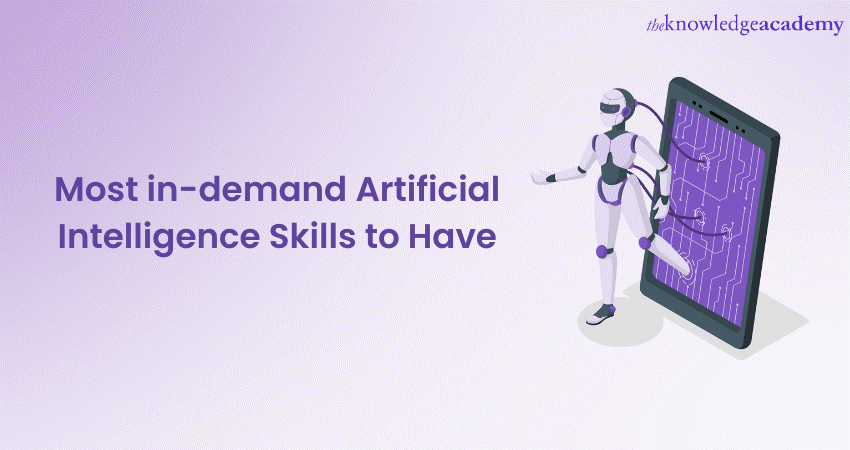
One of the most compelling reasons for the growing dependence on Artificial Intelligence Skills is automation. Businesses are increasingly adopting AI to automate routine and repetitive tasks. AI-driven automation has proven to enhance operational efficiency and significantly reduce costs in various industries.
Automation liberates human resources, enabling them to concentrate on their roles' more strategic and creative facets. Customers now expect a personalised experience, making AI skills essential for creating and maintaining these customer-centric services. Further, read this blog to explore the essential Artificial Intelligence Skills required for a successful programming career and land your dream job in 2025.
Table of contents
1) Why Artificial Intelligence Skills are essential in today's world?
2) Key Artificial Intelligence Skills
3) How to develop AI skills?
4) Real-world applications of AI
5) Conclusion
Why Artificial Intelligence Skills are essential in today's world?
AI is not just a technological advancement; it's a driver of economic growth and a tool for solving complex problems. Organisations increasingly seek AI talent to harness its potential and stay ahead in the global market.
The demand for AI talent is surging across industries. Job postings seeking AI expertise have seen a remarkable increase. Possessing AI skills can open doors to a wide array of career opportunities and significantly boost one's earning potential. Whether you're an Engineer, Data Scientist, Healthcare Professional, or Marketer, AI proficiency is an asset.
Moreover, AI isn't merely about automating tasks but augmenting human capabilities. It empowers professionals across diverse fields, from Healthcare Practitioners making more accurate diagnoses to Artists creating groundbreaking visual effects. The fusion of human ingenuity and AI prowess is the cornerstone of progress in this AI-centric world.
Exploring the question 'Will AI Take My Job?' allows researchers and policymakers to assess AI's impact on employment. Proactive strategies, such as education and reskilling programs, can help mitigate job displacement and foster new opportunities.
Unlock your potential in Machine Learning with our comprehensive Machine Learning Training. Start your journey today!
Key Artificial Intelligence Skills
Technical Artificial Intelligence Skills are the foundation, providing the tools to create, innovate, and extract intelligence from data. Soft skills act as the compass guiding professionals through the complex AI landscape and ensuring ethical AI practices. Just like understanding how to Find your Face Shape is essential for choosing the right cosmetic treatments, mastering soft skills is crucial for AI practitioners. These two sets of Artificial Intelligence Skills harmonise to shape proficient AI practitioners and leaders.
Technical skills
Possessing the right technical skills is akin to having a toolbox filled with essential instruments. These skills empower AI professionals to create, fine-tune, and optimise AI systems.
Programming languages: Proficiency in Python, a versatile language favoured for its extensive libraries, and R, known for statistical analysis, forms the cornerstone of AI development. Depending on project requirements, Java, C++, and Julia bring additional versatility.
Machine Learning:Machine Learning is the beating heart of AI. It involves data preprocessing, a crucial step that ensures data quality and suitability for AI models. Model selection and tuning are where AI practitioners craft algorithms and adjust parameters for optimal performance. Understanding supervised and unsupervised learning paradigms equips professionals with tools for both labelled and unlabelled data.
Data Science: The art of Data Science begins with data collection and cleaning, where professionals gather, sanitise, and prepare data for analysis. Using tools like Matplotlib or Tableau, data visualisation transforms raw data into insights. Statistical analysis involves applying mathematical models to data and drawing meaningful conclusions. Knowledge of technologies like Hadoop and Spark is invaluable for Big Data scenarios.
Natural Language Processing (NLP): NLP skills are increasingly essential in a world driven by text and language. Text mining involves extracting valuable information from unstructured text data. Sentiment analysis interprets emotions and opinions from text, which is vital for understanding customer feedback. Language modelling enables AI systems to understand and generate human-like text. Named Entity Recognition (NER) identifies and classifies entities within text, a key component of information extraction.
Computer vision: AI's visual perception, known as computer vision, opens the door to applications like image recognition, object detection, and video analysis. Proficiency in Opencv and other computer vision libraries empowers professionals to effectively work with images and videos.
Soft Skills
While technical skills provide the tools, soft skills are the glue that binds AI professionals and their work effectively.

Problem-solving:AI professionals are modern-day problem solvers. Critical thinking is the bedrock, allowing for identifying and assessing complex challenges. Efficient algorithm design is the next step, where AI practitioners craft elegant solutions to intricate problems. Troubleshooting is a constant companion, as AI systems are not immune to hiccups along the way.
Communication: The ability to translate complex AI concepts into understandable language is vital. AI professionals must communicate findings, progress, and implications to non-technical stakeholders,facilitating informed decisions. Collaborating with cross-functional teams requires effective communication to ensure everyone is on the same page.
Creativity: Creativity in AI is not limited to artistry;it's about thinking outside the box to devise innovative AI solutions. AI professionals often need to experiment with novel approaches to tackle unique challenges.
Adaptability: The AI landscape is a swiftly changing one. Professionals must stay current with the latest advancements, tools, and methodologies. Flexibility in adapting to new technologies and paradigms is a hallmark of successful AI practitioners.
Ethical Awareness: As AI increasingly permeates society, understanding its ethical implications is paramount. AI professionals bear the responsibility of ensuring responsible AI development and deployment. This involves considering fairness, bias, transparency, and privacy issues in AI systems to avoid harm and promote ethical AI solutions.
Explore Artificial Intelligence & Machine Learning Courses to supercharge your career and stay ahead in the digital age.
How to develop AI skills?
The practical applications of AI span across many industries, revolutionising how we live, work, and interact with technology. In this section, we'll illuminate the tangible and transformative ways in which AI is opening opportunities for professionals in various fields.
a) Chooseyour path: To begin your journey into the world of AI, it's crucial to choose your specialisation. Machine Learning and other AI subfields offer distinct opportunities. Consider the industries and applications that resonate with you, as this choice will shape your AI career path.
b) Educationalresources: The foundation of your AI skills lies in education. Access a wealth of online courses, some offered by renowned universities. These courses cover a broad spectrum of AI topics, from the basics to advanced techniques. You can also enrol in AI-focused degree programs, whether full-time degrees or specialised certifications.
c) Hands-on projects: Knowledge comes to life through practice. Engage in practical AI projects to reinforce your learning. Start with small, manageable tasks and gradually progress to more complex challenges. Building predictive models will not only refine your Artificial Intelligence Skills but also give you a portfolio that showcases your capabilities to potential employers.
d)Onlinecommunities: Joining AI communities and forums is invaluable. These online spaces bring together AI enthusiasts, experts, and learners from around the world. Participating in discussions and sharing your insights can accelerate your learning. As you interact with peers and mentors, you'll gain valuable feedback and build connections that can prove instrumental in your AI journey.
e) Booksand research: Beyond structured courses, explore the depth of AI through books and research papers. Books provide comprehensive insights into AI concepts, algorithms, and applications. Often published in journals and conferences, research papers offer the latest advancements and innovative approaches.
f) Certifications: Earning certifications in AI-related fields demonstrates your commitment and competence. These credentials can set you apart in a competitive job market. Recognised organisations and platforms offer AI certifications covering various topics and skill levels. Consider pursuing certifications that align with your specialisation and career goals.
g) Networking: Building a professional network is a strategic move in your AI journey. Attend AI conferences, seminars, and meetups to connect with like-minded individuals and industry experts. Engaging in these events not only expands your knowledge but also provides opportunities for collaboration and mentorship. Networking can open doors to internships, job referrals, and collaborative research projects. Cultivate relationships with professionals who share your passion for AI and can offer guidance as you progress in your career.
Real-world applications of AI
As AI technologies continue to advance, their real-world applications are expanding unprecedentedly. One can easily find innovative solutions for the most pressing challenges businesses and society face.
Healthcare: AI aids in medical imaging, drug discovery, and patient care, improving diagnostics and treatments.
Finance: In finance, AI detects fraud, optimises trading, and predicts market trends, enhancing decision-making.
E-commerce: AI powers personalised recommendations, chatbots, and supply chain optimisation, boosting sales and efficiency.
Autonomous vehicles: AI is the driving force behind self-driving cars and drones, revolutionising transportation.
Entertainment: AI enhances gaming experiences, generates Computer-Generated Imagery (CGI), and recommends content, elevating entertainment quality.
Customer service: Chatbots and virtual assistants streamline customer support, improving user experiences.
Manufacturing: AI-driven robots automate factory tasks, increasing productivity and product quality.
Level up your AI knowledge with the right Books on Artificial Intelligence for Beginners and Professionals
Conclusion
AI is creating a multitude of job opportunities across industries, and professionals with Artificial Intelligence Skills are in high demand. Possessing these skills not only ensures job security but also opens doors to career growth and advancement.
Elevate your business analysis skills with our Artificial Intelligence (AI) for Business Analysts!
Frequently Asked Questions

Lily Turner


Senior AI/ML Engineer and Data Science Author
Lily Turner is a data science professional with over 10 years of experience in artificial intelligence, machine learning, and big data analytics. Her work bridges academic research and industry innovation, with a focus on solving real-world problems using data-driven approaches. Lily’s content empowers aspiring data scientists to build practical, scalable models using the latest tools and techniques.
View Detail
Upcoming Data, Analytics & AI Resources Batches & Dates
Date
 Introduction to AI Course
Introduction to AI Course
Fri 24th Apr 2026
Introduction to AI Course
Fri 24th Jul 2026
Introduction to AI Course
Fri 13th Nov 2026

 If you wish to make any changes to your course, please


