


 Top Rated Course

We may not have the course you’re looking for. If you enquire or give us a call on 01344203999 and speak to our training experts, we may still be able to help with your training requirements.
Ansible vs Terraform | Differences Explained
Lily Turner 15 July 2026Ansible and Terraform are two popular tools for automating infrastructure provisioning and configuration. They carry different approaches and use cases but also share some common features and benefits. This blog will shed light on Ansible vs Terraform, powerful and insightful, and help you decide which is best suited for your needs.

Training Outcomes Within Your Budget!
We ensure quality, budget-alignment, and timely delivery by our expert instructors.
Table of Contents
Imagine you’re about to embark on a journey to create and manage a complex digital landscape. Would you prefer the expertise of a master architect or the precision of a meticulous planner? Your choice hinges on your specific goals, and that’s exactly what we’re here to explore: Ansible vs Terraform.
In this comparison, we will venture into real-world scenarios where Ansible and Terraform are the major players. By the end, you will not only grasp the key differences between these two heavyweights but also confidently choose the one that aligns with your tailored infrastructure vision.
Table of Contents
1) What is Terraform?
2) What is Ansible?
3) Ansible vs Terraform: Key Similarities
4) Ansible vs Terraform: Key Differences
5) Which one should you choose: Terraform or Ansible?
6) Conclusion
What is Terraform?
Terraform is a widely asked topic among aspirants, and reviewing Terraform Interview Questions and Answers can be beneficial in preparing for interviews. It is an open-source tool designed for provisioning and managing infrastructure across various cloud providers and platforms. Using a declarative language called HCL (HashiCorp Configuration Language), Terraform defines the desired state of infrastructure and then applies changes to achieve that state.
Terraform can create, modify, and destroy resources such as Virtual Machines, networks, storage, databases, and load balancers. It also supports modules, variables, functions, and expressions, enabling the creation of reusable and dynamic configurations, as highlighted in the Terraform Cheat Sheet Guide.

What is Ansible?
Ansible is an open-source tool for automating configuration management, application deployment, and orchestration of complex tasks. Ansible uses a procedural language called YAML (Yet Another Markup Language), to define the tasks and commands that must be executed on the target hosts. Ansible can configure and control any host with SSH or WinRM access, such as Linux, Windows, macOS, etc. Ansible also supports modules, variables, loops, conditionals, and templates to create flexible and dynamic playbooks.
Boost Your DevOps Workflow – Get the Ansible DevOps PDF for expert insights!
Ansible vs Terraform: Key Similarities
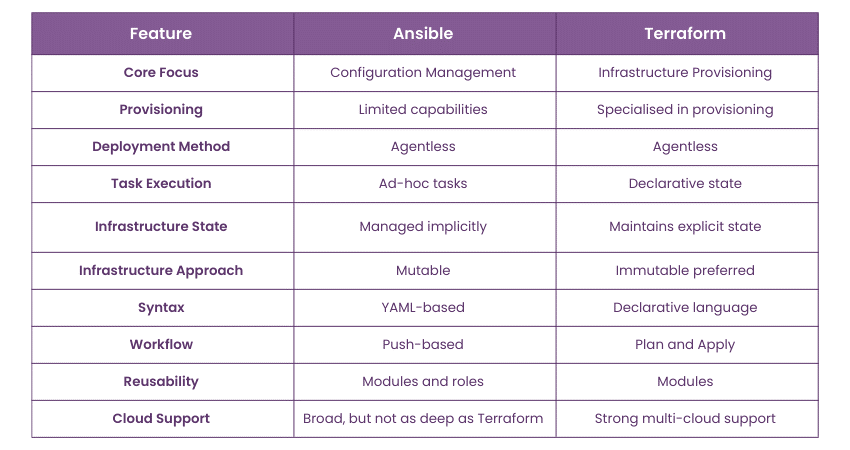
When comparing Ansible and Terraform, it's important to recognise the key similarities that make both tools effective for managing infrastructure. Below are the shared characteristics that highlight their complementary roles in automation and infrastructure as code:
1) Agentless Deployment
Ansible and Terraform both operate without the need for agents, making them lightweight and easier to deploy across various systems. Agentless deployment means that neither tool requires pre-installed software or agents on the target nodes, reducing the complexity and maintenance overhead.
Both tools directly communicate with systems through SSH or API calls, enhancing security and reducing points of failure. This streamlined approach ensures that users can quickly configure and provision resources without worrying about agent installation or configuration, providing an efficient and hassle-free deployment experience.
2) Modular Reusability
Both Ansible and Terraform emphasise reusability through modular designs, which makes them highly efficient for managing complex infrastructure. Ansible uses roles and Ansible Modules, which allow users to bundle tasks, variables, and handlers into reusable components that can be applied across various projects.
Terraform similarly leverages modules, enabling the definition of infrastructure components in a reusable and scalable manner. This modularity not only promotes code reusability but also ensures consistency across environments. By adopting a modular approach, both tools help teams standardise configurations, reduce redundancy, and maintain clean, organised infrastructure-as-code practices.
3) Cloud Support
Ansible and Terraform both offer extensive cloud support, making them versatile tools for managing multi-cloud environments. Ansible provides broad cloud compatibility, supporting various platforms like AWS, Azure, Google Cloud, and more. However, Terraform excels in deeper integrations with cloud providers, offering advanced provisioning features and strong multi-cloud support.
Terraform’s robust cloud provider plugins make it a go-to for complex, multi-cloud infrastructure management. Despite this, both tools allow users to automate tasks and manage resources across multiple cloud environments, ensuring flexibility in cloud operations while simplifying the infrastructure management process.
4) Declarative Syntax
Both Ansible and Terraform utilise a declarative syntax, focusing on the desired end state rather than detailing each step to achieve it. Ansible’s YAML-based playbooks allow users to define configurations in a straightforward, human-readable format, making it easy to understand and maintain.
Terraform, on the other hand, uses HashiCorp Configuration Language (HCL), a purpose-built declarative language that defines infrastructure as code. With the use of Terraform Modules, users can further enhance the reusability and organisation of their infrastructure code. Despite the differences in syntax, both tools abstract the underlying complexity, enabling users to express infrastructure goals clearly. This declarative approach enhances consistency, reduces human error, and makes infrastructure automation more reliable.
5) Infrastructure Management
Ansible and Terraform both focus on automating infrastructure management, though their approaches differ slightly. Ansible is more geared towards configuration management and handling ad-hoc tasks, making it suitable for mutable infrastructure where systems are updated in place.
Terraform, by contrast, is designed with an infrastructure provisioning focus, promoting an immutable infrastructure model where updates typically involve replacing resources rather than modifying them directly. Despite these differences, both tools share the common goal of providing reliable, automated infrastructure management, enabling teams to efficiently manage complex environments and maintain consistency across deployments.
Keen on transforming your DevOps Strategy, refer to our blog on Ansible Tower.
Ansible vs Terraform: Key Differences
Ansible and Terraform have different approaches and use cases for infrastructure automation. Here are some of the key differences between them:
1) Configuration management versus orchestration
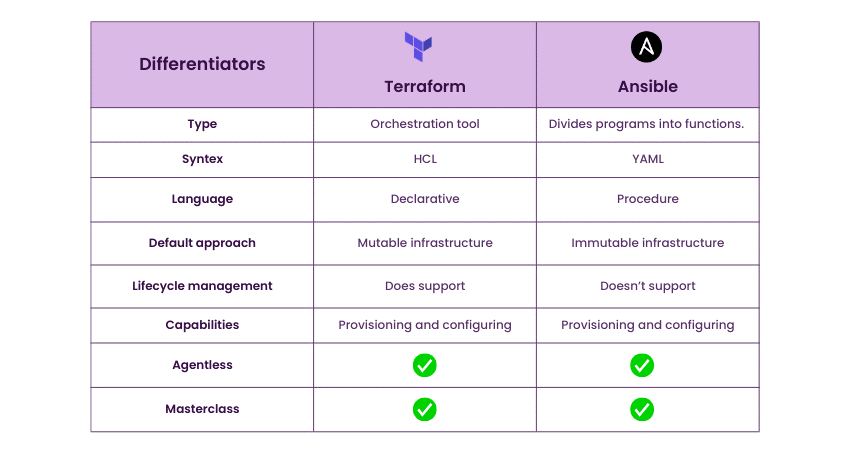
Ansible is primarily a configuration management tool. It focuses on configuring and managing the state of the existing hosts and applications. Ansible can also perform orchestration, meaning that it can coordinate and execute complex tasks across multiple hosts and systems, such as deploying an application, scaling a cluster, or performing a backup. However, Ansible is not designed to provision and manage the underlying infrastructure, such as creating and destroying virtual machines, networks, storage, etc.
Terraform is primarily an orchestration tool that provides and manages the infrastructure across multiple cloud providers and Cloud Computing Platforms. Terraform can also perform configuration management as it can configure and manage the state of the resources that it creates, such as:
a) Setting up firewall rules
b) Attaching disks
c) Installing software
However, Terraform is not designed to handle the finer details of the configuration, such as managing users, services, packages, etc.
Navigate tomorrow’s digital challenges with our Cloud Computing Course – join now!
2) Procedural versus declarative language
Ansible uses procedural language, meaning that it defines the tasks and commands that must be executed on the target hosts in a specific order. Ansible playbooks are written in YAML, a human-readable and easy-to-learn format. Ansible playbooks can also use Jinja2 templates, allowing dynamic and conditional expressions. Ansible playbooks are executed from top to bottom, and each task and command is run on the hosts unless a condition or an error stops it.
Terraform uses declarative language that defines the desired state of the infrastructure without specifying how to achieve it. Its configurations are written in HCL, an easy format like JSON. These configurations can include variables, Terraform Functions, and expressions, allowing for modular and flexible structures.
3) Modifiable versus immutable
Ansible treats infrastructure as elastic as it can change the state of the existing hosts and resources without creating or destroying them. Ansible can add, remove, or update users, packages, files, services, etc., on the hosts and execute commands and scripts. Ansible can also modify the state of the resources it creates, such as changing the size, type, or configuration of a virtual machine, network, storage, etc.
Terraform treats infrastructure as immutable, meaning it can only create or destroy hosts and resources, not modify them. Terraform can create, modify, and resources such as virtual machines, networks, storage, databases, load balancers, etc. However, Terraform only changes the state of the existing hosts and resources if Terraform manages them. It also does not execute commands or scripts on the hosts unless they are part of the resource creation or destruction.
Explore more about Terraform with our expert-led course on Terraform Training. Join now!
4) State Management
Ansible does not have a state file, meaning that it does not keep track of the current state of the infrastructure or the mapping between the configuration and the resources. Ansible relies on the facts and the inventory to gather information about the target hosts and resources and then executes the tasks and commands on them. Ansible does not compare the configuration with the state, nor does it detect conflicts or errors unless they occur during the execution.
Terraform has a state file, meaning that it maintains a record of the current state of the infrastructure and the mapping between the configuration and the resources. Terraform uses the state file to compare the configuration with the state and then determines the changes that need to be applied to the infrastructure. Terraform also uses the state file to track dependencies, detect conflicts and errors, and perform incremental updates.
Drift in configuration
Ansible and Terraform are both widely used tools for infrastructure automation, but they have distinct functions and strengths.
Ansible is primarily a configuration management tool designed to automate the setup and maintenance of software on existing infrastructure. It uses a procedural approach, executing tasks in a specific sequence, making Ansible well-suited for managing configurations, updates, and server deployments.
Terraform, on the other hand, is focused on infrastructure provisioning. It uses a declarative approach, where users define the desired state of their infrastructure, and Terraform creates and manages the resources needed to achieve that state. This makes Terraform particularly effective for provisioning and managing infrastructure across various cloud providers.
While both tools can manage infrastructure, Terraform excels at provisioning and maintaining it. At the same time, Ansible is more suited for configuring and managing the software on top of that infrastructure. They are often used together to cover both provisioning and configuration needs comprehensively.
Gain in-depth knowledge and acquire the skills for easy troubleshooting? Sign up now for our Microservices Architecture Training!
Which One Should You Choose: Terraform or Ansible?
Terraform and Ansible are both powerful tools for infrastructure automation, each suited to different scenarios. Terraform is ideal for managing large, complex infrastructures across multiple cloud providers, thanks to its declarative language and state management, making it perfect for environments with frequent, radical changes.
In contrast, Ansible is better suited for smaller, simpler setups, offering quick configuration through its inventory-based approach and procedural YAML scripts. It excels in handling incremental, non-destructive updates with precision control over detailed configurations like users, packages, and services.
In summary, choose Terraform for complex, large-scale infrastructure with frequent changes, and opt for Ansible for simpler, more detailed tasks requiring fine-grained control.
Don't miss out on essential preparation! Dive into comprehensive Terraform Interview Questions and Answers to improve your interview performance today.
Conclusion
After exploring this blog on Ansible vs Terraform, you'll find that both tools excel in different areas: Ansible is perfect for configuration management and ad-hoc tasks, while Terraform is ideal for infrastructure provisioning with its declarative approach. Understanding the difference between Terraform and Kubernetes is essential for making the right choice in container orchestration and infrastructure management. By aligning your specific needs—whether fine-tuning configurations or scaling infrastructure—you can choose the best tool or even combine them for a comprehensive automation strategy. Additionally, if you are preparing for a role that involves Ansible, reviewing Ansible Interview Questions can provide deeper insights into how this tool is applied in real-world scenarios.
Become an expert in Cloud Computing today – register now with our Cloud Computing Training!
Frequently Asked Questions
What Is Replacing Ansible?

Ansible is being increasingly replaced by alternatives like Puppet, Chef, and SaltStack, which offer similar automation capabilities with additional features like enhanced scalability, continuous deployment, and better schedulability.
Is Python used in Terraform?
Yes, Python is used in Terraform to enhance cloud infrastructure automation. While Terraform itself is written in Go, Python can be integrated with Terraform for tasks like creating custom modules, managing configurations, and handling complex logic, making it a powerful combination for robust cloud infrastructure management.

Lily Turner


Senior AI/ML Engineer and Data Science Author
Lily Turner is a data science professional with over 10 years of experience in artificial intelligence, machine learning, and big data analytics. Her work bridges academic research and industry innovation, with a focus on solving real-world problems using data-driven approaches. Lily’s content empowers aspiring data scientists to build practical, scalable models using the latest tools and techniques.
View Detail

 If you wish to make any changes to your course, please


