




We may not have the course you’re looking for. If you enquire or give us a call on +852 2592 5349 and speak to our training experts, we may still be able to help with your training requirements.
What is AI Orchestration: A Complete Guide
ByRichard HarrisLast updated on: 07 October 2026
AI orchestration automates AI workflows by integrating data, models and computing resources to optimise efficiency, scalability and decision-making. This includes steps such as data preparation, model training and deployment, model monitoring, and automating decision-making processes to achieve specific business goals.
The Main Idea
1. AI orchestration coordinates AI models, agents, data, tools and infrastructure across connected workflows.2. It combines integration, automation, resource management and monitoring to keep AI workflows running effectively.3. Orchestration can improve scalability, efficiency and consistency across complex AI environments.4. Common use cases include customer support, process automation, knowledge management and data workflows.5. Effective orchestration requires monitoring, governance, security and appropriate human oversight.
Think of AI as a bustling city with data streams flowing, models interacting and systems exchanging information. Then, AI orchestration is the traffic controller that keeps everything running smoothly. It coordinates multiple models, data sources and tools to work seamlessly together.
From automating workflows to managing resources, AI orchestration simplifies the most complex processes and enables businesses to harness AI’s full potential. This blog takes a deep dive into AI orchestration, how it streamlines workflows, and why it’s the key to tapping into AI’s full potential in any organisation. So read on and bring your organisation up to speed!
What is AI Orchestration?
AI orchestration involves managing and coordinating AI models, systems, and integrations. It includes setting up, integrating, and maintaining AI components in a larger system or workflow. Along with AI models and agents, it also involves data storage, computational resources, and data pipelines.
AI orchestration connects these elements using Application Programming Interfaces (APIs), streamlining the entire AI lifecycle. It automates workflows, monitors data flow, manages resources, and handles errors. With the rise of Large Language Models (LLMs) and generative AI, organisations use LLM orchestration to build smarter AI apps like chatbots.
AI Orchestration at a Glance
Data Sources → AI Models/Agents → APIs and Tools → Orchestration Layer → Business Applications
How Does AI Orchestration Work?
AI orchestration functions by bridging the gaps between an AI workflow's components. AI workflow orchestration is facilitated by AI integration, AI automation and AI management. Let's check how AI orchestration works:
1) AI Integration
a) AI integration connects AI tools, databases and other system components to form a unified AI solution.
b) Data pipelines automate the data organisation, storage and transfer processes. This ensures data quality and accessibility.
c) Data flow diagrams illustrate data movement within the organisation, and aid in AI tool development.
d) Integration includes linking ML models with tools through APIs for real-time communication and function calling.
e) Orchestration platforms create AI ecosystems by chaining models in complex workflows to handle high-level tasks.
2) AI Automation
a) Automation involves completing tasks without human intervention, ranging from basic code to entire workflows.
b) AI applications automate workflows. This simplifies tasks like document summarisation, code generation, and research.
c) AI orchestration tools automate processes like function calls from LLMs to tools through APIs.
d) Orchestration platforms manage resources, prioritising memory and compute power based on urgent demands.
e) Automation can also support monitoring, retries, scheduled tasks and predefined recovery actions when workflow errors occur.
Trainer's Insight
Automation executes individual tasks or workflows, while orchestration coordinates multiple components and dependencies, so the wider AI system works together effectively.
3) AI Management
a) AI management supports governance, responsible AI practices and oversight across AI workflows.
b) Orchestration oversees the entire lifecycle of AI applications, from development to deployment.
c) Performance monitoring helps data scientists ensure data quality and reliability for accurate AI model outputs.
d) AI management supports security, reporting, and compliance, helping organisations align with regulatory standards.
e) Strong data protection measures can help safeguard user data and support compliance with applicable requirements.
AI Orchestration in Action
Imagine a customer asks an AI assistant about a delayed order:
Customer request↓AI agent interprets the query↓CRM retrieves customer details↓Order system checks delivery status↓Knowledge base provides guidance↓AI generates a response↓Complex issue? → Human escalation
Rather than each component operating independently, orchestration coordinates the entire workflow.
Gain practical insights into how AI is transforming industries with our AI Course for Beginners – Sign up now and unlock the code of intelligence!
Benefits of AI Orchestration
From improved scalability to more reliable governance, here are the key benefits of AI orchestration:
1) Greater Scalability
AI orchestration allows businesses to grow their operations easily. For example, during peak times like holidays, an online store can coordinate its chatbots, order systems, and delivery services to handle increased demand smoothly.
2) Improved Performance
Ensuring different AI tools work well together improves overall system performance. In healthcare, for instance, connecting diagnostic tools with scheduling systems can lead to quicker patient care.
3) Increased Efficiency
AI orchestration streamlines processes by automating repetitive tasks and making sure the tools communicate effectively. This leads to faster operations and reduces manual work.
4) Improved Cross-system Coordination
When AI tools are well-orchestrated, teams across different departments can collaborate more effectively. For instance, sales and marketing teams can share insights seamlessly, leading to more cohesive strategies.
5) More Reliable Governance and Compliance
AI orchestration can support governance and compliance by controlling how data moves between systems, enforcing workflow rules and improving visibility. However, compliance still depends on wider organisational, legal and technical controls.
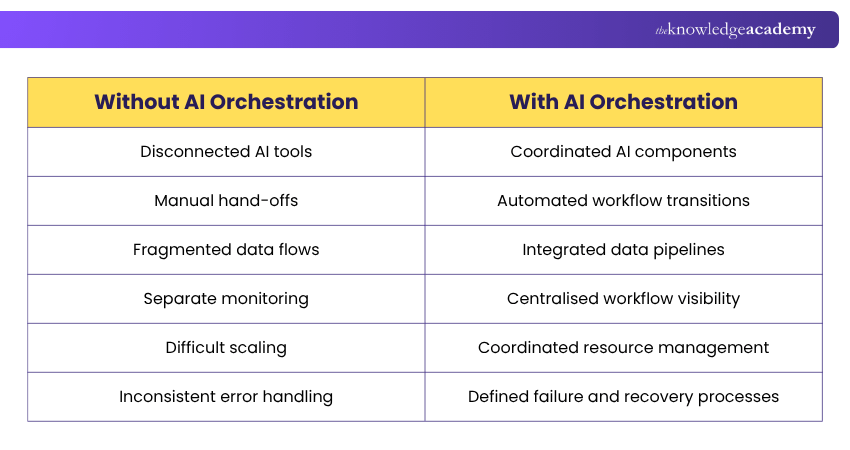
Here’s a quick look at how AI orchestration can bring positive change:
AI Orchestration Use Cases
From supporting automation and sales assistance to knowledge management and lead generation, AI orchestration has plenty of use cases. Let’s explore them in detail:
1) Support Automation
a) AI orchestration connects AI support agents and CRMs to streamline customer interactions effectively.
b) It enables chatbots to access knowledge base content, providing accurate and consistent responses to customer queries.
c) AI orchestration uses CRM data to personalise replies, enhancing the overall customer experience.
d) Automated follow-ups ensure timely communication, preventing missed interactions and improving customer satisfaction.
e) AI orchestration provides context when issues need escalation, allowing support agents to resolve problems more efficiently.
2) Sales Assistance
a) AI tools automate the qualification process by analysing customer behaviour and detecting needs.
b) AI orchestration can coordinate scheduling tools to help identify suitable meeting times and reduce manual scheduling effort.
c) Customer interactions are tracked across various touchpoints.
d) Sales teams receive real-time insights, helping them prioritise high-value leads.
e) Automation reduces manual tasks and allows sales reps to focus on relationship-building and closing deals.
3) Process Automation
a) AI orchestration accelerates the workflow by automating repetitive tasks in every department.
b) It integrates tools like CRMs, scheduling systems and email platforms for seamless data flow.
c) Routine tasks such as updating customer records, sending reminders, and managing emails are handled automatically.
d) AI orchestration reduces manual work and allows employees to focus on more complex tasks.
e) Streamlined workflows minimise operational delays.
4) Knowledge Management
a) AI orchestration connects multiple systems and streamlines data access across the organisation.
b) Automated data flows provide uninterrupted access to information.
c) In one workflow, employees can access data from various sources, like document repositories, analytics platforms, and CRMs.
d) Integrated systems enable quick data retrieval and minimise the need to switch between tools.
e) Unified workflows help make sure that employees gather relevant insights more efficiently, enhancing productivity.
Common Misconception
“If a process uses AI Automation, it is automatically AI Orchestration.”
Not necessarily. A single AI-powered automated task may require no orchestration. Orchestration becomes relevant when multiple components, dependencies and workflow stages need to be coordinated.
5) Lead Generation
a) AI orchestration automates lead engagement, qualification, and sales channel routing. This reduces the burden of manual effort.
b) AI agents initiate conversations via email or chat and can engage prospects based on predefined criteria.
c) Leads are qualified based on customer behaviour. This helps ensure that only high-potential prospects are prioritised.
d) Qualified leads are directed to the appropriate sales teams. This optimises the sales process.
e) AI orchestration streamlines lead generation, qualification, and initial marketing outreach by connecting CRM and marketing tools.
Gain the skills to integrate AI into project management processes. Sign up for our Artificial Intelligence (AI) for Project Managers Course now!
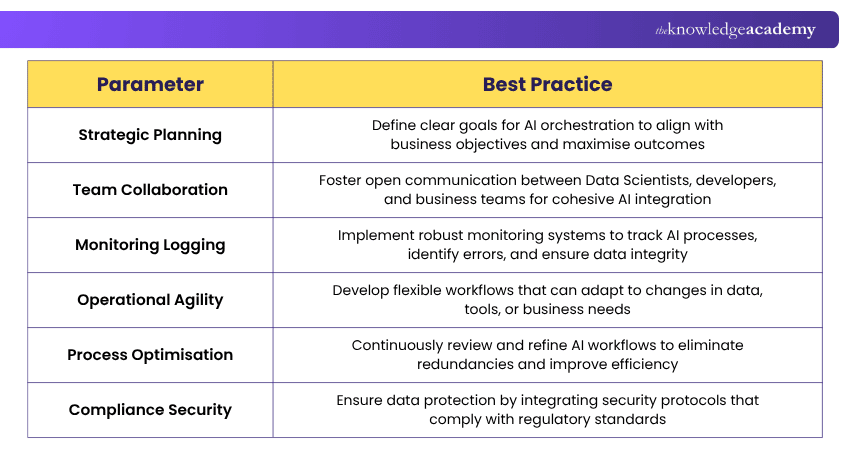
Best Practices for AI Orchestration
Here are the best practices associated with AI orchestration:
AI Orchestration Tools
Here's a list of the best AI orchestration tools to help you manage workflows and connect different AI systems across your organisation. These tools can boost your business like never before by improving efficiency and supporting better decision-making.
1) Botpress
Botpress is an AI agent platform for building conversational agents and coordinating interactions with tools, APIs and external systems. It allows businesses to create conversational agents that can handle customer interactions across multiple channels. Here are its key features:
a) Visual flow builder for easy chatbot creation
b) Multi-channel deployment for web and messaging apps
c) Integration with third-party APIs
d) An NLU engine for advanced natural language understanding
2) Kubeflow
Kubeflow is a Kubernetes-based platform that simplifies the development, deployment, and management of scalable machine learning workflows. It helps data scientists automate and monitor ML processes efficiently. Here are its key features:
a) Modular components for each stage of the ML lifecycle
b) Support for Jupyter notebooks and pipelines
c) Model serving
d) Integration with TensorFlow and PyTorch
3) DataRobot
DataRobot is an enterprise AI platform supporting predictive AI, generative AI and agentic AI workflows, including model development, deployment, monitoring and governance. Its features include:
a) Automated ML model development
b) Tools for model explainability and monitoring
c) Integration with various data sources
d) Predictive analytics capabilities
4) Apache Airflow
Apache Airflow is an open-source tool designed to author, schedule, and monitor workflows programmatically. It is widely used for data engineering and pipeline orchestration. Its features include the following:
a) Dynamic pipeline generation using Python
b) Modular architecture for scalability
c) Extensive integration with third-party services
d) Visualisation of workflow progress
5) MLflow
MLflow is an open-source platform that helps you manage the machine learning lifecycle, from experimentation to deployment. It helps data teams track ML models and ensure consistency. The key features include:
a) Experiment tracking
b) Model registry
c) Support for multiple ML libraries and tools
d) Packaging and deployment of ML models
e) Model versioning and lifecycle management
6) Apache NiFi
Apache NiFi is a dataflow and integration platform that can support AI orchestration by moving, transforming and routing data between systems. Its best features are:
a) Web-based interface for designing data flows
b) Real-time and batch processing
c) Fine-grained data prioritisation
d) Data backpressure handling capabilities
7) TensorFlow Extended (TFX)
TensorFlow Extended (TFX) is a comprehensive ML platform designed to deploy TensorFlow models in production. It provides components for data processing, model validation, and deployment. Its best features are:
a) Data validation
b) Data transformation
c) Model analysis
d) Integration with orchestration platforms such as Apache Airflow and Kubeflow.
e) Support for scalable production ML pipelines.
Discover how AI-driven insights can optimise workflows and improve operational efficiency. Sign up for our Artificial Intelligence (AI) for DevOps Training now!
Challenges and Solutions in AI Orchestration
Despite its groundbreaking benefits, AI orchestration is not without its challenges. Here we explore these challenges and the solutions to handle them:
1) Data Integration
Bringing together different data sources into AI workflows can be tricky due to varying formats, structures, and quality issues. Here are some solutions you can try:
a) Standardise data formats.
b) Set up data quality checks.
c) Use data integration tools to simplify data collection and processing.
2) Model Management
Tracking different AI model versions can be challenging, especially in dynamic work environments. Here are some solutions:
a) Use Git for code and configuration changes and use model registries or dedicated artefact stores to manage model versions.
b) Containerisation tools like Docker can package models and their dependencies.
c) Implement model registries to keep a record of model versions for easy access and management.
3) Resource Optimisation
Effectively managing computational resources for AI tasks can be difficult, especially when workloads vary. Try out these solutions:
a) Use dynamic resource allocation strategies and tools like Kubernetes for scaling resources as needed.
b) Implement auto-scaling to adjust based on demand.
c) Regularly monitor performance to identify areas for optimisation.
4) System Interoperability
Ensuring that different AI models, frameworks and systems work together can be very challenging due to compatibility issues. Here’s how you can handle it:
a) Use standardised interfaces like RESTful APIs to connect components smoothly.
b) Adopt common frameworks.
c) Maintain open communication among teams to address compatibility issues early.
AI Orchestration Readiness Checklist
Before implementing AI orchestration, ask:
□ Are the workflow objectives clearly defined?□ Are the required models, tools and data sources identified?□ Can the systems communicate through reliable integrations?□ Are monitoring and logging mechanisms available?□ Are security and governance requirements defined?□ Is there a plan for failures and human escalation?Can the workflow scale as demand changes?
So, successful orchestration depends on more than technology. Clear objectives, reliable integrations, effective monitoring, security and governance are equally important. With these foundations in place, organisations can use AI orchestration to turn separate AI capabilities into connected and manageable workflows.
Supercharge your data analysis skills with the power of AI! Register for our Artificial Intelligence (AI) for Business Analysts Course now!

Richard Harris creates technically detailed yet accessible content on full-stack development, software architecture and modern development frameworks. His knowledge of frontend and backend technologies helps developers understand how scalable, efficient and high-performing applications are designed and built.
View Detail

 If you wish to make any changes to your course, please


