


 Top Rated Course

We may not have the course you’re looking for. If you enquire or give us a call on 01344203999 and speak to our training experts, we may still be able to help with your training requirements.
What is Generative AI? The Complete Guide
Lily Turner 22 August 2026Generative AI is a type of Artificial Intelligence that creates new content from learned patterns and user inputs. Learn how it works, its models, applications, benefits, and limitations.

Training Outcomes Within Your Budget!
We ensure quality, budget-alignment, and timely delivery by our expert instructors.
Table of Contents
Key Takeaways
1. Generative AI creates new content such as text, images, audio, video, code and other digital outputs.2. Generative AI models learn patterns from training data and use them to produce new outputs based on inputs.3. Transformers, diffusion models, GANs, VAEs and autoregressive models use different approaches to content generation.4. Generative AI is used across areas such as content creation, software development, healthcare, finance and customer service.5. Generative AI offers significant opportunities but requires human oversight to manage accuracy, bias, privacy and security risks.
Imagine describing an image, writing a few lines of text or explaining an idea, and watching an AI system turn your instructions into something new. What once required hours of creative or technical work can now begin with a simple prompt.
This is the capability behind Generative AI. Unlike AI systems designed mainly to analyse information or make predictions, Generative AI can produce new content by learning patterns from large datasets.
In this blog, we’ll explore What Is Generative AI, how it works, the models behind it, what it can create, where it is used, its benefits and limitations, and what its future could look like.
What is Generative AI?
Generative AI is a branch of Artificial Intelligence that uses trained models to create new content based on patterns learned from existing data. Depending on the model and input, it can generate text, images, audio, video, code and other forms of digital content.

Unlike AI systems that primarily analyse or classify existing information, Generative AI produces new outputs based on what it has learned. For example, it can create an article from a prompt, generate an image from a description or produce code based on a user's requirements.
In Simple Terms: Generative AI learns from existing information, understands what you ask for, and uses those learned patterns to create something new.
How Does Generative AI Work?
Generative AI works by learning patterns and relationships from training data and using what it has learned to generate outputs in response to new inputs. The exact process varies between model architectures, but it can be understood through four broad stages.
1) Collecting and Preparing Training Data
Generative AI models are trained using large datasets relevant to the type of content they are expected to generate. These datasets can contain text, images, audio, code or other forms of information.
The data needs to be processed so that the model can identify useful patterns and relationships. The quality and suitability of the training data can influence the quality of the resulting model.
2) Training the Model
During taining, the model processes data and adjusts its internal parameters to learn patterns within that information. The training process allows the model to develop an understanding of structures such as language, images or sequences.
Different model architectures use different training methods. The resulting model can then use what it has learned when generating new content.
3) Understanding Patterns
Once trained, a model can recognise relationships within the information it has learned. For example, a language model can identify patterns in words and sentences, while an image model can learn relationships between visual features.
This does not mean the model simply stores and retrieves a complete copy of its training data. Instead, it uses learned patterns to produce outputs based on new inputs.
4) Generating New Content
When a user provides an input, the model processes it and generates an output according to its learned patterns. A text model may predict a sequence of words, while an image model can construct visual content based on a description.
The generated result depends on the model, the input and the way the system has been designed and trained.
5) Refining the Output
Generated content may require review, editing or further prompting before it is suitable for its intended purpose. Users can assess the output and provide additional instructions to improve or change the result.
Human review remains important because Generative AI can produce inaccurate, biased or unsuitable content.
Build effective prompts and get more accurate, relevant and useful outputs from Generative AI with our Generative AI in Prompt Engineering Training- Sign up today!
What Can Generative AI Create?
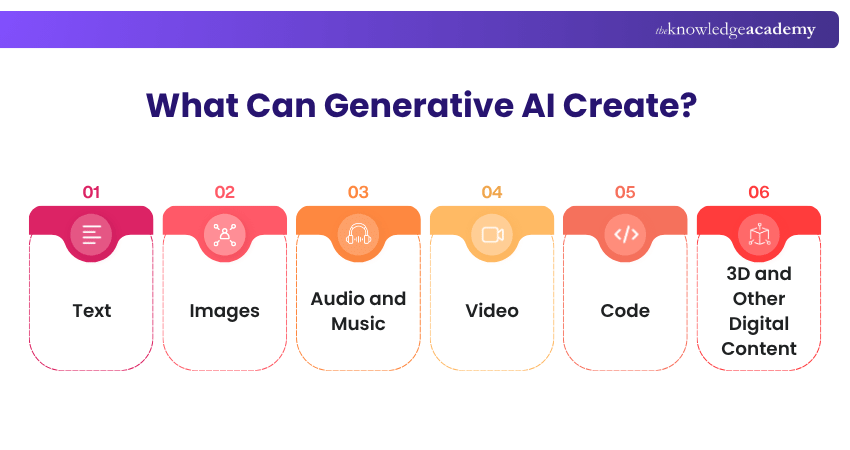
Different models can generate different forms of output, depending on their architecture, training and intended application.
1) Text
Generative AI can create articles, summaries, emails, stories, reports and other forms of written content. Language models can also help rewrite, translate or organise existing information.
2) Images
Image-generation models can create visuals from text descriptions or other inputs. They can support activities such as concept development, illustration, design exploration and creative production.
3) Audio and Music
Generative AI can create or modify audio, including music and synthetic speech. These capabilities can support applications such as voiceovers, music production and other forms of audio content.
4) Video
Generative AI can assist with creating and modifying video content. Depending on the system, users can generate visual sequences, transform existing content or create video elements from text and other inputs.
5) Code
Generative AI can generate code from natural-language instructions and assist developers with tasks such as code completion, explanation and debugging. It can therefore support parts of the software development workflow.
6) 3D and Other Digital Content
The models can be used to create or assist with 3D assets, designs and other digital content. These capabilities can support industries such as gaming, architecture, product design and engineering.
Test Your Understanding
You want to turn a written product description into a short visual sequence. Which Generative AI capability would be most directly suited to the task?
A) Text GenerationB) Image GenerationC) Video GenerationD) Code Generation
Answer: C) Video Generation
Main Generative AI Model Architectures
Generative AI includes different model architectures, each using a distinct approach to learning and generating content. Understanding these models helps explain why different Generative AI systems perform different tasks.
1) Transformer Models
Transformer models use mechanisms such as self-attention to identify relationships between different parts of an input. This makes them particularly effective for processing sequences and understanding context.
Transformers have become important in language generation and are used in many Large Language Models. They can support tasks such as text generation, translation, summarisation and conversation.
2) Diffusion Models
Diffusion models generate content by learning how to transform noisy data into meaningful outputs. During training, noise is progressively added to data, and the model learns how to reverse this process.
They are particularly associated with high-quality image generation and can create detailed visuals from text or other inputs.
3) Generative Adversarial Networks (GANs)
GANs use two neural networks called a generator and a discriminator. The generator creates new content, while the discriminator evaluates whether the generated content resembles real examples.
The two networks work against each other during training, creating a feedback process that can help the generator produce increasingly realistic outputs. GANs have been used for image generation, image transformation and other creative applications.
4) Variational Autoencoders (VAEs)
VAEs use an encoder and decoder to learn a compressed representation of data. The encoder converts information into a latent representation, while the decoder uses that representation to reconstruct or generate content.
VAEs can generate new outputs that share characteristics with the training data. They have applications in areas such as image generation, data representation and anomaly detection.
5) Autoregressive Models
Autoregressive models generate content sequentially by predicting the next element based on previous elements. In text generation, for example, the model can predict the next token based on the sequence that came before it.
This approach can be applied to different forms of sequential content, including text, audio and other data. Its sequential nature can, however, affect how quickly some outputs can be generated.
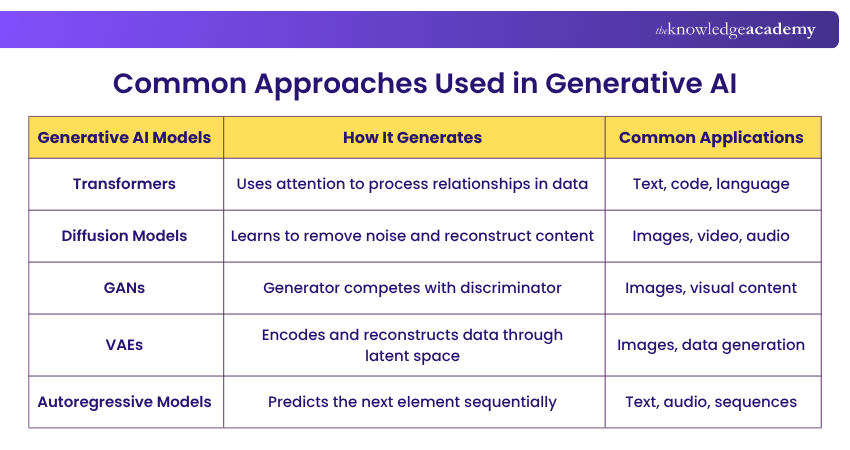
Note: These categories are not always mutually exclusive. For example, a Transformer-based model may also generate content autoregressively. The terms can describe different aspects of how a Generative AI system is designed or generates outputs.
What are the Applications of Generative AI?
Generative AI can be applied to tasks that involve creating, transforming, summarising or adapting content. Its applications are expanding as organisations explore how the technology can support existing workflows.
1) Content and Media
Media and marketing teams can use Generative AI to create drafts, visual concepts, scripts and other content. It can help accelerate creative workflows while allowing professionals to review and refine the final output.
2) Software Development
Developers can use Generative AI to generate code, explain existing code and support debugging. It can reduce time spent on some repetitive development tasks while developers remain responsible for reviewing and validating the output.
3) Healthcare and Drug Discovery
Generative AI can support research by helping generate or analyse potential molecular structures and other scientific outputs. These applications can assist researchers in exploring possibilities more efficiently.
Did You Know?
Generative AI applications in healthcare extend beyond scientific research. In 2026, NHS England reported that a trial of AI-powered administrative support involving more than 30,000 NHS workers saved an average of 43 minutes or more per staff member per day, showing another way AI can support healthcare workflows.
4) Finance
Financial organisations can explore Generative AI for tasks such as document analysis, customer communication and summarisation. Its use requires appropriate controls because financial information can be sensitive and accuracy is important.
5) Education
Generative AI can support personalised learning materials, explanations, practice questions and content creation. Educators can use these capabilities alongside human judgement to adapt learning resources to different needs.
6) Product Design and Manufacturing
Design teams can use Generative AI to explore concepts and produce variations during early design stages. This can support faster prototyping and help teams consider more alternatives.
7) Customer Service
Generative AI can support customer service through conversational assistants, response drafting and information summarisation. Human agents can then review or handle cases that require judgement, empathy or specialised knowledge.
Learn how Generative AI can support Cyber Security practices, threat analysis and modern security workflows with our Generative AI in Cybersecurity Training - Join now!
Benefits of Generative AI
When used appropriately, Generative AI can support organisations and professionals by reducing the effort required for certain creative, analytical and knowledge-based tasks. Key benefits include:
1) Faster First Drafts: Generates initial versions of text, code, designs and other content that users can review and refine.
2) Greater Productivity: Reduces time spent on selected repetitive or time-consuming tasks, allowing people to focus on work requiring greater judgement.
3) Rapid Exploration: Produces multiple ideas, alternatives or concepts quickly, supporting brainstorming and experimentation.
4) Scalable Personalisation: Helps adapt content, explanations and responses for different audiences or requirements.
5) Easier Knowledge Interaction: Can summarise, reorganise and transform complex information into formats that may be easier to work with.
6) Supports Innovation: Enables teams to explore new concepts, prototypes and approaches more quickly before deciding which ideas deserve further development.
Limitations of Generative AI
Generative AI can produce useful and convincing outputs, but those outputs are not automatically accurate, unbiased or appropriate. The key drawbacks of Generative AI are:
1) Accuracy and Hallucinations
Generative AI sometimes produces information that looks accurate but in reality, they are incorrect or unsupported. These outputs are sometimes described as hallucinations, making human verification important when accuracy matters.
2) Bias
Models can reflect biases present in their training data or introduced through other stages of development. Unchecked bias can influence generated content and potentially lead to unfair or inappropriate outcomes.
3) Lack of Transparency
Some Generative AI systems can be difficult to interpret because users may not be able to understand exactly why a particular output was produced. This can create challenges when transparency and explainability are important.
4) Intellectual Property Concerns
Generative AI raises questions around the use of training data, ownership, and the appropriate use of generated content. Organisations should consider applicable intellectual property requirements when using AI-generated material.
5) Privacy and Data Security
Providing sensitive or confidential information to an AI system can create privacy and security considerations. Users should understand how information is handled and follow relevant organisational policies.
6) Misuse and Cybersecurity Risks
Generative AI can be used for harmful purposes, including creating convincing fraudulent content or supporting certain cyber threats. Organisations therefore need appropriate security controls and responsible use practices.
7) Need for Human Verification
Generative AI outputs may require human review before they are used, particularly in high-impact, sensitive or specialised contexts. This can limit the extent to which some tasks can be fully automated. People remain responsible for checking important facts, applying appropriate judgement and ensuring that outputs meet the required standards.
Trainer’s Insight
Use Generative AI to accelerate the work, not to skip the review. Check important facts, remove sensitive information, assess the output for bias and make sure the final result meets your requirements.
AI vs Generative AI: What's the Difference?
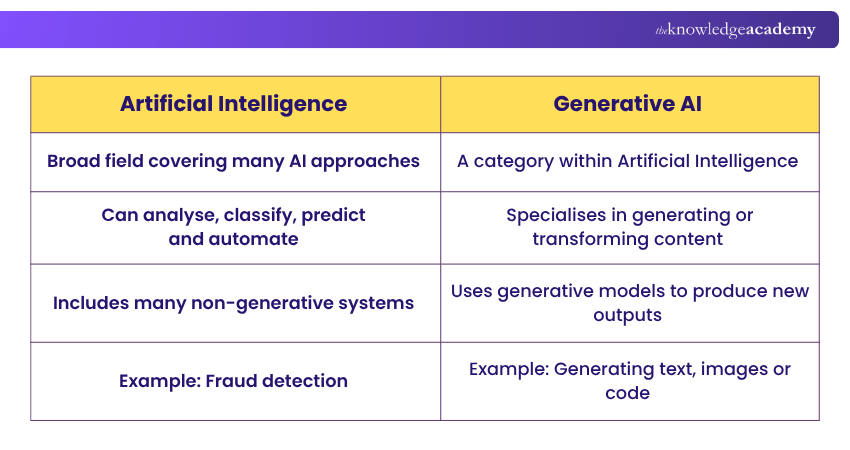
Generative AI is part of the broader field of Artificial Intelligence, rather than a separate alternative to AI. Traditional AI applications often focus on analysing data, recognising patterns, making predictions or supporting decisions, while Generative AI is distinguished by its ability to generate new content.
What is the Future of Generative AI?
Generative AI is likely to become increasingly integrated into everyday software and business workflows. Instead of operating only as standalone tools, generative capabilities can become part of the applications people already use for writing, coding, designing, analysing information and communicating.
Models are also becoming increasingly multimodal, allowing systems to work across combinations of text, images, audio and video. More specialised models and AI systems may also support particular industries, organisational functions and professional tasks.
As these capabilities expand, governance will become equally important. Organisations will need to consider accuracy, security, privacy, intellectual property, transparency and human accountability when deciding where and how Generative AI should be used.
Conclusion
Generative AI enables systems to create new content by using patterns learned from training data. Understanding what Generative AI is, how it works and where it can be applied can help people use these capabilities more effectively. Its potential is significant, but generated outputs still require appropriate human judgement, especially when accuracy, privacy, security or accountability matters.
Explore practical AI tools and learn how to use them effectively across different workplace tasks with our Artificial Intelligence Tools Training - Register now!
Frequently Asked Questions
What are Foundation Models in Generative AI?

Foundation models are models trained on broad datasets that can be adapted or used for a wide range of tasks rather than being developed for only one narrow application. Many Large Language Models (LLMs) are examples of foundation models, although foundation models can also work with images, audio and other types of data.
Does Generative AI Create Completely Original Content?
Generative AI produces new outputs based on patterns learned during training and the input it receives. Whether an output can be considered legally or creatively “original” depends on factors such as the system, source material, human contribution and applicable intellectual property rules.
What Data is Needed to Train Generative AI?
The type of training data depends on what the model is designed to generate. Text models may require large collections of text, while image-generation models can be trained using visual datasets and associated information.

Lily Turner


Senior AI/ML Engineer and Data Science Author
Lily Turner is a data science professional with over 10 years of experience in artificial intelligence, machine learning, and big data analytics. Her work bridges academic research and industry innovation, with a focus on solving real-world problems using data-driven approaches. Lily’s content empowers aspiring data scientists to build practical, scalable models using the latest tools and techniques.
View Detail

 If you wish to make any changes to your course, please


