


 Top Rated Course

We may not have the course you’re looking for. If you enquire or give us a call on 01344203999 and speak to our training experts, we may still be able to help with your training requirements.
Best 15 Adobe Experience Manager Alternatives: An Overview
Richard Harris 21 February 2026Embark on a journey to explore Alternatives that outshine Adobe Experience Manager with our comprehensive blog to the top 15 Alternatives. Uncover user-friendly platforms tailored to diverse needs, providing solutions beyond the usual landscape of Adobe Experience Manager Alternatives. Let's delve into these options, discovering digital innovation beyond the ordinary.

Training Outcomes Within Your Budget!
We ensure quality, budget-alignment, and timely delivery by our expert instructors.
Table of Contents

Finding the right platform to suit your organisation's needs is crucial in the dynamic landscape of digital experience management. Adobe Experience Manager (AEM) has been a stalwart in this domain, but businesses often seek Alternatives that align better with their specific requirements. This comprehensive overview will delve into the top 15 Adobe Experience Manager Alternatives, offering insights into their features, functionalities, and what sets them apart.
Table of Contents
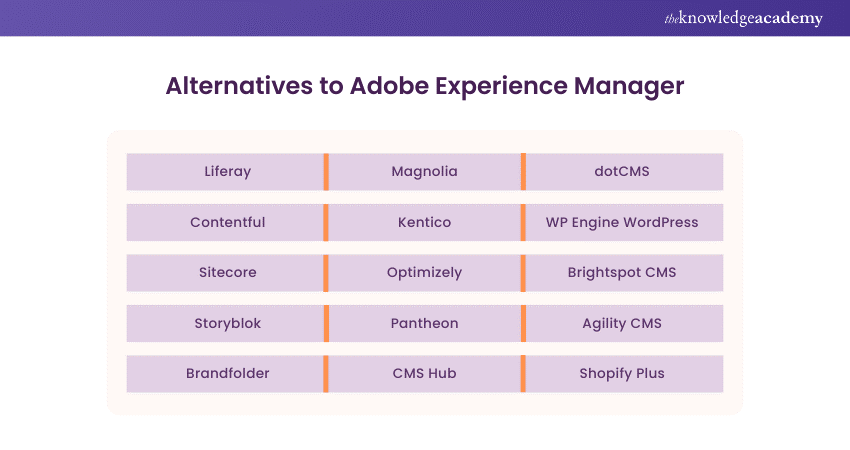
1) Alternatives to Adobe Experience Manager
a) Liferay
b) Magnolia
c) dotCMS
d) Contentful
e) Kentico
f) WP Engine WordPress
g) Sitecore
h) Optimizely
i) Brightspot CMS
j) Storyblok
k) Pantheon
l) Agility CMS
m) Brandfolder
n) CMS Hub
o) Shopify Plus
2) Conclusion
Alternatives to Adobe Experience Manager
Let's take an in-depth look at each alternative to understand the Features of Adobe Experience Manager and capabilities comprehensively.
1) Liferay
Liferay's open-source nature brings forth unparalleled flexibility. Organisations can customise the platform to suit their unique needs, making it an ideal choice for those with specific requirements. Whether you're building an intranet portal, collaboration platform, or content management system, Liferay provides the tools and frameworks necessary for a tailored digital experience.
The platform's strength lies in its ability to seamlessly integrate with other tools and systems, promoting a cohesive digital ecosystem. This interoperability ensures that Liferay can adapt to an organisation's existing infrastructure, reducing friction during implementation.
Liferay's commitment to user experience is evident in its intuitive interface, making it accessible to both technical and non-technical users. This ease of use contributes to efficient content creation and management, fostering a productive digital environment.
2) Magnolia
Magnolia CMS distinguishes itself with a user-friendly interface that prioritises simplicity without compromising on functionality. Content creation and management are streamlined, allowing users to focus on delivering engaging digital experiences. Magnolia's drag-and-drop features enhance the ease with which users can organise and present their content.
Scalability is a standout feature of Magnolia, making it an attractive option for enterprises with evolving digital needs. As businesses grow, Magnolia can seamlessly accommodate increased content and user interactions, ensuring a consistent and reliable performance.
The platform's integration capabilities further enhance its appeal. Magnolia can integrate with various third-party applications, enabling organisations to leverage their existing tools while benefiting from Magnolia's content management prowess.
3) dotCMS
dotCMS's hybrid approach to content management sets it apart in the market. By combining traditional and headless CMS capabilities, dotCMS offers a versatile solution for organisations seeking a balanced approach to content management.
Traditional CMS features allow for easy content creation and management through a user-friendly interface. Simultaneously, dotCMS's headless capabilities provide the flexibility needed to deliver content seamlessly across different front-end technologies.
This hybrid approach makes dotCMS a suitable choice for organisations with diverse content delivery requirements. Whether managing a traditional website, a mobile app, or emerging technologies, dotCMS empowers businesses to adapt to evolving digital landscapes.
4) Contentful
Contentful's headless CMS approach focuses on empowering developers to create, manage, and deliver digital content across various channels. The cloud-based architecture ensures scalability, allowing organisations to handle increased content volumes and user interactions without compromising performance.
The API-first approach of Contentful facilitates seamless integration with third-party applications. This enables organisations to build a connected digital ecosystem, integrating Contentful effortlessly into their existing tech stack.
Contentful's emphasis on content delivery and omnichannel experiences aligns well with the evolving expectations of modern audiences. It provides the tools necessary to deliver content consistently across websites, mobile apps, and other digital touchpoints, ensuring a cohesive and engaging user experience.
5) Kentico
Kentico's comprehensive suite of digital experience solutions encompasses a robust content management system, making it a one-stop shop for organisations seeking an all-in-one platform. From e-commerce to online marketing and community management, Kentico provides a holistic solution for businesses aiming to consolidate their digital efforts.
The user-friendly interface of Kentico enhances the content creation and management process. Non-technical users can navigate the platform effortlessly, enabling teams to collaborate effectively in delivering compelling digital experiences.
Kentico's versatility is a key strength, allowing businesses to scale their digital efforts without the need for disparate tools. Integrating various functionalities into a unified platform promotes efficiency and consistency across digital initiatives.
Unlock your potential with expert-led Adobe Training! Gain the skills to bring your creative visions to life.
6) WP Engine WordPress
WordPress, a household name in website creation, receives a performance boost with WP Engine's managed hosting solution. This collaboration ensures that organisations leveraging WordPress can enhance their site's performance, security, and scalability.
WP Engine's focus on managed hosting alleviates the technical burden on businesses, allowing them to concentrate on content creation and strategy. With automatic updates, robust security measures, and optimised performance, WP Engine ensures that WordPress websites run smoothly and reliably.
The managed hosting solution caters to businesses heavily invested in WordPress, providing the infrastructure necessary for high-performance websites. This collaborative approach between WordPress and WP Engine ensures a symbiotic relationship, benefitting organisations seeking a reliable and optimised web hosting solution.
7) Sitecore
Sitecore's position as a leading digital experience platform is underscored by its seamless content management integration and personalised marketing capabilities. The platform empowers organisations to manage content effectively while optimising customer experiences and driving personalised marketing campaigns.
A unified platform for content management and marketing streamlines digital efforts, fostering efficiency and consistency. Sitecore's user-friendly interface ensures that teams can collaborate seamlessly, delivering targeted content to the right audience at the right time.
The platform's emphasis on personalised marketing aligns with the growing expectations of consumers for tailored digital experiences. Sitecore provides the tools necessary to analyse user behaviour, segment audiences, and deliver personalised content, contributing to enhanced customer engagement.
8) Optimizely
Optimizely, now part of Episerver, it positions itself as a digital experience platform integrating content management, e-commerce, and experimentation. This convergence enables businesses to deliver personalised experiences while optimising content for improved user engagement.
The experimentation capabilities of Optimizely empower organisations to test and optimise content strategies. This data-driven approach ensures that businesses can refine their digital efforts, delivering content that resonates with their target audience.
Optimizely's integration of content management and experimentation provides a holistic solution for organisations aiming to refine their digital strategies continually. The platform's user-friendly features enable both marketers and developers to collaborate effectively in driving optimal digital experiences.
9) Brightspot CMS
Brightspot CMS's cloud-based architecture positions it as a flexible and fast content management system. Designed for speed and adaptability, the platform streamlines content creation, management, and distribution across various digital channels.
The modular architecture of Brightspot CMS allows for easy customisation, catering to businesses with unique content management requirements. Organisations can tailor the platform to suit their specific needs, ensuring that it aligns seamlessly with their digital objectives.
The platform's emphasis on speed enhances the efficiency of content creation and delivery. Brightspot CMS is an ideal choice for organisations seeking a nimble content management solution that adapts to the dynamic nature of digital experiences.
10) Storyblok
Storyblok's focus on delivering structured content for modern web and mobile applications positions it as an ideal choice for organisations prioritising a headless CMS approach. The visual editor and flexible content modelling empower content creators and developers alike, ensuring a collaborative and efficient content creation process.
The headless architecture of Storyblok provides the flexibility needed to deliver content across diverse digital touchpoints. This adaptability aligns well with the evolving expectations of modern audiences, who access content through various channels and devices.
Storyblok's visual editor enhances the content creation process, making it accessible to non-technical users. Simultaneously, the flexibility of content modelling ensures that developers have the tools necessary to create seamless and engaging digital experiences.
Unlock the possibilities of career in Adobe with our Adobe Edge Animate Training- Sign up today!
11) Pantheon
Pantheon's webOps platform simplifies website management, development, and hosting. The platform's focus on speed and scalability ensures high-performance websites, catering to organisations seeking an efficient and reliable solution for their digital presence.
Pantheon streamlines the development and deployment of websites, reducing the complexities often associated with webOps. This simplification enables organisations to focus on creating compelling content and optimising user experiences without the technical hurdles.
The scalability of Pantheon positions it as a reliable choice for businesses expecting growth in their online presence. As traffic and content volumes increase, Pantheon can seamlessly accommodate the demands, ensuring a consistently high level of performance.
12) Agility CMS
Agility CMS's headless architecture prioritises flexibility and developer-friendly features. The platform empowers content creators to manage content effortlessly while providing developers with the freedom to choose their preferred front-end technologies.
The decoupling of the content management system from the presentation layer ensures adaptability to evolving technologies. Agility CMS allows organisations to future-proof their digital presence by embracing emerging front-end frameworks and technologies.
Agility CMS's commitment to empowering developers contributes to a collaborative and efficient content creation process. The platform ensures that technical teams have the tools necessary to create seamless and engaging digital experiences.
13) Brandfolder
Brandfolder, positioned as a digital asset management (DAM) platform, focuses on organising, sharing, and optimising digital assets. The platform streamlines the management of brand assets, ensuring consistency across various channels and touchpoints.
Effective digital asset organisation is crucial for maintaining brand consistency and streamlining content creation. Brandfolder provides the tools necessary for businesses to manage their digital assets efficiently, ensuring that teams have access to the latest and most relevant brand elements.
The platform's emphasis on sharing and optimising digital assets enhances collaboration across teams. Brandfolder is an excellent choice for organisations prioritising effective digital asset organisation and distribution.
14) CMS Hub
CMS Hub, by HubSpot, integrates content management with marketing automation, providing a unified solution for organisations seeking a comprehensive approach to digital experiences. The platform combines content creation, optimisation, and marketing automation in one integrated solution.
The seamless integration of CMS Hub ensures that content creation aligns with marketing strategies. Organisations can create, optimise, and distribute content while leveraging marketing automation tools to target specific audiences and drive engagement.
CMS Hub's position within the broader HubSpot ecosystem enhances its appeal. Businesses already utilising HubSpot's suite of marketing tools can seamlessly integrate CMS Hub into their existing workflows, fostering consistency and efficiency.
15) Shopify Plus
Shopify Plus is a robust e-commerce platform designed for scalability and high-performance online stores. While primarily an e-commerce solution, Shopify Plus includes content management features, making it a comprehensive choice for businesses aiming to integrate content seamlessly with their online storefronts.
Stay at the forefront of adobe skills with our Adobe Experience Manager Training- Join today!
Conclusion
These 15 Adobe Experience Manager Alternatives offer a diverse range of features and functionalities, catering to various business needs. Whether you prioritise flexibility, or streamlined content management, an alternative aligns with your goals. Explore these options, weigh their pros and cons, and choose the one that best suits your organisation. Embracing a new digital experience platform can pave the way for enhanced user engagement, streamlined workflows, and, ultimately, business success. If you're also considering graphic design tools, understanding the difference between Adobe Illustrator and InDesign can be crucial in selecting the best tool for your creative work.
Unlock the possibilities of Adobe skills with our Adobe Muse Training– Sign up today!
Frequently Asked Questions
Why consider Alternatives to Adobe Experience Manager?

Exploring Alternatives enables businesses to discover platforms better aligned with their unique requirements, ensuring flexibility and customised solutions. These Alternatives cater specifically to diverse needs.
How does data modelling differ in MongoDB compared to traditional relational databases?
Certainly! Our handpicked list caters to enterprises of all sizes, providing scalable solutions for varied digital management needs. Whether you're a small business seeking efficiency or a large corporation with complex requirements, our Alternatives ensure a tailored fit. We prioritise flexibility to accommodate the dynamic demands of companies, making these options suitable for organisations of any scale.
What are the other resources and offers provided by The Knowledge Academy?
The Knowledge Academy takes global learning to new heights, offering over 3,000+ online courses across 490+ locations in 190+ countries. This expansive reach ensures accessibility and convenience for learners worldwide.
Alongside our diverse Online Course Catalogue, encompassing 19 major categories, we go the extra mile by providing a plethora of free educational Online Resources like Blogs, eBooks, Interview Questions and Videos. Tailoring learning experiences further, professionals can unlock greater value through a wide range of special discounts, seasonal deals, and Exclusive Offers.
What is Knowledge Pass, and how does it work?
The Knowledge Academy’s Knowledge Pass, a prepaid voucher, adds another layer of flexibility, allowing course bookings over a 12-month period. Join us on a journey where education knows no bounds.
What are related Adobe courses and blogs provided by The Knowledge Academy?
The Knowledge Academy offers various Adobe Courses including InDesign Course, Adobe Connect, Adobe Dreamweaver and Adobe acrobat. These courses cater to different skill levels, providing comprehensive insights into Adobe Experience Manager vs Sitecore.
Our Office Application Blogs covers a range of topics related to Adobe and graphic skills, offering valuable resources, best practices, and industry insights. Whether you are a beginner or looking to advance your App and Web Development skills, The Knowledge Academy's diverse courses and informative blogs have you covered.

Richard Harris


Senior Full Stack Developer and Technology Educator
Richard Harris is a highly experienced full-stack developer with deep expertise in both frontend and backend technologies. Over his 12-year career, he has built scalable web applications for startups, enterprises and government organisations. Richard’s writing combines technical depth with clear explanations, ideal for developers looking to grow in modern frameworks and tools.

Upcoming Office Applications Resources Batches & Dates
Date
 Photoshop Course

 If you wish to make any changes to your course, please


