




We may not have the course you’re looking for. If you enquire or give us a call on 01344203999 and speak to our training experts, we may still be able to help with your training requirements.
What is a Mobile App: A Complete Guide
ByRichard HarrisLast updated on: 02 October 2026
In this blog, we will explore the question of what is a mobile app and how it works. We will also look at the different types of mobile apps, their advantages and disadvantages, and some examples of popular mobile apps. By the end of this blog, you will have a better understanding of what a mobile app is and why it matters.
Quick Snapshot
1. Mobile apps can interact with device features such as cameras, location services and storage.2. Native, Web and Hybrid Apps use different approaches to deliver mobile experiences.3. Some mobile apps rely on remote servers and APIs to provide data and functionality.4. The right app approach depends on factors such as performance, platform requirements and development resources.5. Security, privacy, compatibility and maintenance should be considered throughout an app's lifecycle.
Have you ever wondered what is a mobile app and how it differs from a website or a software program? A mobile app, or a mobile application, is a software application designed to run on a mobile device, such as a smartphone or a tablet.
Mobile apps can perform various functions, such as gaming, social networking, education, entertainment, productivity, and more. Unlike websites, which are accessed through a web browser, mobile apps are downloaded and installed on the device. Incorporating principles of mobile SEO into app design can also improve user engagement and visibility.
Unlike software programs, which are usually compatible with multiple platforms, mobile apps are often specific to a particular operating system. In this blog, we will answer the question of what is a mobile app and how it functions. We will also discuss the different types of mobile apps, their advantages and disadvantages, and some examples of popular mobile apps.
Understanding What is a Mobile App?
A mobile app is a software application designed to run on a mobile device, such as a smartphone or a tablet. Mobile apps can perform various functions, such as gaming, social networking, education, entertainment, productivity, and more. Mobile apps are usually developed using programming languages like Java, Swift, Kotlin, C#, etc. Mobile apps can also use frameworks like React Native, Flutter, Ionic, etc., to create cross-platform applications that can run on multiple devices.
When comparing frameworks, Developers often consider factors such as performance, development speed, and platform-specific capabilities. Mobile apps can be distributed through App stores, such as Google Play Store and Apple App Store, or through other channels, such as websites and QR codes.

How do Mobile Apps Function?
Mobile apps function by interacting with the device’s hardware and software components, such as the camera, the microphone, the GPS, the accelerometer, the memory, the processor, the operating system, etc. Mobile apps can also communicate with external servers, databases, APIs, etc., to access or store data, such as user information, images, videos, etc.
Mobile apps can also use various features, such as authentication, encryption, caching, synchronisation, etc., to enhance their functionality and security. Mobile apps can also update themselves automatically or manually, depending on the user’s preference and the App’s settings. A simplified process looks like this:
User → Mobile App → Operating System & Device Features → API or External Server → Database/Data → Response Returned to the App
Types of Mobile Apps
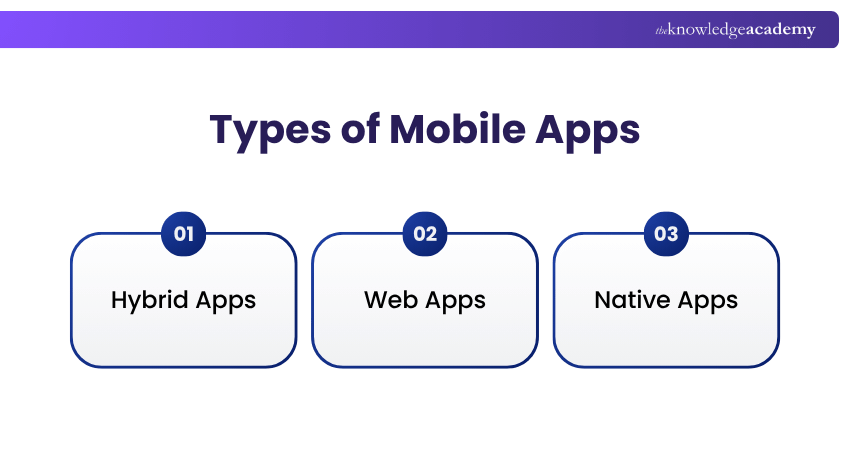
There are three main types of mobile apps: Hybrid apps, web apps, and native apps. Each type of mobile app has its own characteristics, advantages, and disadvantages.
1) Hybrid Apps
Hybrid apps are mobile apps that are developed using web technologies, such as HTML, CSS, JavaScript, etc., and wrapped in a native container, such as Cordova, PhoneGap, etc. They can run on platforms like Android, iOS, Windows, etc., using the same code base. Hybrid apps can also access the device’s native features, such as the camera, the microphone, the GPS, etc., using plugins or APIs.
Hybrid apps are easier and faster to develop and maintain than native apps, as they require less code and resources. However, hybrid apps may have lower performance, user experience, and security than native apps, as they rely on a web view to render the App’s interface and functionality.
Trainer Insight
A mobile app does not necessarily perform everything locally. Many apps combine functionality on the device with data and services provided by remote servers.
2) Web Apps
Web apps are mobile apps that are accessed through a web browser, such as Chrome, Safari, Firefox, etc. Web apps are developed using web technologies, such as HTML, CSS, JavaScript, etc., and hosted on a web server. They can run on any device with a web browser, regardless of the operating system or the screen size. Web apps do not require downloading or installing, as they are available online.
Web apps are also easier and cheaper to develop and update than native apps, as they do not require App store approval or distribution. However, they may have limited functionality, user experience, and security compared to native apps, as they cannot access the device’s native features, such as the camera, microphone, GPS, etc., or work offline.
Learn Flutter and discover how to turn your creative ideas into dynamic mobile applications with the Mobile App Development Training Using Flutter – Sign up now!
3) Native Apps
Native apps are mobile apps developed using programming languages and tools specific to a particular platform, such as Java or Kotlin for Android and Swift or Objective-C for iOS. Unlike Web Apps, which run in a browser, native apps can operate only on devices that support the platform they are built for. They can also access the device’s native features, such as the camera, microphone, and GPS, through the platform’s SDKs or APIs.
Native apps stand out for their superior performance, user experience, and security, as they are optimised for the device’s hardware and software. However, they are more complex and costly to develop and maintain than hybrid or Web Apps due to the need for extensive coding, resources, and expertise. Additionally, native apps require App Store approval and distribution, which can involve time and financial investment, along with the use of mobile app testing tools to ensure app quality before submission.
Pro Tip
Request only the device permissions an app genuinely needs. Limiting unnecessary access can improve privacy and make permission requests easier for users to understand.
Advantages of Mobile Apps
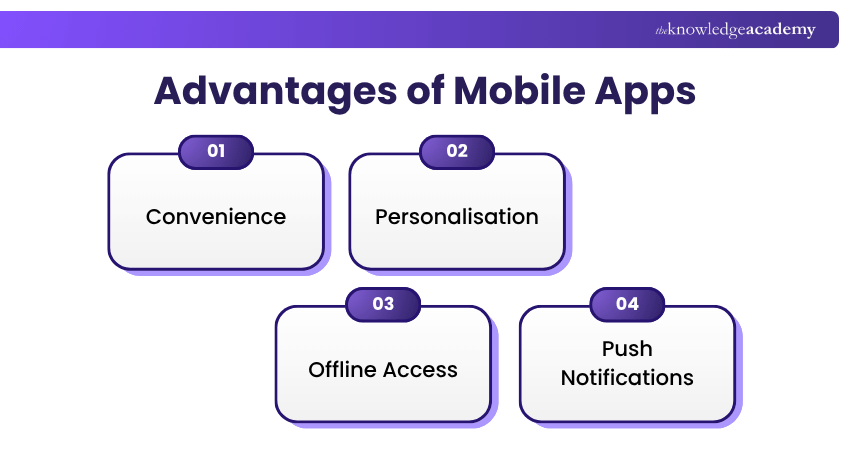
Mobile apps have many advantages over websites or software programs, such as:
1) Convenience
Mobile apps are more convenient than websites or software programs, as they are always accessible on the device without the need to open a web browser or a computer. Mobile apps can also work offline, without needing an internet connection, using the device’s storage or cache. Mobile apps can also provide faster and smoother functionality, as they do not depend on the web server’s speed or availability.
2) Personalisation
Mobile apps are more personalised than websites or software programs, as they can tailor the App’s content, features, and appearance to the user’s preferences, behaviour, and location. Mobile apps can also use the device’s data, such as contacts, the calendar, photos, etc., to enhance the App’s functionality and relevance. Mobile apps can also create user profiles, accounts, or settings to store the user’s information and preferences.
3) Offline access
Mobile apps can provide offline access to the App’s content and features without the need for an internet connection by using the device’s storage or cache. It can be useful for users with limited or unreliable internet access or who want to save their data or battery. Mobile apps can also synchronise the offline data with the online data when the internet connection is restored to ensure the App’s accuracy and consistency.
4) Push notifications
Mobile apps can send push notifications to the user’s device to inform them of new updates, offers, messages, etc. Push notifications can increase the user’s engagement and retention, as they can prompt the user to open the App or take an action. Push notifications can also be customised and personalised to suit the user’s interests and preferences.
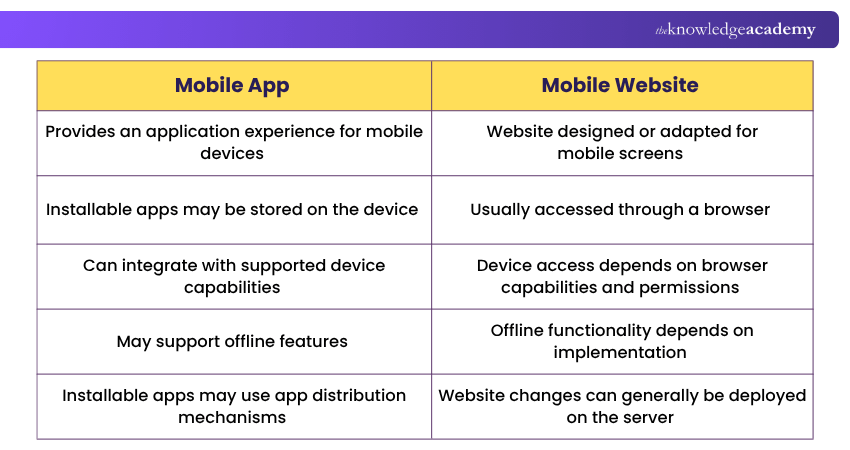
A firm grasp on the key differences between a mobile app and a mobile website is crucial here. They both provide experiences on smartphones and tablets, but they differ in how users access them and how they interact with devices:
Disadvantages of Mobile Apps
Mobile apps also have some disadvantages over websites or software programs, such as:
1) Limited Functionality
Mobile apps may have limited functionality than websites or software programs, as they may not be able to perform complex or intensive tasks, such as video editing, data analysis, etc. Mobile apps may also have limited compatibility with other devices, platforms, or software, as they may not be able to share or transfer data, files, or formats easily or accurately.
2) Limited Compatibility
Mobile apps may have limited compatibility with other devices, platforms, or software, as they may not be able to run on all types of devices, such as laptops, desktops, smart TVs, etc. Mobile apps may also have to be developed separately for each platform, such as Android, iOS, Windows, etc., which may increase the development time and cost. Mobile apps may also have to be updated frequently to keep up with the changes and updates of the platforms, devices, or software.
3) Security Concerns
Mobile apps may have security concerns, as they may be vulnerable to hacking, malware, viruses, etc., especially if they are downloaded from untrusted sources or use unsecured networks or servers. Mobile apps may also pose privacy risks, as they may access or collect the user’s personal or sensitive data, such as the location, contacts, photos, etc., without the user’s consent or knowledge. Mobile apps may also require permissions, such as the camera, the microphone, the GPS, etc., which may compromise the user’s security or privacy.
4) Limited Updating Capability
Mobile apps may have limited updating capability, requiring the user’s approval or action to download or install the updates, which may take time and space. Mobile apps may also have to go through the App store’s review and approval process, which may delay or reject the updates, depending on the App store’s policies and standards. They may also have to deal with the user’s feedback or ratings, which may affect the App’s reputation or popularity.
Trainer Insight
Launching an app is only one stage of its lifecycle. Mobile Apps often require ongoing testing, security updates, compatibility checks and improvements as operating systems and devices evolve.
Examples of popular Mobile Apps
There are many examples of popular mobile apps that perform various functions, such as gaming, social networking, education, entertainment, productivity, and more. Some of the examples are:
1) Microsoft Word
Microsoft Word is a mobile app that allows the user to create, edit, view, and share documents, such as letters, resumes, reports, etc. Microsoft Word is a native App that was developed for both Android and iOS platforms.
Microsoft Word can access the device’s features, such as the camera, the microphone, the keyboard, etc., to enhance the document’s functionality and quality. Microsoft Word can also sync with the cloud, such as OneDrive, Dropbox, etc., to store and access documents online.
INFO
Apple, Google, Microsoft, Amazon, Gameloft and Netflix are among the top players in the global mobile app market.
2) Adobe Photoshop
Adobe Photoshop is a mobile app that allows the user to edit, enhance, and transform photos, such as cropping, resizing, filtering, retouching, etc. Adobe Photoshop is a native App that was developed for both Android and iOS platforms.
As one of the most innovative Ideas for Apps, Adobe Photoshop can access the device’s features, such as the camera, the gallery, the storage, etc., to import and export the photos. Adobe Photoshop can sync with the cloud, such as Adobe Creative Cloud, Google Photos, etc., to back up and share photos online.
3) Text Grabber
Text Grabber is a mobile app that allows users to scan, recognise, and translate text from any printed source, such as books, magazines, signs, etc. Text Grabber is a hybrid App developed using web technologies and wrapped in a native container. Text Grabber can run on multiple platforms, such as Android, iOS, Windows, etc., using the same code base.
Text Grabber can access the device’s features, such as the camera, the microphone, the speaker, etc., to capture and convert the text. Text Grabber can also communicate with external servers, such as Google Translate, Bing Translator, etc., to translate the text into different languages.
Master Kotlin and develop powerful, responsive mobile applications in no time. Sign up for the Kotlin Mobile App Development Training now!
4) Spotify
Spotify is a mobile app that allows users to stream, download, and discover music, podcasts, and videos from various genres, artists, and playlists. Spotify is a web App that is accessed through a web browser. Spotify is developed using web technologies, such as HTML, CSS, JavaScript, etc., and hosted on a web server.
Spotify can run on any device with a web browser, regardless of the operating system or the screen size. Spotify does not require downloading or installing, as it is available online. Spotify can also communicate with external servers, databases, APIs, etc., to access or store data, such as user information, music files, etc.
5) Capital One
Capital One is a mobile app that enables users to manage their bank accounts, credit cards, loans, and investments anytime and anywhere. As a native app developed for Android and iOS platforms, how to create an iOS app, Capital One seamlessly integrates with device features like fingerprint authentication, face ID, and the camera for secure user verification.
Additionally, it leverages advanced functionalities such as encryption, caching, and synchronisation to enhance both performance and security. Capital One also offers automatic or manual updates based on user preferences and app settings.
Mobile App Selection Checklist
Before selecting an approach, ask:
□ Which platforms must the app support?□ Does it require extensive device integration?□ How important is platform-specific performance?□ Does it need offline functionality?□ Will users install it or access it through a browser?□ What development resources are available?□ How frequently will features change?□ What security and privacy requirements apply?□ How will the app be tested and maintained?□ How will updates reach users?

Richard Harris creates technically detailed yet accessible content on full-stack development, software architecture and modern development frameworks. His knowledge of frontend and backend technologies helps developers understand how scalable, efficient and high-performing applications are designed and built.
View Detail

 If you wish to make any changes to your course, please


