




We may not have the course you’re looking for. If you enquire or give us a call on 01344203999 and speak to our training experts, we may still be able to help with your training requirements.
3 P's of Public Speaking: A Step-By-Step Guide
ByAkhil KLast updated on: 02 October 2026
The 3 P’s of public speaking, namely preparation, practice and performance, provide a simple framework for becoming a more effective speaker.

You are to present a new project proposal to senior leaders next week. You know the subject well. You have the data. You even have a few slides ready. But as the presentation gets closer, questions start appearing.
□ What should I include?
□ How much should I practise?
□ What if I forget something?
□ What if someone asks a question I wasn't expecting?
Knowing your subject is important, but effective public speaking involves much more. You need to prepare a message that suits your audience, practise delivering it clearly and perform confidently when the moment arrives.
That's where the 3 P’s of public speaking (preparation, practice and performance) can help. Together, they provide a practical framework for moving from your first idea to the final delivery.
What is Public Speaking?
Public speaking is the act of delivering a message to an audience in a clear and engaging manner. It can involve communicating information, ideas or opinions to inform, inspire, entertain or influence listeners. It is used in many settings, including business presentations, academic environments, community gatherings and professional events.
Effective public speaking involves understanding what you want to communicate and presenting that message in a way your audience can follow. Preparation, deliberate practice and confident performance can help speakers communicate their ideas more effectively and build credibility with an audience.

What are the 3 P’s of Public Speaking?
The 3 P’s of public speaking are:
Preparation → Practice → Performance
Each represents a different stage of developing and delivering a speech. Let's explore each one in detail:
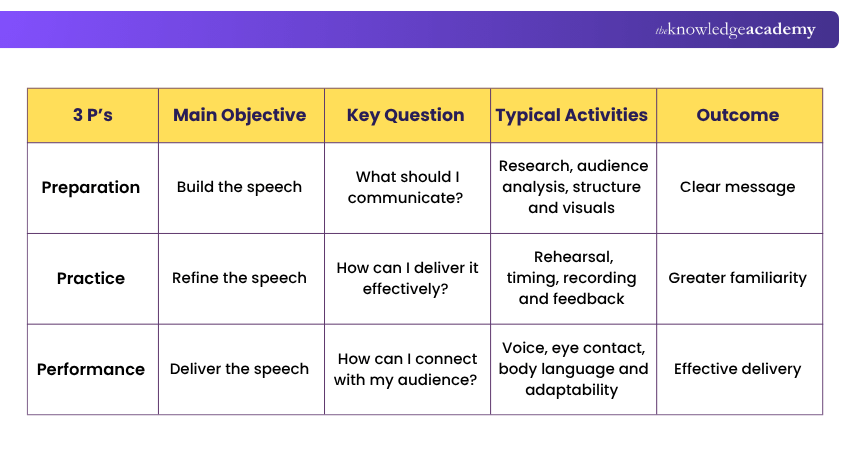
1) Preparation
Preparation lays the foundation for an effective speech. It involves understanding your audience, identifying your purpose, researching your subject and organising your ideas before you begin rehearsing. Good preparation can make the later stages easier because you know what you want to communicate and why it matters.
Here are six important areas to consider:
a) Understand Your Audience
Think about your audience's needs, interests, expectations and existing knowledge. Your content should be relevant to the people listening rather than designed only around what you want to say. Understanding the audience can also help you choose appropriate examples, terminology and levels of detail.
b) Set Clear Objectives
Decide what you want the speech to accomplish. Ask yourself: “What should my audience know, feel or do after listening to me?” A clear objective can help you decide what information belongs to the presentation and what can be removed.
c) Research the Topic
Gather accurate and reliable information to support your message. Depending on the subject, this might include credible sources, evidence, examples or interviews. Research strengthens your understanding of the topic and can improve the credibility of the points you make.
Learn how to express your thoughts clearly and handle difficult conversations professionally with our Assertiveness Skills Training – Sign up now!
d) Structure Your Speech
Organise your ideas logically. A simple structure could be:
Opening → Main Points → Conclusion
Your opening introduces the subject and captures attention. The body develops your key ideas, while the conclusion reinforces the central message.
e) Create Useful Visuals
Slides, charts, images or props can support a speech when they help explain information or make an idea easier to understand.
Visuals should support your message rather than compete with it. Avoid adding information simply to fill a slide.
f) Anticipate Questions
Consider what your audience might ask after or during the speech. Prepare concise answers to likely questions and identify areas where your audience may need clarification. This can make you better prepared for the discussion that follows.
Speech Preparation Checklist
Before moving to practice, check:
□ Audience: Do I know who I'm speaking to?□ Purpose: Is the objective of my speech clear?□ Message: What should listeners remember?□ Structure: Does the speech flow logically?□ Evidence: Are my important points properly supported?□ Visuals: Do they genuinely help the audience?□ Questions: What might listeners ask me?
2) Practice
Once your speech is prepared, the next P is Practice. Practice helps you grow more familiar with your content, improve fluency and develop a smoother delivery. It also gives you an opportunity to identify problems before you speak in front of the actual audience.
Here are some useful ways to practise:
a) Rehearse Your Speech
Deliver the speech aloud several times rather than simply reading through your notes. Rehearsing can help you become familiar with the sequence of ideas and identify sections that sound unnatural or difficult to explain.
b) Check Your Timing and Pace
Time the complete speech during rehearsal. Make sure it fits within the allocated period without forcing you to rush. Practise using appropriate pauses so listeners have time to absorb important information.
c) Practise Vocal Variety and Body Language
Experiment with your tone, volume and emphasis. Also consider your gestures, facial expressions and movement. These elements can support your message and make your delivery more engaging when used naturally.
d) Seek Feedback
Ask family members or friends you trust to listen to your speech and deliver constructive feedback. They may identify unclear explanations, distracting habits or sections that need more detail. Public speaking groups and workshops can also provide opportunities to practise in front of others.
e) Record Yourself
Record one of your rehearsals and review it afterwards. Pay attention to your tone, pace, body language and overall delivery. Look for specific areas you can improve during your next attempt.
f) Practise With Other Speakers
Public speaking groups or clubs can provide opportunities to speak in front of an audience, get feedback and observe how other speakers communicate.
Pro Tip
Reading your speech silently is not the same as rehearsing it. Practise aloud so you can hear awkward wording, test your pacing and discover where natural pauses should occur.
3) Performance
Performance is the point where your preparation and practice come together. Once you stand before the audience, your focus shifts from developing and rehearsing the speech to delivering the message and connecting with listeners.
Here are several areas to focus on:
a) Start With Confidence
Give yourself a moment before beginning. Establish your position, look towards the audience and deliver your opening clearly rather than rushing into the first sentence. A composed start can help establish the tone for the rest of your speech.
b) Connect With Your Audience
Use eye contact, empathy and relevant storytelling to build a connection with listeners. Pay attention to audience reactions as well. Public speaking is not simply about delivering memorised words. It involves communicating with the people in front of you.
c) Manage Your Voice and Body Language
Apply the techniques you developed during practice. Use an appropriate speaking pace, vary your tone where necessary and use natural gestures to reinforce important ideas.
d) Adapt to the Situation
Presentations do not always go exactly as planned. You may receive an unexpected question, have less time than expected or need to clarify a point. Being prepared to adapt can help you continue without losing the main direction of your speech.
e) Finish With a Strong Closing
Use your conclusion to reinforce the main message you want listeners to remember. Depending on the purpose of the speech, your closing might summarise key points, provide a recommendation, encourage action or leave listeners with a memorable thought.
Master the art of influence and persuasion with negotiation skills training. Sign up for our Negotiation Skills Training now!

Akhil K is a Copywriter and Video Editor with experience in content creation, visual storytelling, advertising and brand communication. His background in journalism, research and audience-focused communication strengthens his ability to create clear and engaging Business Skills content.
View Detail

 If you wish to make any changes to your course, please


