


 Top Rated Course

We may not have the course you’re looking for. If you enquire or give us a call on 01344203999 and speak to our training experts, we may still be able to help with your training requirements.
10 Benefits of Blockchain: How it’s Transforming Business
Richard Harris 26 August 2026Discover the 10 key Benefits of Blockchain, from improved transparency and security to faster processes, traceability and automation across industries.

Training Outcomes Within Your Budget!
We ensure quality, budget-alignment, and timely delivery by our expert instructors.
Table of Contents
Key Takeaways
1. Blockchain can provide shared records that improve transparency, traceability and trust between authorised parties.2. Cryptographic linking and distributed records can make Blockchain data tamper-evident and resistant to unauthorised changes.3. Blockchain can support faster workflows, automation and reduced reliance on manual reconciliation in suitable use cases.4. Its benefits extend beyond cryptocurrency into areas such as finance, healthcare, supply chains and records management.
Imagine two businesses need to verify the same transaction, but each keeps its own records. They spend time comparing data, resolving discrepancies and relying on intermediaries to confirm what happened.
What if they could work from a shared record that is difficult to alter?
That is where Blockchain can add value. By distributing records across a network, it can support trust, traceability, and data integrity. The real question isn't whether Blockchain is secure or trendy, it's where it actually makes a measurable difference.
What is Blockchain?
Blockchain is a shared digital record system where information and transactions are stored in connected, cryptographically secured blocks. The ledger can be replicated across many network nodes, while established consensus and verification mechanisms determine how new information is accepted and recorded.
Unlike a conventional database managed through a central repository, Blockchain can allow multiple parties to share and verify records without relying on a single organisation to maintain the complete record. The exact structure varies between Blockchain networks, including whether they are public or permissioned.

10 Key Benefits of Blockchain
Blockchain does not automatically make every process faster, cheaper, or more secure. Its value comes from applying its characteristics to problems where they provide a meaningful advantage. Here are the key Benefits of Blockchain:
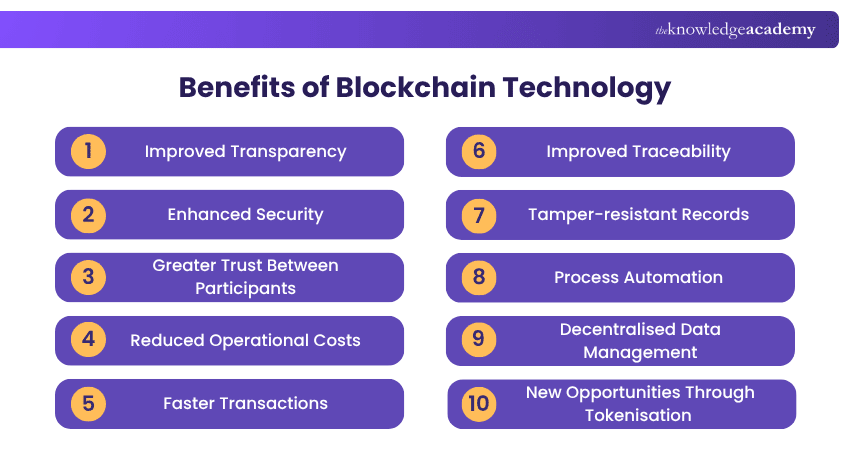
1) Improved Transparency
Blockchain can give authorised network participants a shared view of recorded transactions. This can make it easier to verify what has happened and establish a consistent record across organisations.
However, transparency depends on the type of Blockchain and its access controls. A permissioned Blockchain, for example, does not necessarily make all information publicly visible.
2) Enhanced Security
Blockchain uses cryptographic techniques, distributed records and consensus mechanisms to protect the integrity of transactions. Changing an earlier record can affect its cryptographic links with later records, making unauthorised modification detectable.
This does not mean Blockchain is impossible to attack. Security also depends on the network design, applications, access controls and how private keys are managed.
Myth vs Fact
Myth: Blockchain makes all information publicly visible.Fact: Visibility depends on the type of Blockchain and its access controls. Permissioned Blockchains can restrict who can access certain information.
3) Greater Trust Between Participants
When organisations need to exchange information but do not fully trust one another, a shared ledger can provide a common record against which transactions can be verified.
This can reduce disputes caused by different versions of the same information and provide greater confidence in the integrity of shared records.
4) Reduced Operational Costs
Blockchain can potentially reduce costs where it removes unnecessary reconciliation, manual verification or intermediary processes.
For example, if several parties previously maintained separate records and repeatedly reconciled them, a shared ledger could reduce some of that duplicated work. The actual savings depend on the use case and the cost of implementing and maintaining the Blockchain.
5) Faster Transactions
Blockchain can streamline certain processes by reducing manual checks and enabling transactions to be validated and recorded through predefined network processes.
The improvement is use-case dependent. Blockchain networks can also face throughput and latency limitations, so it would be inaccurate to claim that Blockchain transactions are always faster than conventional systems.
6) Improved Traceability
Blockchain can create a persistent record of transactions or asset movements, helping organisations follow an item or transaction across different stages.
This can be particularly useful in supply chains, where traceability can help organisations identify where an item originated, which parties handled it and where delays or discrepancies occurred.
7) Tamper-resistant Records
Blockchain records are designed to be tamper-evident and tamper-resistant. Cryptographic links between blocks mean that changing historical information can be detected, while the distributed nature of many Blockchain systems makes unauthorised alteration more difficult.
This characteristic can be valuable when organisations need reliable historical records for auditing, verification or tracking.
8) Process Automation
Blockchain can support smart contracts, which are software-based mechanisms that can execute actions when predefined conditions are met.
For example, a smart contract could trigger a transaction when specified conditions have been verified. This can reduce manual intervention in suitable workflows, although the reliability of the outcome still depends on the rules and external data used by the application.
9) Decentralised Data Management
Blockchain can distribute copies of a ledger across participating nodes rather than relying on one central repository.
This can reduce dependence on a single point of control and support shared record-keeping between multiple organisations. However, decentralisation is not absolute across every Blockchain, particularly in permissioned implementations.
Redefine digital trust by building scalable dApps. Our comprehensive Ethereum Developer Training will show you how - Join now!
10) New Opportunities Through Tokenisation
Blockchain can represent ownership or other rights through digital tokens. Tokenisation can support new ways of recording, transferring and managing digital representations of assets.
For example, tokenisation is being explored in areas such as financial assets and digital ownership. Its practical value depends on the underlying asset, legal framework and technology used.
Test Your Understanding
A manufacturer wants several suppliers to share one trusted record of a component's journey from production to delivery. Which Blockchain benefit is most directly relevant?A. TraceabilityB. TokenisationC. Process automationAnswer: A. Traceability
Blockchain Applications Across Several Industries
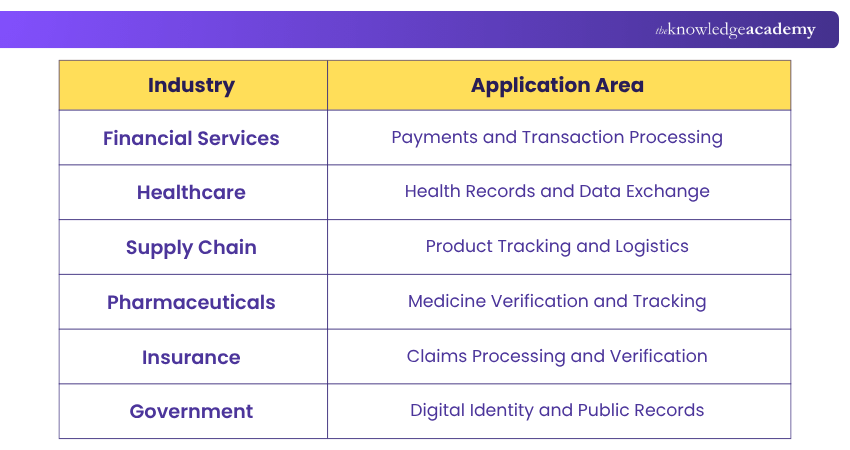
The Benefits of Blockchain can be applied in different ways depending on the requirements of an industry. From verifying transactions in finance to tracking products through a supply chain, the same core strengths, shared records, traceability and tamper resistance, translate differently depending on what a sector actually needs.
Here's a look at where those benefits show up in practice:
Limitations of Using Blockchain
Blockchain offers valuable capabilities, but organisations should not treat it as a universal replacement for conventional databases or other technologies. Here are some of the disadvantages of it:
1) Scalability and Performance
Some Blockchain networks can experience limitations in transaction throughput, processing time and network capacity. The performance of a Blockchain depends heavily on its architecture and consensus mechanism.
2) Implementation Costs
Developing, integrating and maintaining a Blockchain solution can require investment in infrastructure, development, security and specialist skills. A Blockchain project may therefore cost more than an existing database solution if its unique capabilities are not necessary.
3) Integration With Existing Systems
Organisations may need to connect Blockchain networks with existing databases, applications and business processes. Poor integration can create additional complexity rather than simplifying operations.
4) Privacy Considerations
Blockchain's transparency and persistence can create challenges when information needs to remain confidential or be modified or deleted. NIST notes that some Blockchain characteristics can conflict with the requirements of applications where controlled access, privacy or data modification are important.
5) Regulatory Uncertainty
Blockchain applications will be subject to varying legal, regulatory, and compliance obligations based on industry and jurisdiction. Organisations should carefully review these requirements before adopting the technology.
6) Energy Consumption Can Vary
Energy use is not the same across all Blockchain systems. Some proof-of-work networks require substantial computational resources, while other consensus mechanisms can have very different energy requirements. Therefore, it is inaccurate to describe Blockchain technology as universally energy-intensive.
Pro Tip:
Ask “Why Blockchain?” before asking “How do we implement Blockchain?”If a conventional database can solve the problem more simply, Blockchain may not be necessary. Blockchain is most valuable when shared trust, traceability or tamper resistance is essential.
Conclusion
The Benefits of Blockchain come from its ability to provide shared, tamper-resistant records and support transparency, traceability, security and automation. However, these advantages are not universal, so organisations should assess their specific requirements, costs, privacy needs and technical environment before adopting Blockchain.
Master the tech behind crypto, smart contracts and digital transformation. Sign up for our range of Blockchain Courses now!
Frequently Asked Questions
Is Blockchain the Same as a Database?

No. Blockchain is a type of distributed ledger technology with characteristics such as cryptographic linking, consensus and tamper resistance. Traditional databases can generally provide greater flexibility for modifying, deleting and querying data, depending on their design.
What is the Difference Between Blockchain and Cryptocurrency?
Blockchain is the underlying technology used by many cryptocurrency systems, whereas cryptocurrency is a digital asset or form of digital money. Blockchain also has applications beyond cryptocurrency, including supply chains, identity and records management.
What is a Public Blockchain?
A public Blockchain is generally designed to allow a broad group of participants to access and participate in the network according to its rules. Bitcoin and Ethereum are examples of public Blockchain networks.
Can Blockchain Data Ever Be Changed?
Blockchain makes records difficult to alter, but "immutable" doesn't mean change is impossible. This depends on architecture, governance and consensus rules. The National Institute of Standards and Technology (NIST) therefore describes Blockchain records as tamper-evident and tamper-resistant, rather than simply impossible to change.

Richard Harris


Senior Full Stack Developer and Technology Educator
Richard Harris is a highly experienced full-stack developer with deep expertise in both frontend and backend technologies. Over his 12-year career, he has built scalable web applications for startups, enterprises and government organisations. Richard’s writing combines technical depth with clear explanations, ideal for developers looking to grow in modern frameworks and tools.


 If you wish to make any changes to your course, please


