


 Top Rated Course

We may not have the course you’re looking for. If you enquire or give us a call on 01344203999 and speak to our training experts, we may still be able to help with your training requirements.
Top 10 Scaled Agile Framework Tools for Modern Teams
David Evans 29 August 2026Scaled Agile Framework tools can support organisations with PI Planning, portfolio visibility, dependency management, Agile Release Train coordination and team delivery. This blog compares ten platforms that can support different parts of a SAFe environment.

Training Outcomes Within Your Budget!
We ensure quality, budget-alignment, and timely delivery by our expert instructors.
Table of Contents
Key Takeaways
1. SAFe tools help coordinate Agile work across teams, programmes, portfolios, and value streams.2. Enterprise Agile platforms can support PI Planning, roadmaps, dependencies, capacity, and portfolio visibility.3. Jira Align, Rally, Digital.ai Agility, Targetprocess, and Planview are among the platforms used for enterprise Agile planning.4. Different tools serve different purposes, so organisations should evaluate them based on their specific scaling requirements.5. Integration, reporting, strategic alignment, scalability, and dependency management are important factors when choosing a tool.
A SAFe tool should do more than move cards from To Do to Done. At enterprise scale, organisations may need to connect strategy with portfolios, coordinate Agile Release Trains, identify dependencies, plan capacity and understand delivery progress.
Different platforms support different parts of this challenge. Some provide explicit SAFe support, while others offer broader Agile, portfolio or delivery capabilities that can be configured to work within a SAFe environment.
This blog compares ten tools, what each does best and where they can fit from enterprise strategy through to team delivery.
What is Scaled Agile Framework (SAFe)?
The Scaled Agile Framework (SAFe) is a framework for applying Lean, Agile, and DevOps practices across large organisations. It provides principles, practices, roles, events, and guidance for coordinating work across Agile teams, Agile Release Trains (ARTs), value streams, and portfolios.
SAFe helps connect strategy with execution while addressing areas such as PI Planning, product development, built-in quality, Lean Portfolio Management, and continuous delivery.

What Should a SAFe Tool Support?
The right tool depends on how an organisation applies SAFe and which parts of planning and delivery need support. Common capabilities to evaluate include:
1) PI Planning and Roadmapping: Support planning across Agile Release Trains, upcoming work, objectives and delivery roadmaps.
2) Dependency Management: Make dependencies between teams, features and work items easier to identify and coordinate.
3) Portfolio Visibility: Provide visibility into initiatives, epics, progress, investments and priorities across portfolios and value streams.
4) Strategic Alignment: Connect delivery work with wider business objectives and portfolio priorities.
5) Capacity Planning: Help teams and programme-level roles understand available capacity and balance planned work.
6) Reporting and Flow Metrics: Provide dashboards and metrics covering progress, flow, risks, dependencies and delivery outcomes.
7) Toolchain Integration: Connect planning with development, testing, collaboration and DevOps tools so information can move across the delivery lifecycle.
Integrate DevOps principles within the Scaled Agile Framework with our SAFe® DevOps Certification - Register today!
Top Tools that Can Support Scaled Agile Framework (SAFe)
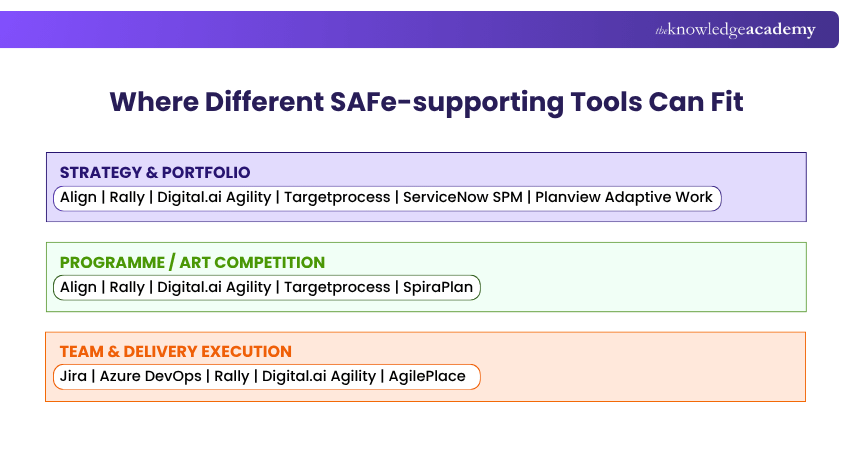
Organisations using SAFe may rely on different platforms for strategy, portfolio planning, programme coordination and team delivery. The tools below support different parts of scaled Agile work, although their level of SAFe-specific functionality varies.
The right choice depends on factors such as organisational scale, existing toolchain, portfolio needs, planning structure and integration requirements.
1) Planview AdaptiveWork
Planview AdaptiveWork is the current name for the platform previously known as Clarizen. It provides collaborative work and portfolio management capabilities for organisations managing complex initiatives.
Its strengths are broader work and portfolio management rather than SAFe-specific functionality, so organisations should assess whether its capabilities match their particular scaled Agile operating model.
Key capabilities include:
1) Portfolio management
2) Resource and capacity planning
3) Roadmapping
4) Work management
5) Financial planning
6) Reporting and analytics
7) Workflow automation
8) Cross-team visibility
AdaptiveWork can be useful where organisations need to coordinate resources, portfolios, and complex work alongside Agile delivery.
2) Targetprocess
Targetprocess is a visual enterprise Agile planning platform within IBM's Apptio portfolio. It can help organisations connect strategy, portfolio planning, and execution while visualising work across multiple organisational levels.
Its configurable approach allows organisations to model different portfolio structures and Agile ways of working rather than relying on a single fixed workflow.
Key capabilities include:
1) Strategic and portfolio planning
2) Visual roadmaps
3) Portfolio and programme visibility
4) Capacity planning
5) Dependency management
6) Custom dashboards
7) Agile metrics and reporting
8) Integration with development tools
Targetprocess can suit organisations that require highly visual and configurable enterprise planning.
3) Digital.ai Agility
Digital.ai Agility is an enterprise Agile planning and portfolio management solution that supports scaling Agile from individual teams through programmes and portfolios.
Importantly for this blog, Digital.ai explicitly supports SAFe as well as Scrum, Kanban, hybrid approaches, and customised Agile frameworks.
Key capabilities include:
1) Portfolio planning
2) Strategic roadmaps
3) PI and increment planning
4) Capacity planning
5) Dependency management
6) OKR support
7) Dashboards and analytics
8) Cross-team collaboration
9) DevOps integrations
Digital.ai Agility also provides PlanningRooms for distributed planning sessions and specifically supports Program Increment planning for SAFe environments.
4) Rally
Rally is Broadcom's Enterprise Agile Management platform and forms part of the ValueOps platform. It is designed to connect portfolios, programmes, products, and teams with organisational strategy.
Rally supports planning and tracking across multiple teams and enterprise Agile structures while providing visibility into dependencies, priorities and delivery progress. Its portfolio-level capabilities can support organisations applying SAFe where teams need to connect execution with strategic and investment priorities.
Key capabilities include:
1) Enterprise Agile planning
2) Capacity management
3) Portfolio visibility
4) Backlog and product management
5) Dependency and risk management
6) Agile metrics and reporting
7) Strategic alignment
8) Integration with development and enterprise tools
Rally can be particularly useful for organisations that need to connect large-scale Agile execution with strategic portfolio management.
Tool Lens
Rally is less about giving one Scrum team another board and more about making work visible across teams, programmes and portfolios. That distinction becomes increasingly important as Agile moves from team coordination to enterprise coordination.
5) ServiceNow Strategic Portfolio Management
ServiceNow Strategic Portfolio Management (SPM) helps organisations connect strategy, investments, planning, and execution. Its portfolio capabilities can complement scaled Agile environments where organisations need visibility beyond individual development teams.
Key capabilities include:
1) Strategic planning
2) Portfolio management
3) Demand management
4) Roadmapping
5) Investment and resource visibility
6) Agile work management
7) Performance reporting
8) Enterprise workflow integration
ServiceNow can be particularly relevant to organisations already using the ServiceNow ecosystem and looking to connect strategic planning with operational and delivery workflows.
Explore how Agile Release Trains deliver value within large organisations with our Certified SAFe® for Teams Course – Sign up now!
6) SpiraPlan
SpiraPlan from Inflectra is a project and portfolio management platform that supports Agile and other delivery approaches. It provides requirements, planning, task, risk, and reporting capabilities within a centralised environment.
For organisations applying scaled Agile approaches, it can help connect requirements and delivery information while maintaining visibility across projects and portfolios.
Key capabilities include:
1) Portfolio management
2) Requirements management
3) Release and iteration planning
4) Risk and issue management
5) Agile boards
6) Dependency tracking
7) Reporting and dashboards
8) Metrics such as velocity, burnup, and burndown
SpiraPlan can be useful where requirements, testing, project management, and Agile delivery information need to be closely connected.
7) Align (Formerly Jira Align)
Align is Atlassian's enterprise strategy and planning platform for connecting strategic objectives with portfolio, programme and team-level delivery.
It supports SAFe alongside other scaling approaches and hybrid operating models. Organisations can use it to manage areas such as portfolio planning, dependencies, capacity, roadmaps and strategic alignment.
Key capabilities include:
1) Portfolio and programme planning
2) Strategic alignment
3) Roadmaps
4) Capacity and investment planning
5) Cross-team dependency management
6) Risk tracking
7) Portfolio progress visibility
8) Backlog management
9) Integration with Jira and Azure DevOps
8) Azure DevOps
Microsoft Azure DevOps provides a collection of development services covering planning, source control, continuous integration, testing, and software delivery.
Azure Boards can be used to organise epics, features, user stories, backlogs, iterations, and teamwork. Organisations can configure these capabilities to support larger Agile structures and integrate planning with development activities.
Key capabilities include:
1) Backlog management
2) Sprint and iteration planning
3) Kanban boards
4) Work-item tracking
5) Dashboards and reporting
6) Source control
7) CI/CD pipelines
8) Testing
9) Development tool integration
Azure DevOps can support the team and development execution layer in a SAFe environment, particularly where organisations already use Microsoft's engineering toolchain. However, organisations requiring broader portfolio, investment or cross-ART visibility may need additional enterprise planning capabilities.
Trainer's Insight
Not every useful SAFe-supporting tool needs to be SAFe-specific. Azure DevOps can provide the execution layer for development teams while another platform provides enterprise portfolio and strategy visibility.
9) Jira
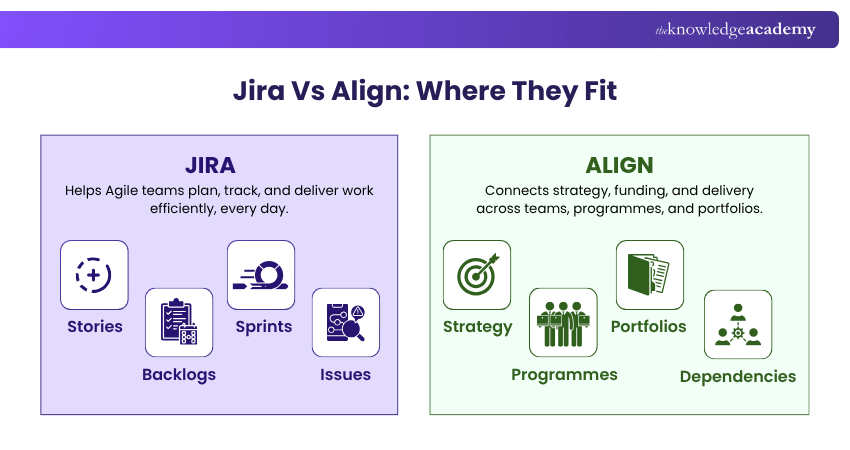
Jira is primarily a project and work management platform rather than a dedicated enterprise SAFe platform. However, it is widely used by Agile software teams for managing backlogs, sprints, workflows, issues, and delivery activities.
For organisations scaling Agile, Jira can act as the team-level execution layer while enterprise planning platforms such as Align provide broader programme and portfolio visibility.
Key capabilities include:
1) Scrum and Kanban boards
2) Backlog management
3) Sprint planning
4) Workflow management
5) Roadmaps
6) Reporting
7) Issue tracking and work-item relationships
8) Extensive integrations
The distinction between Jira and Align is important. Jira primarily supports team and project execution, while Align addresses strategy, portfolios, programmes, and enterprise-scale coordination.
10) Planview AgilePlace
Planview AgilePlace is an enterprise Kanban and Agile work management solution. It focuses on visualising work, improving flow, coordinating teams, and connecting delivery activities across the organisation.
Rather than acting as a replacement for SAFe practices, AgilePlace can support Lean and Agile ways of working within larger enterprise delivery environments.
Key capabilities include:
1) Enterprise Kanban boards
2) Work visualisation
3) Roadmapping
4) Dependency visibility
5) Flow management
6) Work-in-progress management
7) Metrics and analytics
It can be useful for organisations that place a 8) Cross-team coordinationstrong emphasis on Lean flow, Kanban, and visual management.
How Do These SAFe-supporting Tools Compare?
SAFe-supporting tools vary in scope, with some focusing on enterprise strategy and portfolio planning while others are stronger in programme coordination, team delivery or DevOps integration.
The table below compares these tools based on where they fit best and the level of SAFe support they provide.
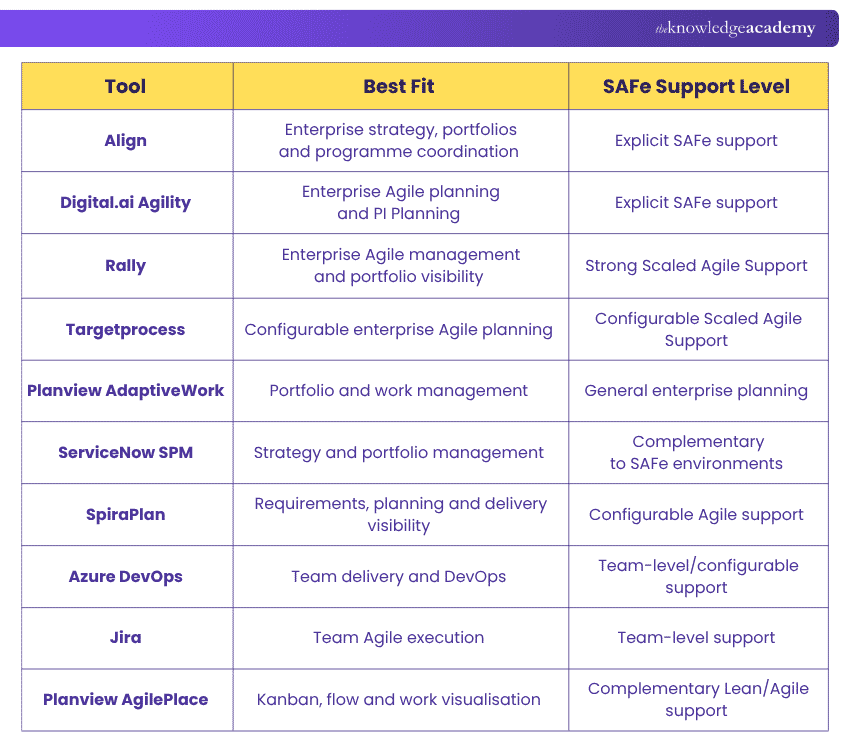
Please note: SAFe support varies by product and configuration. Organisations should confirm current vendor capabilities before selecting a platform.
How to Choose the Right SAFe Tool?
The best tool depends on the scale of your SAFe implementation, existing technology environment and the planning problems you need to solve. Consider the following:
1) Level of SAFe Support: Determine whether you need explicit SAFe constructs or a configurable Agile platform.
2) Planning Scope: Decide whether the tool needs to support teams, ARTs, portfolios or all three.
3) Dependency Management: Check how clearly cross-team and cross-programme dependencies can be identified and managed.
4) Strategic Alignment: Evaluate whether delivery work can be connected to objectives, investments and portfolio priorities.
5) Integration: Confirm whether the platform integrates with your existing development, testing, collaboration and DevOps tools.
6) Reporting and Visibility: Assess whether dashboards provide the level of information required by teams, programme roles and portfolio leadership.
7) Scalability and Governance: Consider how the platform handles multiple teams, products, value streams and organisational controls.
Pro Tip
Do not select a platform simply because it has the largest feature list. Start with the SAFe planning and coordination problems your organisation actually needs to solve, then evaluate which capabilities support those needs.
Conclusion
The right SAFe-supporting tool should help simplify planning, coordination and visibility across the levels where your organisation works. No single platform is automatically the best fit for every SAFe environment. The most suitable choice depends on your required planning scope, integrations, portfolio needs, dependency management and existing delivery toolchain.
Build your skills in Lean budgeting, portfolio governance and value stream coordination with our SAFe® Lean Portfolio Management Course – Join now!
Frequently Asked Questions
Do You Need a Dedicated SAFe Tool to Use SAFe?

No. Organisations can use general Agile, DevOps and portfolio tools to support parts of SAFe, provided they can configure them around the required planning and delivery practices. Dedicated enterprise Agile platforms may provide stronger support for areas such as portfolio alignment, PI Planning and cross-team coordination.
What is the Difference Between Jira and Align for SAFe?
Jira primarily supports team-level work such as backlogs, sprints, workflows, and issue tracking. Align extends visibility to programmes, portfolios, dependencies, investments, capacity, and strategic objectives. Atlassian explicitly lists SAFe among the frameworks supported by Align.
Can Jira and Azure DevOps be Used With Enterprise SAFe Tools?
Yes. Team-level platforms such as Jira and Azure DevOps can be integrated with enterprise planning tools so teams can continue managing day-to-day delivery while programme and portfolio stakeholders gain broader visibility into plans, dependencies and strategic alignment.

David Evans


Certified Project Trainer and Agile Delivery Expert
David Evans brings over a decade of hands-on experience in project delivery, Agile transformation, and team leadership. With a background in technology and business consulting, David has led cross-functional teams through Agile and Waterfall projects in both public and private sectors. He combines technical knowledge with practical insights to help readers navigate the challenges of modern project environments.


 If you wish to make any changes to your course, please


