


We may not have the course you’re looking for. If you enquire or give us a call on 01344203999 and speak to our training experts, we may still be able to help with your training requirements.
10 Best Crisis Management Tools for Business Continuity
ByNilotpal SarmahLast updated on: 02 November 2026
Explore 10 crisis management tools that help organisations identify threats, coordinate emergency responses and communicate during disruptions. Compare their key features, use cases and benefits to understand how different solutions support crisis preparedness and response.
Crisis Response at a Glance
1. Detect: Identify emerging threats, disruptions and potential incidents.2. Assess: Evaluate the severity and possible impact of the situation.3. Communicate: Share accurate information with affected stakeholders.4. Coordinate: Assign responsibilities and manage response activities.5. Recover: Restore operations and review lessons from the incident.
“One unexpected call. A dozen urgent questions. Who takes charge?”
It's 8:30 on a Monday morning, and that question suddenly becomes real. A manager receives a call: "We've got a serious problem, and it's affecting multiple teams." Within minutes, more questions arise. Who needs to be informed? How serious is the situation? What should happen next?
During such moments, clear information and coordinated action matter. Crisis management tools help organisations monitor threats, communicate with stakeholders and coordinate response activities rather than relying on scattered messages and manual updates.
This blog explores 10 crisis management tools, their features and practical uses to help you identify suitable options for your organisation. Let's dive in!
10 Best Crisis Management Tools
The following 10 tools support different aspects of crisis management, including emergency coordination, risk intelligence and emergency communication. Some offer comprehensive response capabilities, while others specialise in monitoring emerging threats and assessing their potential impact on business operations.
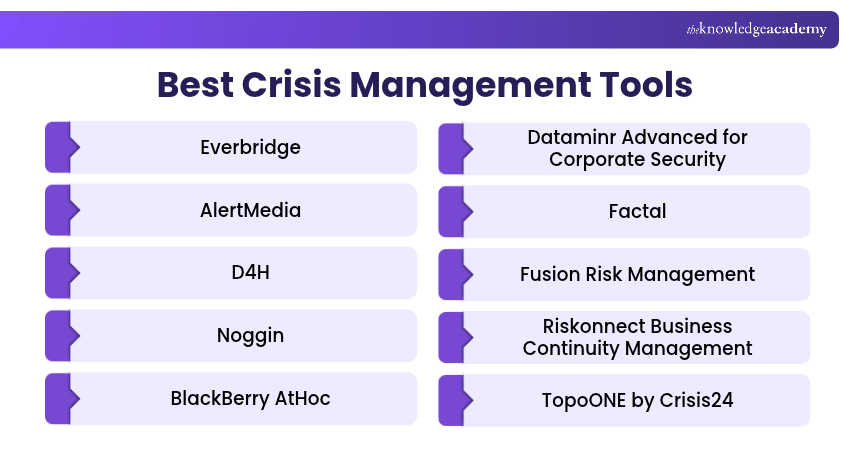
1) Everbridge
Everbridge is a Critical Event Management (CEM) platform that helps organisations prepare for, identify and respond to disruptive events. Its Everbridge 360 AI platform offers emergency communication, risk intelligence and crisis response capabilities, depending on the selected package.
Businesses can use Everbridge to assess threats affecting their employees, facilities and operations. For example, during severe weather, an organisation can identify affected locations, notify relevant personnel and coordinate its response through supported workflows.
Key Features:
a) Critical Event Management: Coordinate activities during disruptive incidents.
b) Risk Intelligence: Monitor potential threats and assess their operational impact.
c) Emergency Notifications: Distribute targeted messages through supported communication channels.
d) Response Workflows: Activate and manage predefined crisis response activities.
e) AI-assisted Analysis: Support threat assessment and communication preparation.
Best For: Large organisations managing complex emergencies across multiple locations or departments.
2) AlertMedia
AlertMedia is an emergency communication and risk intelligence platform that helps organisations identify threats, notify affected individuals and coordinate responses to critical events.
It is particularly useful for employee safety and emergency messaging, helping organisations contact affected individuals, collect responses and communicate updates as situations develop.
Key Features:
a) Emergency Notifications: Send urgent messages through supported communication channels.
b) Two-way Communication: Receive employee responses and safety confirmations.
c) Threat Intelligence: Monitor events that could affect people or business locations.
d) Targeted Messaging: Notify selected groups based on relevant criteria.
e) Notification Reporting: Review delivery and response information.
Best For: Organisations prioritising employee safety, emergency alerts and communication during critical events.
Crisis Response Example: Responding to a Weather Emergency
A company learns that severe flooding may affect one of its offices. It identifies employees working near the affected location and sends a safety notification.Employees confirm their status, while managers communicate alternative working arrangements and monitor the situation for further updates.This demonstrates how targeted alerts and two-way communication can support emergency coordination.
3) D4H
D4H provides software for emergency preparedness, incident management and operational coordination. Its incident management product, delivered through the D4H Operations Center platform, helps teams maintain a shared view of unfolding incidents.
Response teams can document events, assign tasks and maintain operational records in a central system. This can be useful when incidents involve several teams, changing circumstances or multiple response activities.
Key Features:
a) Incident Management: Coordinate activities and document incident developments.
b) Task Boards: Assign and monitor response responsibilities.
c) Forms and Logs: Record incident details, updates and important information.
d) Mapping Tools: View relevant geographical information.
e) Status Boards: Track important operational information.
Best For: Emergency response teams and organisations that require structured incident coordination and operational records.
Note
D4H also offers products for alerting, incident reporting, personnel management and equipment management. Access to these capabilities depends on the products selected.
4) Noggin
Noggin is an integrated resilience platform that supports crisis management, incident response, business continuity and emergency preparedness. It helps organisations organise response plans, coordinate teams and document important decisions during disruptive events.
Businesses can use Noggin to activate predefined response procedures, share situation updates and monitor assigned activities. Its integrated approach is particularly useful when crisis management involves several departments and business continuity responsibilities.
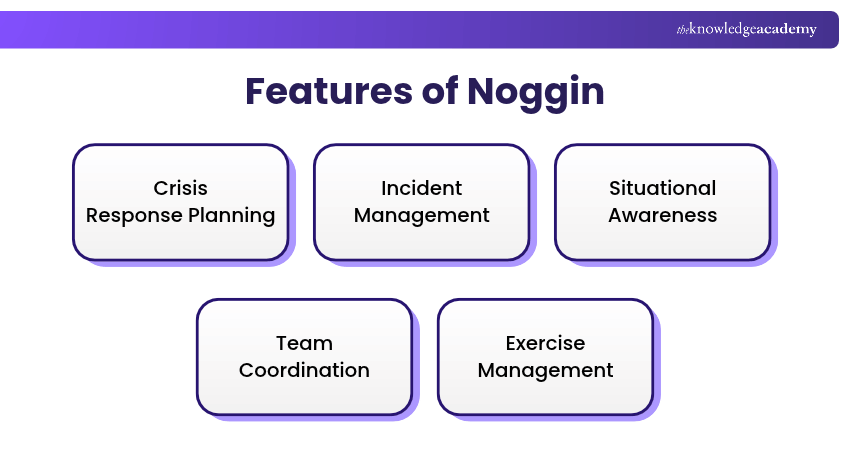
Key Features:
a) Crisis Response Planning: Create and manage response plans and checklists.
b) Incident Management: Record incidents and coordinate response activities.
c) Situational Awareness: View relevant information through dashboards and maps.
d) Team Coordination: Assign tasks, communicate updates and track responsibilities.
e) Exercise Management: Support practice scenarios and preparedness activities.
Best For: Organisations seeking a central platform for crisis management, response planning and business continuity coordination.
5) BlackBerry AtHoc
BlackBerry AtHoc is a critical event management and emergency communication platform that helps organisations deliver urgent notifications, maintain personnel accountability and coordinate responses during disruptive situations.
It supports communication across multiple channels and enables organisations to collect information from affected individuals. For example, during a workplace security incident, response teams can alert employees and review their reported safety status.
Key Features:
a) Emergency Alerting: Send targeted notifications through supported channels.
b) Two-way Communication: Collect responses and important updates.
c) Personnel Accountability: Monitor employee safety confirmations and status.
d) Incident Coordination: Support structured response activities.
e) Mobile Reporting: Collect information from employees and teams in the field.
Best For: Government organisations, large enterprises and teams requiring coordinated emergency communication and personnel accountability.
Trainer’s Insight: Define Approval Responsibilities
During a crisis, uncertainty about who can approve an emergency message may delay communication. Establish clear responsibilities for validating information, authorising alerts and escalating incidents before an emergency occurs.
6) Dataminr Advanced for Corporate Security
Dataminr Advanced for Corporate Security is an AI-powered risk intelligence platform that helps organisations identify emerging events and threats affecting their people, facilities and operations. It also provides AI-driven event corroboration, contextual intelligence and near-term threat predictions to support security decisions.
The platform analyses information from public data sources to identify potentially significant developments. Security and business continuity teams can use these insights to monitor events near company locations, assess disruptions and determine whether additional action is necessary.
Key Features:
a) Event Detection: Identify developing incidents and potential threats.
b) Location-based Intelligence: Monitor risks affecting relevant facilities and locations.
c) Agentic Corroboration: Use AI-assisted verification to corroborate emerging events and supporting information.
d) Near-term Predictive Intelligence: Analyse how emerging risks and threats might evolve and potentially affect people, facilities or operations.
e) Workflow Integration: Connect risk information with supported security and response systems.
Best For: Corporate security and business continuity teams requiring timely intelligence about external threats.
7) Factal
Factal is a risk intelligence platform that provides information about critical events affecting people, assets and business operations. It combines automated event detection with journalist-verified intelligence to help organisations evaluate important developments.
Security and risk management teams can use Factal to identify incidents near company facilities, monitor risks affecting travellers and investigate developing situations. Its intelligence can support decisions about employee safety and operational continuity.
Key Features:
a) Verified Event Intelligence: Access critical-event information checked by Factal's editorial team.
b) Event Alerts: Receive notifications about relevant developing incidents.
c) Location Monitoring: Identify threats near selected locations and assets.
d) Event Tracking: Follow updates as critical incidents unfold.
e) Intelligence Analysis: Explore historical and developing events using supported research capabilities.
Best For: Risk management, corporate security and business continuity teams assessing external threats.
8) Fusion Risk Management
Fusion Risk Management is an enterprise resilience platform that helps organisations prepare for, respond to and recover from disruptive events. It supports crisis management, incident coordination and business continuity planning.
The platform connects response plans, operational dependencies and recovery activities to help teams manage disruptions effectively. For example, during a major IT outage, organisations can identify affected services, activate response plans and coordinate recovery tasks.
Key Features:
a) Crisis Response Planning: Create and activate structured crisis and incident response plans.
b) Business Impact Assessment: Identify affected operations, systems and critical services.
c) Task Coordination: Assign responsibilities and monitor response activities.
d) Communication Integration: Connect emergency notification systems with crisis response workflows.
e) Recovery Tracking: Monitor recovery progress and document lessons learned.
Best For: Large enterprises and business continuity teams requiring coordinated crisis response, operational resilience and recovery management.
9) Riskonnect Business Continuity Management
Riskonnect Business Continuity Management is a software solution that helps organisations prepare for operational disruptions and maintain essential business activities. It supports continuity planning, risk assessments and recovery preparedness.
The platform enables teams to identify critical business processes, evaluate potential disruptions and maintain recovery plans. For example, during a supply chain disruption, organisations can assess affected operations, review dependencies and coordinate appropriate continuity measures.
Key Features:
a) Business Impact Analysis: Assess critical processes, dependencies and potential disruption impacts.
b) Continuity Planning: Develop, maintain and update business continuity and recovery plans.
c) Risk Assessment: Identify operational vulnerabilities and potential threats.
d) Resilience Testing: Test continuity plans through simulated disruption scenarios.
e) Plan Management: Automate plan reviews, approvals and updates.
Best For: Business continuity professionals, risk management teams and organisations seeking structured continuity planning and recovery preparedness.
Learn incident response, risk assessment, recovery planning and compliance with our Certified Business Continuity Management Professional (CBCMP) Training – Sign up today!
10) TopoONE by Crisis24
TopoONE by Crisis24 is a critical event management platform that helps organisations monitor threats, coordinate incident responses and protect people and business operations during emergencies. It combines threat intelligence, communication tools and automated workflows to support timely decision-making.
Key Features:
a) Threat Monitoring: Collect and assess information about emerging risks and critical events.
b) Incident Management: Track incidents, assign tasks and coordinate response activities.
c) Two-way Communication: Send emergency notifications and collect responses through supported channels.
d) Workflow Automation: Automate incident escalation and predefined response procedures.
e) Situational Awareness: Visualise threats alongside employee and asset locations.
Best For: Corporate security teams, multinational organisations and crisis response professionals requiring real-time threat monitoring and coordinated incident management.
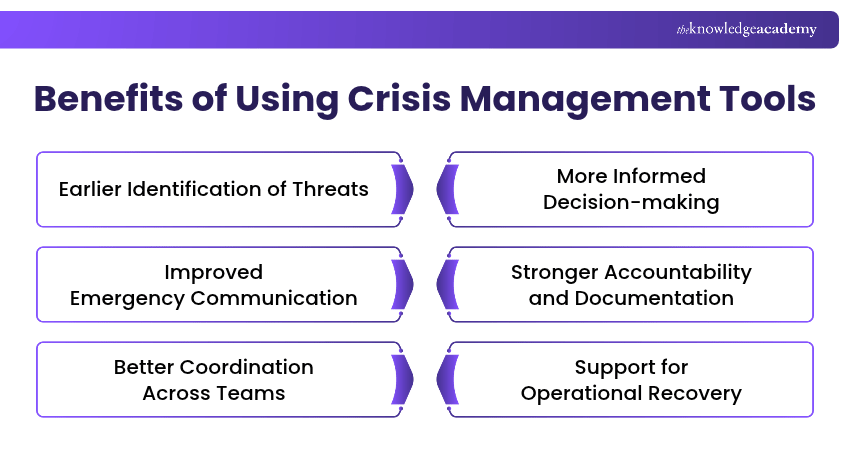
Benefits of Using Crisis Management Tools
Crisis management tools can help organisations respond more systematically to emergencies and operational disruptions. Their effectiveness depends on organisational preparedness, clearly defined responsibilities and the capabilities of the selected platform.
1) Earlier Identification of Threats
Monitoring and risk intelligence tools can help organisations recognise developing issues before their impact becomes more widespread. Earlier awareness provides additional time to assess risks and prepare appropriate actions.
2) Improved Emergency Communication
Emergency notification platforms help distribute important messages to affected employees and stakeholders. Two-way communication capabilities can also provide information about employee safety and changing circumstances.
3) Better Coordination Across Teams
Shared response plans, incident records and task assignments help teams understand their responsibilities. This can reduce confusion and support consistent communication during complex situations.
4) More Informed Decision-making
Depending on their capabilities, crisis management tools can provide information through incident reports, threat intelligence and relevant monitoring data. Decision-makers can use this evidence to evaluate risks, prioritise activities and adapt their responses as events develop.
5) Stronger Accountability and Documentation
Incident logs, response records and communication histories help organisations understand what happened during a crisis. These records can support internal reviews, compliance activities and improvements to future response plans.
6) Support for Operational Recovery
Crisis management software can help teams coordinate recovery tasks and monitor progress towards restoring affected services. Although these tools cannot eliminate disruptions, they can support a more organised recovery process.
Keep This in Mind
Choosing crisis management software is only part of preparing for emergencies. Organisations also need clear responsibilities, reliable communication arrangements and regularly tested response plans. The right combination of people, processes and tools helps teams respond more effectively when unexpected events occur.
Learn how to plan for disruptions and support operational recovery with our Business Continuity Training – Sign up now!

Nilotpal Sarmah is a Senior Content Writer with 11+ years of overall experience spanning engineering, operations and content development. His technical knowledge and extensive writing experience enable him to simplify specialised topics across IT and Tech, Business Skills, Project Management, Health and Safety, and ISO and Compliance.
View Detail

 If you wish to make any changes to your course, please


