


 Top Rated Course

We may not have the course you’re looking for. If you enquire or give us a call on 01344203999 and speak to our training experts, we may still be able to help with your training requirements.
14 Essential Fire Safety Tips for Home and Workplace
The Knowledge Academy 04 September 2026Discover 14 practical Fire Safety Tips for preventing common hazards, preparing safe escape routes, protecting people at greater risk and responding appropriately to fires at home and in the workplace.

Training Outcomes Within Your Budget!
We ensure quality, budget-alignment, and timely delivery by our expert instructors.
Table of Contents
Key Takeaways
1. Working smoke and heat alarms can provide vital early warning when a fire starts.2. Cooking, electrical equipment, batteries, smoking materials and open flames require careful everyday management.3. Clear escape routes and a practised evacuation plan can help people respond more effectively during an emergency.4. Workplace Fire Safety requires suitable risk assessments, maintained equipment, staff training and evacuation arrangements.5. If a fire starts, personal safety and evacuation come before attempting to protect property or tackle the fire.
Fire Safety is often associated with alarms, extinguishers and emergency exits. Yet many fires can be prevented through much simpler everyday actions: supervising cooking, using electrical equipment correctly, charging batteries safely and keeping combustible materials away from heat. None of these habits require special training or expensive equipment, just consistency.
At home and in the workplace, effective Fire Safety combines prevention with preparation. Prevention lowers the chances of a fire starting in the first place. Preparation determines how quickly and safely people can respond if one does. Together, they turn Fire Safety from a list of rules into something people can actually rely on when it matters most.
14 Essential Fire Safety Tips
Fire Safety involves both preventing fires and being prepared to act if one occurs. The following tips cover practical precautions for homes and workplaces:
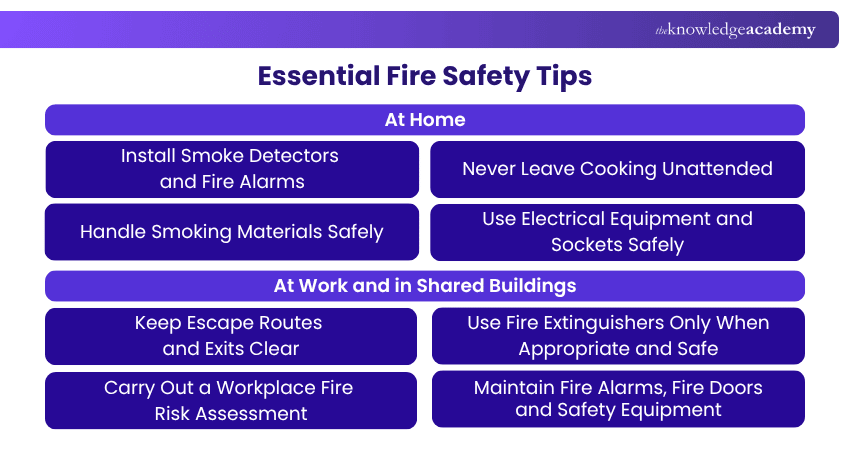
1) Install Smoke Detectors and Fire Alarms
Smoke detectors give you early warning before a fire gets worse. Alarms help people react fast and leave safely. Check them often to make sure they work properly.
a) Test alarms monthly to check they still work
b) Change batteries once a year or when needed
c) Install detectors in every bedroom and hallway
d) Use interconnected alarms so all go off at once
2) Never Leave Cooking Unattended
Cooking is a significant source of household fires. Hot oil, open flames and heated appliances can become dangerous quickly when left unattended.
a) Stay nearby when using the hob and monitor cooking carefully.
b) Keep tea towels, paper and other combustible materials away from heat.
c) Turn pan handles inward so they are less likely to be knocked.
d) Keep the hob, oven and grill clean to prevent grease and fat from building up.
3) Use Electrical Equipment and Sockets Safely
Damaged wiring, unsuitable equipment and overloaded sockets can increase fire risk. Electrical problems should be addressed rather than ignored.
a) Replace damaged plugs, cables and electrical equipment.
b) Avoid overloading sockets or connecting multiple extension leads together.
c) Follow the manufacturer's instructions when using electrical appliances.
d) Arrange for a competent professional to investigate faulty wiring or recurring electrical problems.
4) Charge Batteries and Devices Safely
Rechargeable lithium-ion batteries are now widely used in phones, laptops, e-bikes, e-scooters and other equipment. Safe charging is therefore an increasingly important part of Fire Safety. UK preparedness guidance advises using compatible chargers and avoiding charging equipment on escape routes.
a) Use the charger recommended or approved for the device.
b) Avoid charging batteries where they could obstruct an escape route.
c) Stop using damaged batteries, chargers or devices showing signs of overheating.
d) Follow the manufacturer's instructions for charging, storage and replacement.
5) Keep Candles, Heaters and Open Flames Away from Combustibles
Candles, portable heaters and other heat sources can ignite nearby materials when placed too close to them.
a) Keep candles in stable holders away from curtains, paper and furniture.
b) Never leave an open flame unattended.
c) Keep portable heaters clear of clothing, furnishings and other combustible materials.
d) Extinguish candles and other flames fully before leaving the room or going to sleep.
6) Handle Smoking Materials Safely
Cigarettes and other smoking materials can remain hot enough to ignite furniture, bedding or waste after they appear to have gone out.
a) Smoke outside wherever possible.
b) Extinguish cigarettes completely after use.
c) Use a stable, suitable ashtray rather than disposing of hot materials directly in rubbish bins.
d) Keep smoking materials away from bedding, upholstered furniture and other combustible items.
Quick Fire Hazard Check
Before leaving a room or going to bed, ask:
Is cooking switched off?Are candles and smoking materials fully extinguished?Are electrical devices charging safely?Are escape routes clear?A short routine can help identify simple hazards before they become more serious.
7) Keep Escape Routes and Exits Clear
An escape plan is only useful when people can actually reach the exit. Furniture, boxes, rubbish and other objects can delay evacuation, especially when visibility is poor.
a) Keep doorways, corridors and stairways free from unnecessary items.
b) Make sure emergency exits can be opened easily when required.
c) Avoid storing bikes, boxes or equipment along escape routes.
d) Check escape routes regularly and correct obstructions promptly.
8) Create and Practise a Fire Escape Plan
Everyone should know how they will leave the building before an emergency occurs. The plan should identify usable routes and a safe place where people can gather outside.
a) Identify the main escape route and an alternative where appropriate.
b) Practise the plan with everyone in the home or workplace.
c) Choose a safe meeting point outside the building.
d) Make sure everyone knows not to return inside after evacuating.
9) Plan for Anyone Who May Need Help Evacuating
Not everyone can respond to an alarm or leave a building at the same speed. Children, older people, disabled people and others who may need assistance should be considered in advance. Workplace guidance specifically requires appropriate arrangements for people with mobility needs.
a) Identify anyone who may require assistance during evacuation.
b) Decide who can provide appropriate help where necessary.
c) Consider suitable alarms or alerting methods for people with hearing difficulties.
d) Review arrangements whenever people's needs or the building layout changes.
10) Maintain Good Housekeeping and Store Flammables Safely
Clutter and poorly stored combustible materials can increase the opportunity for a fire to start or spread.
a) Remove unnecessary waste and combustible materials regularly.
b) Keep paper, packaging and fabrics away from ignition and heat sources.
c) Store flammable substances appropriately and follow relevant instructions.
d) Keep work areas, corridors and storage spaces organised and unobstructed.
11) Carry Out a Workplace Fire Risk Assessment
In England and Wales, the responsible person for most non-domestic premises must carry out and regularly review a fire risk assessment. It should identify hazards, people at risk and the measures required to reduce those risks.
a) Identify potential ignition sources and combustible materials.
b) Identify employees, visitors and other people who may be at risk.
c) Remove or reduce hazards and introduce suitable Fire Safety measures.
d) Record, review and update the assessment as required.
Learn to identify, evaluate, and control fire risks with our Fire Risk Assessment Training – Join now!
12) Maintain Fire Alarms, Fire Doors and Safety Equipment
Fire protection systems are only useful when they remain operational. Workplace guidance requires regular checks of systems including alarms, emergency lighting, exits and automatic fire doors.
a) Check that alarm and warning systems are functioning correctly.
b) Report faults and arrange repairs without unnecessary delay.
c) Make sure fire doors close correctly and are not improperly obstructed.
d) Inspect and maintain emergency lighting and other relevant Fire Safety equipment.
13) Train Staff and Practise Workplace Evacuation Procedures
Employees need to understand the risks in their workplace and what they should do when an alarm is raised. UK government guidance says new staff should receive training and workplaces should generally carry out at least one recorded fire drill each year.
a) Explain evacuation arrangements to new employees.
b) Tell staff about new or changing fire risks.
c) Conduct appropriate fire drills and record the outcomes.
d) Use drill findings to identify weaknesses and improve the evacuation plan.
14) Use Fire Extinguishers Only When Appropriate and Safe
Fire extinguishers can be useful in certain circumstances, but attempting to tackle a fire must never prevent a safe escape. At workplaces, the equipment provided depends on the premises and risks, and staff should receive training where necessary.
a) Make sure the correct firefighting equipment is provided where required.
b) Keep equipment accessible and properly maintained.
c) Ensure relevant employees receive suitable instruction or training.
d) Do not attempt to fight a fire if doing so could put you or others in danger.
Did You Know?
UK Government home Fire Safety guidance states that a person is around eight times more likely to die in a home fire without a working smoke alarm.
What Should You Do If a Fire Starts?
Prevention is important, but people also need to know how to respond once a fire has started. The priority should be getting people to safety rather than protecting possessions.
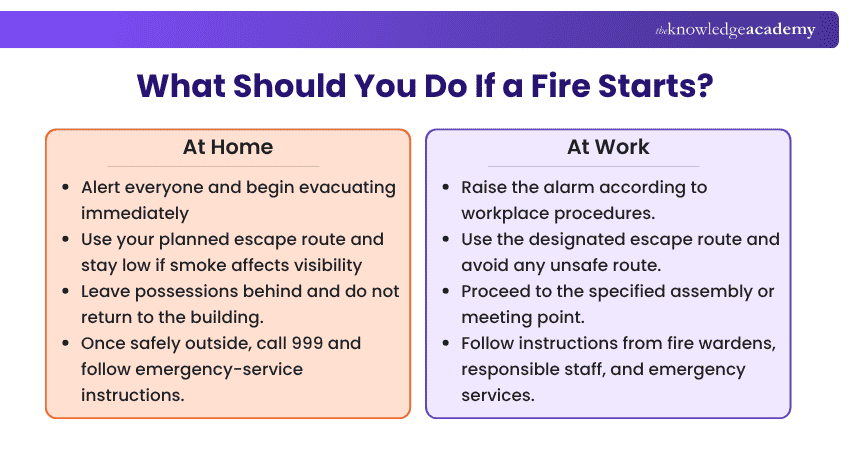
At Home
If you discover a fire at home, act quickly and avoid taking unnecessary risks. Government guidance advises people to get out, remain outside and call the emergency services once clear of the building.
a) Alert everyone and begin evacuating immediately.
b) Use your planned escape route and stay low if smoke affects visibility.
c) Leave possessions behind and do not return to the building.
d) Once safely outside, call 999 and follow emergency-service instructions.
At Work
Workplaces should follow the emergency procedures established through their fire risk assessment and evacuation plan.
a) Raise the alarm according to workplace procedures.
b) Use the designated escape route and do not use an unsafe route.
c) Proceed to the specified assembly or meeting point.
d) Follow instructions from fire wardens, responsible staff and emergency services.
Emergency Action Reminder
ALARM → EVACUATE → ASSEMBLE → CALL FOR HELPDo not delay evacuation to collect belongings or investigate the cause of the fire.
Conclusion
Effective Fire Safety depends on what happens before an emergency as much as what happens during one. Working alarms, safer everyday habits, clear exits and practised evacuation arrangements all help reduce risk. The most useful Fire Safety Tips are the ones turned into regular habits: check hazards, maintain equipment, and make sure everyone knows how to escape.
Gain the skills to manage fire emergencies with our Fire Warden Training - Join now!
Frequently Asked Questions
How Often Should Workplace Fire Drills be Carried Out?

Most fire safety guidance recommends carrying out at least one fire drill per year and recording the results. Additional drills may be appropriate depending on the premises, risks and findings of the fire risk assessment.
Where Should You Place a Smoke Alarm at Home?
Government guidance recommends at least one smoke alarm on every level of the home, typically positioned where it can provide effective warning. Kitchens generally require different consideration because cooking fumes can trigger smoke alarms; a heat alarm may be more suitable there.
Should You Use a Lift During a Fire?
Generally, people should follow the building's specific Fire Safety and evacuation plan. Standard home guidance advises avoiding lifts during a fire unless a building has specially designed evacuation arrangements.

The Knowledge Academy


Global Training Provider
The Knowledge Academy is a world-leading provider of professional training courses, offering globally recognised qualifications across a wide range of subjects. With expert trainers, up-to-date course material, and flexible learning options, we aim to empower professionals and organisations to achieve their goals through continuous learning.


 If you wish to make any changes to your course, please


