




We may not have the course you’re looking for. If you enquire or give us a call on 01344203999 and speak to our training experts, we may still be able to help with your training requirements.
13 Creative Writing Tips to Improve Your Storytelling Skills
ByThe Knowledge AcademyLast updated on: 24 November 2026
Learn how to develop compelling characters, create engaging plots, find inspiration, write natural dialogue and refine your writing style with practical techniques and examples.

Before We Dive In
1. Creative writing improves through regular practice, observation and experimentation.2. Developing a distinct writing voice makes your work more recognisable and engaging.3. Compelling stories feature clear character motivations, meaningful conflict and purposeful dialogue.4. Writing prompts and different narrative perspectives help writers explore fresh ideas.5. Revising drafts and seeking constructive feedback can improve clarity, structure and storytelling.
Have you ever had a brilliant story idea but struggled to find the right words? Creative writing tips can help you turn those scattered thoughts into engaging stories, memorable characters and meaningful narratives.
Whether you are working on your first short story or developing a novel, learning effective creative writing tips can help strengthen your creativity and writing abilities. This blog explores the best practical tips and exercises to help you develop ideas, improve your storytelling and refine your work.
Essential Creative Writing Tips
Improving your writing requires more than waiting for inspiration. The following creative writing tips can help you develop ideas, strengthen your technique and turn rough drafts into more effective pieces of writing:
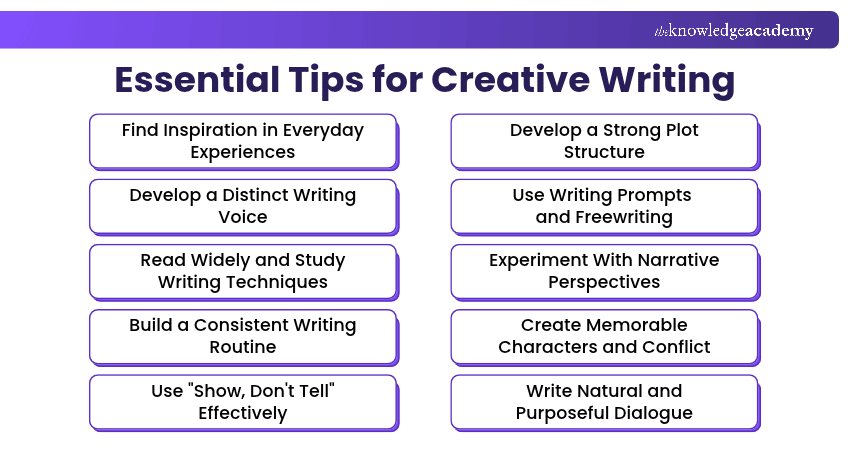
1) Find Inspiration in Everyday Experiences
Inspiration can emerge from ordinary experiences, interesting conversations, personal memories or unexpected observations. Learning to notice these details can help you discover ideas worth developing.
For example, overhearing two strangers discussing a mysterious letter could inspire a short story about a forgotten family secret. Similarly, visiting an unfamiliar place might provide a setting for a fictional adventure. Pay attention to questions that make you curious.

2) Develop a Distinct Writing Voice
Your writing voice is the distinctive way you express ideas through vocabulary, sentence structure, rhythm and tone. Some writers use short, direct sentences to create tension, while others prefer descriptive language and longer passages to establish an atmosphere.
Developing your voice involves experimenting with different styles and understanding how language affects the reader's experience.
Mini Exercise: One Scene, Three Voices
Describe someone entering an empty house using three different tones:
a) Humorous: Make the situation amusing through playful observations.b) Mysterious: Create uncertainty using selective details and suspense.c) Melancholic: Use reflective language to establish sadness or loss.
Compare the results to understand how word choice, rhythm and tone influence your writing voice.
3) Read Widely and Study Writing Techniques
Reading different genres and authors exposes you to a variety of storytelling approaches. Fiction, poetry, plays and creative non-fiction can demonstrate different ways to develop ideas, structure narratives, and use language.
For example, while reading a mystery novel, observe how the author introduces clues and controls suspense. In poetry, pay attention to imagery, rhythm and word choice. You can also study how writers open stories, introduce characters and transition between scenes.
4) Build a Consistent Writing Routine
Writing regularly helps develop discipline and makes creative work a manageable part of your schedule. Start by setting realistic goals, such as writing for 15 minutes or completing a short scene several times a week.
Choose a time and place that allows you to concentrate, but remain flexible when other responsibilities arise. Some writing sessions may involve drafting new material, while others focus on outlining, researching or revising existing work.
Create worlds and captivate readers with the art of storytelling. Sign up for the Fiction Writing Course now!
5) Use "Show, Don't Tell" Effectively
"Show, don't tell" is a writing technique that communicates emotions, situations or character traits through actions, dialogue and carefully chosen details. Instead of directly explaining how a character feels, you can allow readers to infer emotions from behaviour and surroundings.
Here's how it works:
TELLING"Sarah was nervous about the interview."SHOWING"Sarah straightened her jacket for the third time and glanced at the interview room door."
Sensory details can also make scenes more vivid. Sounds, textures, smells and visual descriptions help establish atmosphere when used selectively. Also, direct narration is useful when summarising events, providing context or maintaining a story's pace.
6) Develop a Strong Plot Structure
Plot structure organises the events of a story and helps readers understand how situations develop. A clear progression can make a narrative more engaging and easier to follow. Many conventional stories include the following elements:
a) Beginning: Introduces the main situation, characters and setting.
b) Inciting Incident: Creates a problem or change that sets the story in motion.
c) Rising Action: Develops obstacles, complications and important decisions.
d) Climax: Presents a major turning point or confrontation.
e) Resolution: Shows the consequences of events and brings the main conflict to an outcome.
For example, a story might follow a young musician who wants to perform at a major concert but struggles with stage fright. The plot develops as the character faces setbacks, makes decisions and eventually confronts the central challenge.
7) Use Writing Prompts and Freewriting
Writing prompts provide starting points when you are uncertain where to begin. They can take the form of unusual situations, questions, images or combinations of unrelated words. For example, try these prompts:
a) A character receives a letter addressed to someone who disappeared decades ago.
b) Two strangers discover they have been dreaming about the same place.
c) Describe a city where nobody is allowed to speak after sunset.
You can also use freewriting to explore ideas without worrying about grammar, spelling or structure. Set a timer for five to ten minutes and write continuously. Avoid editing during the exercise and focus on recording whatever thoughts emerge.
8) Experiment With Narrative Perspectives
Narrative perspective determines whose viewpoint shapes a story and how much information readers receive. Experimenting with different perspectives can change the tone, emotional connection and interpretation of events.
Common narrative perspectives include:
a) First-person: The narrator uses "I" or "we" to narrate events through the narrator's experiences and understanding.
b) Third-person Limited: The narrative uses "he", "she" or "they" while following one character's viewpoint at a time.
c) Third-person Omniscient: The narrator can provide information about multiple characters' thoughts, feelings and experiences.
For example, a disagreement between two friends might feel entirely different when narrated by each participant. Rewrite a short scene from another character's viewpoint to explore how perspective influences the information and emotions conveyed.
9) Create Memorable Characters and Conflict
Memorable characters have clear motivations, individual personalities and challenges that influence their decisions. Rather than relying only on appearance or personality labels, consider what each character wants, what they fear and what prevents them from achieving their goals.
A useful approach is to develop four elements:
a) Goal: What does the character want?
b) Motivation: Why does the goal matter to them?
c) Obstacle: What prevents them from achieving it?
d) Change: How might their experiences affect their choices or beliefs?
For example, an independent character may learn to trust others when facing a difficult situation. The setting can also influence their behaviour and strengthen the story's atmosphere.
10) Write Natural and Purposeful Dialogue
Dialogue helps reveal characters' personalities, relationships and intentions. It can also introduce conflict, communicate important information and move the narrative forward. Real conversations often contain repetition and unrelated details that may slow a story. Instead, focus on exchanges that feel believable while serving a clear narrative purpose.
For example:
Ordinary dialogue:"Are you angry with me?""Yes, I am angry with you."More revealing dialogue:"You could have told me.""I didn't think you'd understand.""You never gave me the chance."
11) Experiment With Different Writing Genres
Exploring different genres can introduce you to unfamiliar storytelling techniques and help develop versatility. Each genre places different demands on language, structure and reader expectations. For example:
a) Mystery: Encourages careful clue placement, suspense and controlled revelation.
b) Poetry: Develops attention to imagery, rhythm and precise language.
c) Science Fiction: Encourages speculative thinking and coherent world-building.
d) Romance: Explores relationships, emotional development and interpersonal conflict.
e) Horror: Develops atmosphere, anticipation and psychological tension.
f) Creative Non-fiction: Combines factual accuracy with narrative techniques and expressive language.
Choose an unfamiliar genre and write a short piece using one of its characteristic techniques. You may discover approaches that can strengthen your writing in other genres.
12) Revise and Edit Your Work
Completing a first draft is an important milestone, but revision transforms initial ideas into effective writing. Revision focuses on broader elements such as character development or plot consistency, while editing focuses on sentence clarity, grammar, word choice and readability.
Begin by reviewing the overall purpose and organisation of your work. Then examine individual paragraphs and sentences to identify unclear or unnecessary details. Reading your work aloud can help reveal awkward phrasing, repetitive expressions and unnatural dialogue.
Polish every sentence and let your best writing shine through by joining the Proofreading Course today!
13) Seek Feedback and Improve Your Writing
Constructive feedback helps identify unclear descriptions, inconsistent characters and pacing issues you may have overlooked. Share your work with trusted readers, writing groups or mentors, and ask specific questions, for example:
a) Was the opening interesting and clear?
b) Did the main character's decisions feel believable?
c) Were there any sections that felt confusing or unnecessarily long?
d) Did the ending feel appropriate for the story?
Consider the feedback carefully but remember that not every suggestion will align with your creative intentions. Over time, learning to evaluate feedback and make deliberate revisions can help you become a more confident writer.
Creative Writing Revision Checklist
Check your draft for the following before sharing:
□ Does the opening give readers a reason to continue?□ Are the characters' goals and motivations clear?□ Does each important scene contribute to the story?□ Are dialogue and descriptions relevant and purposeful?□ Are there unnecessary repetitions or confusing passages?□ Have grammar, spelling and punctuation been checked?

The Knowledge Academy develops accessible learning content across Project Management, IT, Cybersecurity, Data Science, Business Analysis, HR, Accounting and Finance, Leadership and Health and Safety. Its resources combine subject research with clear explanations to help professionals build practical knowledge across a wide range of disciplines.
View Detail

 If you wish to make any changes to your course, please


