


 Top Rated Course

We may not have the course you’re looking for. If you enquire or give us a call on 01344203999 and speak to our training experts, we may still be able to help with your training requirements.
Software Testing Techniques: Types, Examples and How to Choose
Richard Harris 07 September 2026Explore the world of Software Testing to gain a solid understanding of Software Testing Techniques, starting with the basics.

Training Outcomes Within Your Budget!
We ensure quality, budget-alignment, and timely delivery by our expert instructors.
Table of Contents

Key Takeaways
1. Software Testing helps identify defects, validate requirements, and improve overall software quality.2 Software Testing Techniques provide structured approaches for designing effective and focused test cases.3. Black-box, White-box, and Experience-based Testing examine software from different perspectives.4 .Testing levels such as Unit, Integration, System, and Acceptance Testing evaluate software at different development stages.5. Choosing suitable testing techniques based on requirements, risks, and system behaviour improves testing effectiveness.
That is why testing is more than a final checkpoint. The right Software Testing Techniques help teams uncover issues early, validate expected behaviour, and build confidence before software reaches users. Let’s explore these techniques in more detail.
What is Software Testing?
Software Testing involves systematically evaluating software and related work products to identify defects and determine whether requirements and expectations are being met. It can include both static activities, such as reviews, and dynamic testing where software is executed under selected conditions. Testing helps provide information about software quality and whether it behaves as expected.

What are Software Testing Techniques?
Software Testing Techniques are systematic approaches used to design test cases and evaluate different aspects of software behaviour. They help testers determine what should be tested, which inputs and conditions should be considered, and how defects can be identified efficiently.
Common testing techniques include Black-box Testing, White-box Testing, and Experience-based Testing. Specific techniques within these categories include Equivalence Partitioning, Boundary Value Analysis, Decision Table Testing, State Transition Testing, Statement Testing, Branch Testing, and Exploratory Testing.
Types of Software Testing Techniques
To improve software quality, testing can use different techniques to identify defects and examine the system from different perspectives. The following are some of the commonly used Software Testing Techniques:
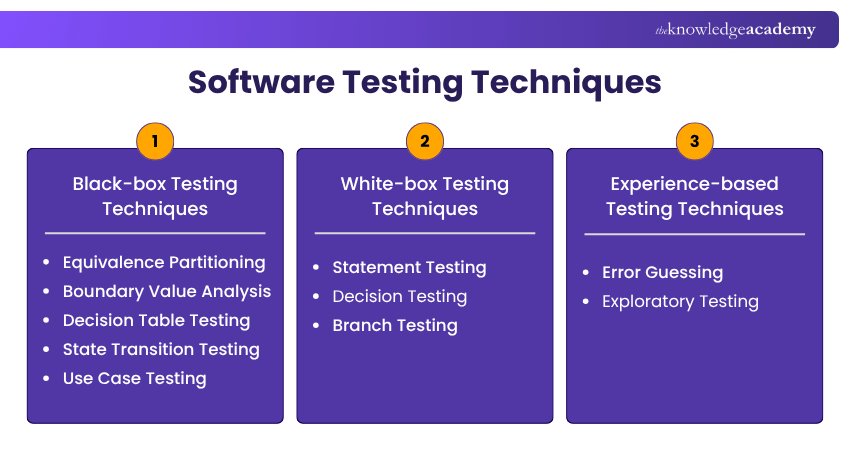
1) Black-box Testing Techniques
Black-box Testing Techniques assess software functionality without examining its internal code. Testers focus on inputs, expected outputs, requirements, and user behaviour to determine whether the software works as intended.
1) Equivalence Partitioning: Divides input data into groups that are expected to behave similarly. Testers select representative values from each group to check valid and invalid input conditions efficiently.
2) Boundary Value Analysis: Focuses on values at the edges of an input range, where defects are more likely to occur. Testers examine minimum, maximum, and values just inside or outside the defined boundaries.
3) Decision Table Testing: Tests different combinations of conditions and their corresponding outcomes. This technique helps verify complex business rules where multiple inputs can lead to different actions.
4) State Transition Testing: Examines how software moves from one state to another in response to events or inputs. Testers check valid and invalid transitions to ensure the system behaves correctly in different states.
5) Use Case Testing: Tests complete user interactions with the software based on real or expected workflows. It follows a user journey from the initial action to the final outcome to validate functional behaviour.
Pro Tip
When testing input ranges, combine Equivalence Partitioning with Boundary Value Analysis. Use representative values from each partition, then test the values at and immediately around the boundaries to uncover defects with fewer, more focused test cases.
2) White-box Testing Techniques
White-box Testing Techniques examine the internal structure, logic and control flow of the software. Testers use knowledge of the source code to design test cases that verify how the program operates internally.
1) Statement Testing: Focuses on executing individual statements within the source code. Test cases are designed to cover as many executable statements as possible and identify untested sections of code.
2) Branch Testing: Focuses on exercising branches in the control flow of the software. This helps testers verify alternative execution paths under different conditions.
3) Experience-based Testing Techniques
Experience-based Testing Techniques rely on the tester’s knowledge, judgement, and previous experience rather than predefined specifications or code structure. They are particularly useful for identifying defects that structured techniques might overlook.
1) Error Guessing: Uses tester experience to predict where defects are most likely to occur. Testers consider common mistakes, previous defects, and system behaviour when selecting areas to examine.
2) Exploratory Testing: Combines test design, execution, and learning during the testing process. Testers investigate the software dynamically and use findings from one test to decide what to test next.
Learn the art of seamless software quality with the Software Testing And Automation Course – Sign up now!
Examples of Software Testing Techniques
Software Testing Techniques become easier to understand when applied to real situations. Here are some simple examples:
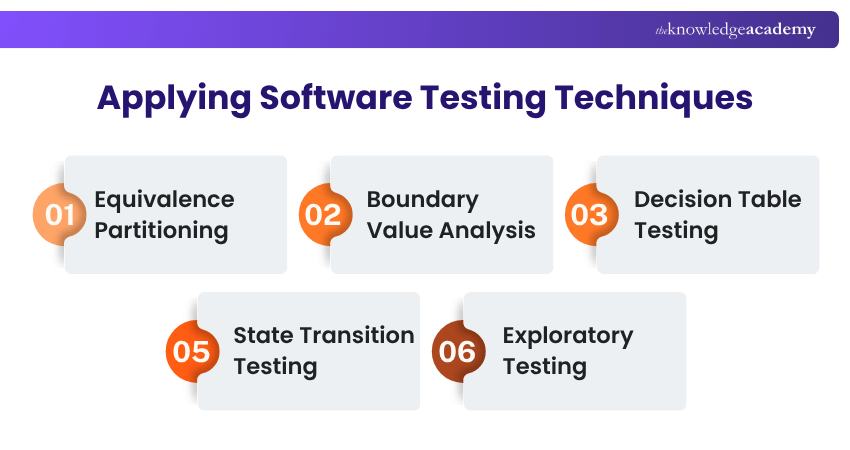
1) Equivalence Partitioning
Imagine a website that allows users aged 18 to 60 to register. Instead of testing every possible age, the tester divides the values into three groups: below 18, between 18 and 60, and above 60.
For example, the tester can enter 15, 30, and 65. The system should reject 15 and 65, but accept 30. This shows whether each group of values is handled correctly.
2) Boundary Value Analysis
Suppose a password must contain 8 to 20 characters. The tester focuses on the values around these limits because errors often happen at the boundaries.
They can test passwords with 7, 8, 20, and 21 characters. The system should reject 7 and 21 characters, while accepting 8 and 20 characters. This confirms whether the minimum and maximum limits work properly.
3) Decision Table Testing
Imagine an online store offers free delivery only when a customer is a member and spends £50 or more.
The tester checks different situations. For example, a member spending £60 should receive free delivery, while a non-member spending £60 should not. Testing these combinations helps confirm that the correct rule is applied in each situation.
4) State Transition Testing
Suppose a banking app locks an account after three incorrect PIN attempts. The tester enters the wrong PIN once, then twice, and finally a third time. After the third incorrect attempt, the account should move from an active state to a locked state.
This demonstrates whether the system changes its behaviour correctly after a specific sequence of actions.
5) Exploratory Testing
Imagine a tester is checking the shopping cart on an e-commerce website. Instead of following a fixed script, they explore the feature by adding products, removing items, changing quantities, and applying discount codes.
If the total price becomes incorrect after changing the quantity, the tester investigates further. This demonstrates Exploratory Testing because the tester learns about the system while testing it and uses each finding to decide what to check next.
Trainer’s Insight
A test case should verify more than whether an action succeeds. Include valid, invalid, and unexpected inputs to see how the software behaves when users move beyond the intended path.
Advance your test analysis skills with the ISTQB Advanced Level Test Analyst Course – Join now!
How to Choose the Right Software Testing Technique?
There is no single testing technique that is suitable for every application. The choice should depend on what needs to be tested, the risks involved, and the information available to the testing team.
Consider the following factors:
1) Testing Objective: Determine whether the goal is to validate functionality, examine internal code, test business rules, or investigate potential defects.
2) Software Requirements: Clear functional specifications can support techniques such as Equivalence Partitioning, Boundary Value Analysis, and Decision Table Testing.
3) System Complexity: Applications with multiple states, rules, or interactions may require State Transition or Decision Table Testing.
4) Access to Source Code: White-box techniques are appropriate when testers have knowledge of the application's internal structure and code.
5) Risk Level: High-risk or business-critical functions should receive greater testing attention and can require multiple complementary techniques.
6) Tester Experience: Experience-based techniques such as Error Guessing and Exploratory Testing are particularly useful when testers have strong domain or product knowledge.
Trainer's Tip
Do not rely on one testing technique for every scenario. Combine specification-based, structure-based, and experience-based techniques where appropriate to examine software from multiple perspectives and improve defect detection.
Advantages of Software Testing Techniques
Using structured Software Testing Techniques can make test design more focused and systematic. Key advantages include:
1) More Focused Test Cases: Helps select useful test conditions instead of testing inputs randomly.
2) Better Coverage: Techniques help examine relevant inputs, boundaries, rules, states and code structures.
3) Reduced Unnecessary Testing: Techniques such as Equivalence Partitioning can reduce the number of test cases while maintaining useful coverage.
4) Different Testing Perspectives: Black-box, White-box and Experience-based techniques examine software in different ways.
5) Risk-focused Testing: Suitable techniques can direct greater testing attention towards important or complex areas.
Disadvantages of Software Testing Techniques
Software Testing Techniques also have limitations that should be considered:
1) Technique Selection Requires Judgement: Using the wrong technique may provide limited value for the testing objective.
2) Some Techniques Require Specialist Knowledge: White-box or domain-specific techniques may require technical expertise.
3) No Technique Provides Complete Coverage: Testing every possible input, condition or execution path is rarely practical.
4) Multiple Techniques May Be Needed: One technique may not reveal all types of defects.
5) Effectiveness Depends on the Test Basis: Incomplete requirements, designs or other information can limit how effectively some techniques are applied.
Common Testing Mistakes to Avoid
1) Testing only valid or “happy path” scenarios.
2) Choosing techniques without considering risk.
3) Repeating similar test cases without increasing coverage.
4) Failing to update tests after requirements change.
5) Treating high test-case quantity as proof of good testing.
Conclusion
Software Testing Techniques provide structured ways to examine software from different perspectives. By combining suitable Black-box, White-box and Experience-based techniques, testers can design more focused tests, identify defects and build greater confidence in software quality. Choosing techniques according to the requirements, risks and characteristics of the system can make testing more effective throughout the Software Development Life Cycle.
Advance your testing expertise with the ISTQB Certified Tester Model-Based Testing Training - Join now!
Frequently Asked Questions
What is the Difference Between Black-box and White-box Testing?

Black-box Testing evaluates software behaviour without examining the internal code, while White-box Testing focuses on internal structures such as statements, branches, and control flow.
Which Software Testing Technique is Best for Beginners?
Black-box techniques such as Equivalence Partitioning and Boundary Value Analysis are beginner-friendly because they focus on inputs, outputs, and expected behaviour rather than internal code structure.
Can Software Testing Techniques Be Automated?
Yes, many tests designed using Software Testing Techniques can be automated, especially repetitive regression, functionality, and performance tests. However, automation depends on the test objective, tool, and application.

Richard Harris


Senior Full Stack Developer and Technology Educator
Richard Harris is a highly experienced full-stack developer with deep expertise in both frontend and backend technologies. Over his 12-year career, he has built scalable web applications for startups, enterprises and government organisations. Richard’s writing combines technical depth with clear explanations, ideal for developers looking to grow in modern frameworks and tools.


 If you wish to make any changes to your course, please


