


We may not have the course you’re looking for. If you enquire or give us a call on 01344203999 and speak to our training experts, we may still be able to help with your training requirements.
NLP Techniques: Everything You Need to Know
ByNilotpal SarmahLast updated on: 17 September 2026
NLP Techniques are used to explore communication, behaviour and personal development. This blog explains techniques such as reframing, anchoring, modelling, mental rehearsal and rapport-building.
Imagine you are talking to a colleague over tea.
They tell you they have an important presentation coming up and ask:
“I keep losing confidence when I speak. Could NLP Techniques help me prepare?”
It is a simple question, but the answer is not straightforward.
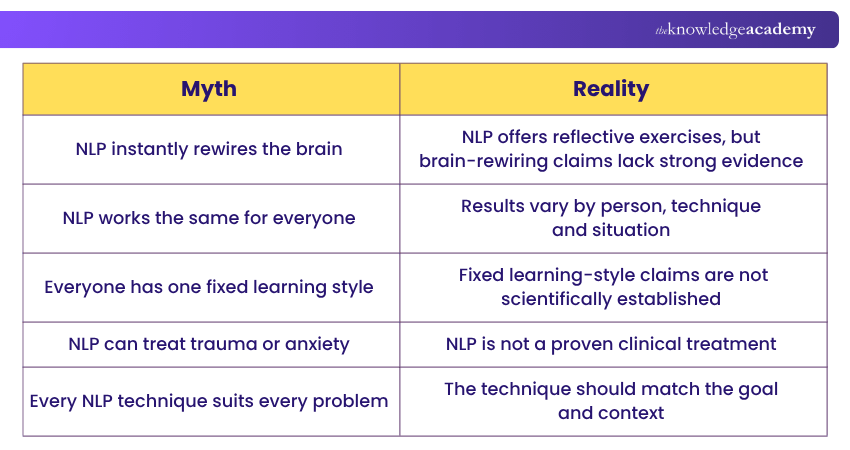
Some people use reframing, mental rehearsal and rapport-building to reflect on their communication and prepare for challenging situations. However, the results vary and many broader claims about NLP lack strong scientific evidence.
So, how can you decide whether these techniques are useful for your situation?
This blog explains top NLP Techniques and how they are applied and where they may be useful. Let’s get started!
What is Neuro-linguistic Programming (NLP)?
Neuro-linguistic Programming (NLP) is an approach to communication and personal development developed by Richard Bandler and John Grinder in the 1970s. It includes different techniques intended to explore how language, thought patterns and behaviour may influence the way people interpret and respond to situations.
NLP Techniques include exercises such as reframing, modelling, mental rehearsal, rapport-building and Meta Model questioning. They are commonly used in coaching, communication and professional development.
However, NLP as a broader system does not have strong scientific support for psychological or therapeutic outcomes and should not be presented as a substitute for evidence-based clinical treatment.

Common Uses of NLP Techniques
NLP Techniques are commonly explored in personal and professional development. Their usefulness depends on the technique, the context and the individual applying it. Let’s look at some key areas below:
a) Communication: Meta Model questions, active listening and rapport-building can clarify vague language, check assumptions and support more precise conversations.
b) Coaching and Personal Development: Coaches may use reframing, visualisation and future pacing to help clients explore goals and actions. However, NLP coaching should not replace professional therapy or medical care.
c) Learning and Education: Modelling and questioning may help learners understand tasks and identify difficulties. Teaching methods should reflect individual needs and evidence rather than fixed learning-style claims.
d) Business and Leadership: Some NLP-associated exercises, such as questioning, mental rehearsal and communication reflection, may be used when preparing for meetings, feedback or stakeholder conversations. Their usefulness will depend on the individual technique and context, and they should never be used to mislead or manipulate others.
e) Performance and Goal Setting: Mental rehearsal, modelling and future pacing may support preparation for interviews and presentations. However, they should complement practical preparation, not replace it.
Important Note
Neuro-linguistic Programming focuses on communication, personal development and behavioural patterns. It should not be confused with Natural Language Processing, an Artificial Intelligence field that enables computers to analyse and generate human language.
Top NLP Techniques
The following methods are commonly associated with Neuro-linguistic Programming (NLP). These techniques provide a useful framework for reflection and communication. Let’s learn about them below:
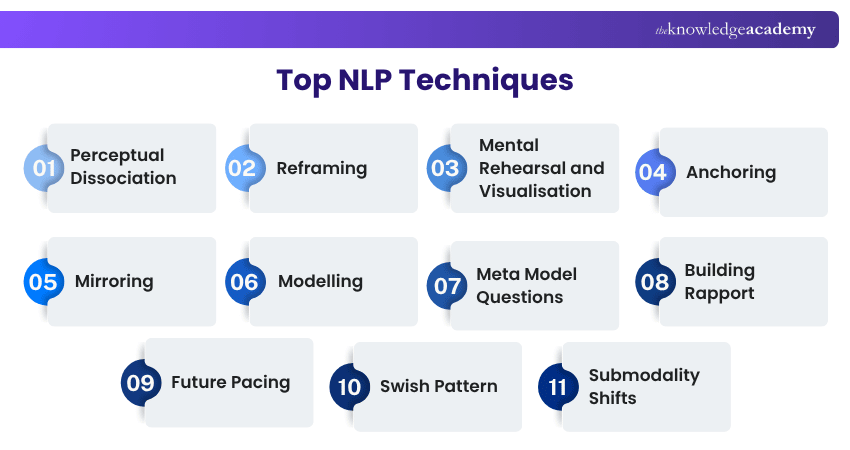
1) Perceptual Dissociation
Perceptual dissociation is an NLP exercise that involves imagining a manageable, non-traumatic experience from an observer's perspective. It is intended to create some distance from the immediate reaction so that the situation can be reflected on differently.
The following steps illustrate how it may be used for everyday situations:
a) Identify the Situation: Choose a manageable event, such as a difficult conversation or meeting.
b) Adopt an Observer's View: Imagine watching the event from an outside perspective.
c) Notice What Happened: Observe the words, actions and responses involved.
d) Consider Another Response: Think about what you could do differently if a similar situation occurs again.
Example: After a difficult meeting, imagine watching the conversation as a neutral observer. Notice where the discussion changed and consider how you could respond more clearly next time.
2) Reframing
Reframing involves changing how a situation is interpreted while recognising that the underlying facts may remain the same. It is intended to help people consider a different meaning, context or response.
The following points explain how this technique can be applied:
a) Context Reframing: Identifying a situation in which a behaviour or quality could be useful.
b) Meaning Reframing: Finding another reasonable interpretation of an event.
c) Evidence Check: Confirm that the new perspective remains consistent with the facts.
d) Action Selection: Decide whether the new interpretation suggests a constructive response.
Example: Instead of viewing critical feedback as proof of failure, consider it specific information that can help improve your next attempt.
3) Mental Rehearsal and Visualisation
Mental rehearsal involves imagining yourself completing a task or responding to an upcoming situation. It can include the actions you take, the words you use and the difficulties you may encounter.
The following points explain how this technique can be applied:
a) Choose a Specific Activity: Focus on one presentation, interview or another upcoming task.
b) Visualise the Sequence: Imagine completing each stage in the correct order.
c) Include Realistic Challenges: Picture possible questions, interruptions or mistakes.
d) Rehearse Your Response: Imagine taking a calm and practical action.
e) Practise Physically: Use the exercise alongside real preparation.
Example: Before a presentation, imagine entering the room, introducing the topic, explaining each point and responding to questions. Then practise the presentation aloud.
4) Anchoring
Anchoring is described as the deliberate association of a sensory cue with a particular mental or emotional state. The cue may be a gesture, word, sound, image or movement. Sometimes it is also compared with learned cue associations.
The following points explain how this technique can be applied:
a) Select a Useful State: Choose a feeling such as calmness or confidence.
b) Recall a Relevant Experience: Think of a time when you experienced that state.
c) Choose a Distinctive Cue: Use a simple gesture or word.
d) Introduce the Cue: Apply it while concentrating on the memory.
e) Test it Cautiously: Repeat the cue later and notice your response.
Example: While recalling a successful presentation, press your thumb and finger together. Before another presentation, repeat the gesture as a personal reminder of that experience.
Begin your journey towards greater self-awareness with the NLP Foundation Course – Sign up now!
5) Mirroring
Mirroring involves subtly matching selected aspects of another person’s communication, such as their speaking pace, level of formality or conversational energy. NLP practitioners commonly associate it with rapport.
The following points explain how this technique can be applied:
a) Observe the Interaction: Notice the person’s pace, tone and communication style.
b) Adapt Selectively: Make small and appropriate adjustments to your own approach.
c) Remain Natural: Avoid copying gestures or movements precisely.
d) Monitor the Response: Stop if the other person appears uncomfortable.
e) Prioritise Listening: Focus on their meaning rather than imitation.
Example: If a colleague speaks slowly and takes time to explain an issue, respond at a similar pace instead of interrupting or rushing the conversation.
6) Modelling
Modelling is the process of studying how another person completes a task and then practising useful elements of their approach. It is one of NLP’s foundational concepts. Effective modelling considers both observable actions and the circumstances that support performance.
The following points explain how this technique can be applied:
a) Actions: What does the person do?
b) Sequence: In what order do they complete the task?
c) Questions: What information do they seek?
d) Decisions: How do they choose between different options?
e) Responses: How do they handle mistakes or difficulties?
f) Context: What knowledge, experience and resources support their performance?
Example: To improve your public speaking, observe how an experienced speaker structures a presentation, introduces examples and uses pauses. Practise the useful elements while retaining your own style.
Trainer’s Insight
Effective modelling involves more than copying visible behaviour. Examine the preparation, decisions and actions behind successful performance, then adapt the useful elements to suit your strengths and situation.
7) Meta Model Questions
The Meta Model is an NLP framework for asking questions about vague, missing or generalised language. It is intended to help people clarify what they mean, examine assumptions and replace broad statements with more precise information.
Some useful questions include:
a) Request Detail: “What specifically do you mean?”
b) Check Generalisations: “Does this happen every time?”
c) Examine Evidence: “How do you know that?”
d) Identify a Barrier: “What is preventing you from doing it?”
e) Question an Assumption: “What makes that necessary?”
f) Explore Consequences: “What might happen if you tried?”
Example: If someone says, “I never communicate well,” ask, “In which situations do you find communication most difficult?” This identifies a more specific issue that can be discussed.
Pro Tip
Ask clarification questions with genuine curiosity. A calm question such as “What specifically is causing difficulty?” is more constructive than challenging the person’s statement directly.
8) Building Rapport
Rapport refers to a sense of mutual understanding and comfortable communication. NLP places particular emphasis on rapport, although many of the behaviours associated with it, such as active listening, checking understanding and adapting communication, are also widely used outside NLP.
Practical ways to support rapport include:
a) Listen Actively: Give the person time to explain without interrupting.
b) Ask Relevant Questions: Explore their ideas instead of making assumptions.
c) Acknowledge Their Perspective: Demonstrate that you understand their position.
d) Summarise Key Points: Check that you have interpreted their message correctly.
e) Adapt Your Communication: Use a suitable level of detail, pace and formality.
f) Respond Appropriately: Recognise concerns without making false promises.
Example: During a project discussion, summarise a colleague’s concern before presenting your response. This demonstrates that you have listened and allows them to correct any misunderstanding.
9) Future Pacing
Future pacing involves imagining yourself using a planned response in a specific future situation. In traditional NLP practice, it is also used to consider how a newly practised behaviour might transfer to an upcoming context.
The following points explain how this technique can be applied:
a) Identify the Situation: Choose a specific upcoming event.
b) Set the Desired Response: Decide what you want to do.
c) Imagine the Context: Include the people, setting and likely challenges.
d) Rehearse the Behaviour: Picture yourself applying the response.
e) Identify Barriers: Consider what might prevent you from acting.
f) Create a Practical Plan: Prepare an action for each likely barrier.
Example: If you want to contribute during meetings, identify a suitable point in the next agenda and prepare one relevant idea or question in advance.
10) Swish Pattern
The Swish Pattern is an NLP visualisation exercise in which an image linked to an unwanted habit is rapidly replaced with an image representing a preferred response. It is intended to interrupt an automatic mental sequence and direct attention towards another action.
The following points explain how this technique can be applied:
a) Identify the Cue: Recognise what usually starts the unwanted behaviour.
b) Picture the Current Response: Form a brief image of what you normally do.
c) Create a Preferred Image: Imagine yourself taking a more useful action.
d) Replace the First Image: Rapidly make the unwanted image smaller as the preferred image becomes larger.
e) Clear the Image: Pause before repeating the sequence.
f) Add a Practical Change: Modify the environment to support the preferred behaviour.
Example: If your phone distracts you while working, picture yourself reaching for it. Replace this with an image of placing it out of reach and completing the next task.
11) Submodality Shifts
In NLP terminology, submodalities are the perceived qualities of an internal experience. A submodality exercise changes one quality and asks the person to observe whether their subjective response also changes.
The following points explain how this technique can be applied:
a) Select a Mental Image: Choose a manageable, non-traumatic situation.
b) Notice its Qualities: Consider its size, distance, brightness and movement.
c) Change One Quality: Make the image smaller, dimmer or more distant.
d) Observe Your Response: Notice whether the image feels different.
e) Choose a Practical Action: Translate the reflection into a manageable next step.
Example: If an upcoming task feels overwhelming, imagine it as a large image. Make the image smaller, then represent the task as several individual steps.
Create strong foundations for communicating with purpose by joining the Introduction to NLP Course today!
Potential Benefits of NLP Techniques
The evidence supporting NLP as a complete system is limited. However, some individual NLP-associated exercises may provide useful structures for reflection, preparation and communication when applied appropriately.
Potential benefits include:
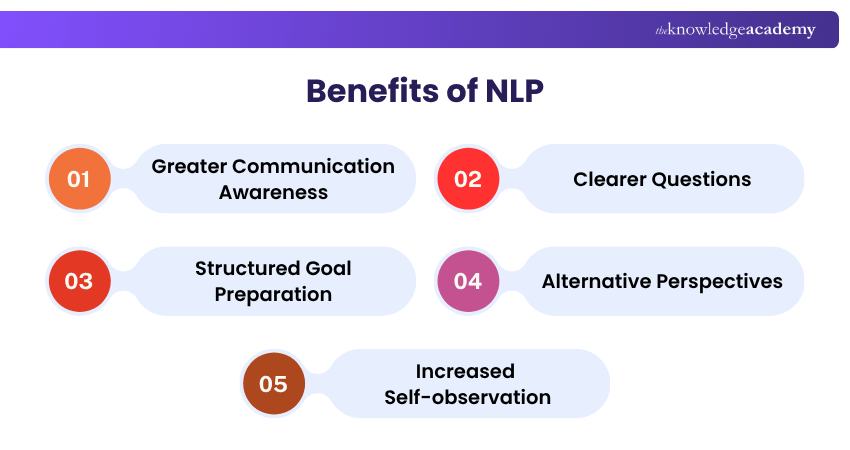
1) Greater Communication Awareness
NLP exercises may encourage people to pay closer attention to their language, listening habits and non-verbal behaviour. This awareness can help them notice ambiguity, avoid assumptions and adapt their communication to different situations.
2) Clearer Questions
Meta Model questions can turn broad statements into specific information. They encourage people to clarify what they mean, explain their assumptions and identify missing details. This may support problem-solving, improve mutual understanding and reduce misunderstandings.
3) Structured Goal Preparation
Future pacing, modelling and mental rehearsal provide frameworks for considering how a goal might be approached. They can also help identify practical obstacles and prepare suitable responses before action begins.
4) Alternative Perspectives
Reframing and perceptual exercises may encourage people to examine a situation from another point of view. This can support balanced reflection and help them identify responses they may not have previously considered.
5) Increased Self-observation
NLP activities may help individuals notice repeated language or behaviour patterns. Recognising these patterns can support more deliberate choices, although lasting change usually requires continued practice and appropriate support.
How to Choose the Right NLP Technique?
Choosing an NLP Technique involves matching the exercise to a clear objective. Then consider whether the technique is appropriate, practical and safe for that context. Let’s learn about it in detail below:
a) Clarify Your Objective: Define the outcome you want before choosing a technique. Use meta model questions for clarity, reframing for perspective, future pacing for preparation or modelling for learning.
b) Consider the Type of Challenge: Identify whether the challenge involves communication, preparation, behaviour or interpretation. Some situations may benefit from combining suitable techniques.
c) Choose the Simplest Technique: Select a straightforward technique that directly supports your objective. Avoid complex exercises when practical planning or clear communication may work better.
d) Test It in a Low-risk Situation: Apply the technique to a manageable situation and review the result. Adapt it or try another approach if it does not help.
e) Combine it With Practical Action: Use NLP exercises alongside real action. For example, combine visualisation with preparation, rehearsal and feedback.
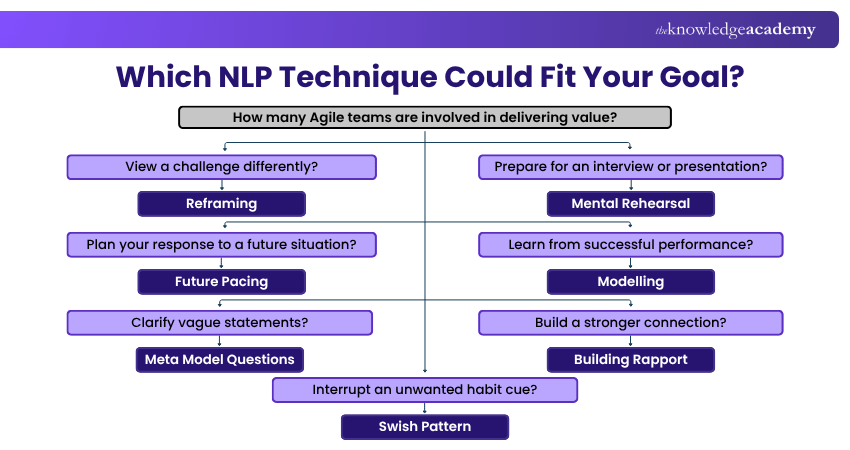
Note: Examples only. Technique choice depends on the context and objective.
Learn to shape clearer thoughts and stronger conversations with the NLP Foundation and Practitioner Training – Register now!

Nilotpal Sarmah is a Senior Content Writer with 11+ years of overall experience spanning engineering, operations and content development. His technical knowledge and extensive writing experience enable him to simplify specialised topics across IT and Tech, Business Skills, Project Management, Health and Safety, and ISO and Compliance.
View Detail

 If you wish to make any changes to your course, please


