


 Top Rated Course

We may not have the course you’re looking for. If you enquire or give us a call on 01344203999 and speak to our training experts, we may still be able to help with your training requirements.
Essential Minute Taking Techniques You Need to Know
Charlotte Wilson 31 August 2026Effective Minute Taking Techniques involve capturing key discussions, decisions, action items, and responsibilities in a clear, concise and organised manner.

Training Outcomes Within Your Budget!
We ensure quality, budget-alignment, and timely delivery by our expert instructors.
Table of Contents
Key Takeaways
1. Effective Minute Taking focuses on important discussions, decisions and actions rather than recording every word.2. Preparing with the meeting agenda and relevant documents makes it easier to organise notes.3. Active listening and selective summarisation help identify the information that matters most.4. Clear, neutral and concise language makes Meeting Minutes easier to understand and reference.5. Reviewing minutes soon after a meeting helps improve their accuracy and identify unclear information.
Imagine two people taking minutes during the same meeting:
• Minute Taker A tries to write down almost every sentence. By the end, they have pages of notes but struggle to identify what was actually decided.
• Minute Taker B listens carefully, summarises the key discussion and only records the decisions, actions, owners and deadlines.
Whose Meeting Minutes would be easier to use later? The answer is clearly B
Effective Minute Taking is not about capturing the most words. It is about identifying and recording the information people need after the meeting. Preparation, active listening, organised note-taking and careful review all contribute to accurate and useful Meeting Minutes.
What is Minute Taking?
Minute Taking is the process of recording important information from a meeting in a clear and organised format. This typically involves capturing key discussions, decisions and agreed actions so that participants have a reliable record to refer to afterwards.
Proper Minute Taking Techniques involve preparation, active listening, selective note-taking, summarisation, organisation and post-meeting review. The goal is not necessarily to reproduce everything that was said. Instead, minutes should provide an accurate record of the meeting's important outcomes.

Why Effective Minute Taking Matters?
Meeting Minutes provide a clear record of important discussions, decisions and action items. They help participants remember what was agreed, keep absent stakeholders informed and provide a reliable reference for future meetings. Effective Minute Taking can also support:
1) Accountability: Records agreed actions and clearly assigns ownership, so it's obvious who is responsible for what.
2) Clarity: Provides a shared, unambiguous record of what was decided, reducing the risk of different people remembering the outcome differently.
3) Reference: Creates a reliable point to look back on when a past decision or discussion needs to be revisited.
4) Communication: Keeps people who weren't in the room, or need reminding, informed of what was agreed.
5) Continuity: Supports follow-through by making it easy to track outstanding actions and progress between meetings.
Essential Minute Taking Techniques
Effective Minute Taking combines what you do before, during and after a meeting. Using a consistent process makes it easier to capture relevant information without becoming overwhelmed by every conversation.
Here are the proven techniques for reliable Minute Taking:
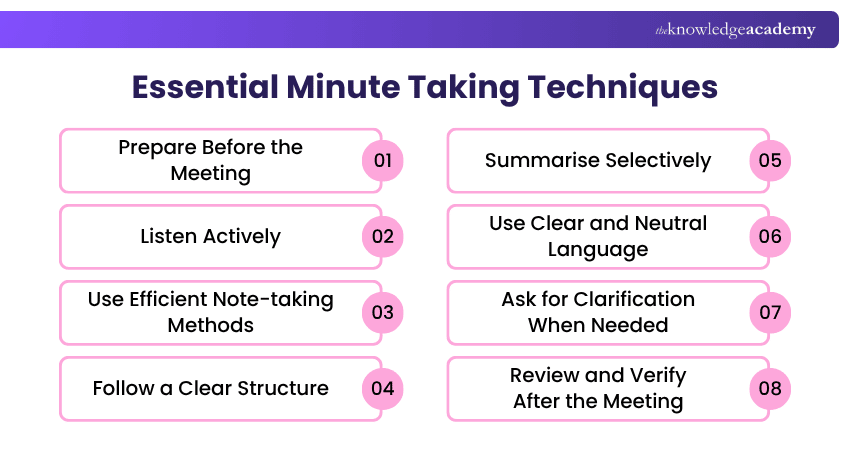
1) Prepare Before the Meeting
Preparation makes Minute Taking considerably easier. Review the agenda before the meeting and familiarise yourself with its purpose, discussion topics and expected outcomes. Where available, review relevant materials such as previous Meeting Minutes, reports or presentations. This preparation will help minute takers anticipate the meeting flow and improve accuracy.
Pro Tip
Turn each agenda item into a heading in your notes before the meeting starts. That way, the basic structure is already in place once the discussion begins.
2) Listen Actively
Active listening helps you recognise what information deserves to be recorded. Pay particular attention to important discussion points, decisions and agreed actions rather than attempting to capture every spoken sentence. Maintaining concentration throughout the meeting can help improve the accuracy and completeness of your notes.
3) Use Efficient Note-taking Methods
Develop a note-taking system that allows you to record information quickly. Techniques such as abbreviations, symbols, bullet points, arrows, asterisks and participant initials are highly recommended. For example:
D: Decision
A: Action
?: Needs clarification
*: Important point
The exact system matters less than using it consistently and being able to understand your notes afterwards.
Make sure every keystroke counts. Build speed and accuracy with our Touch Typing Course. Sign up today!
4) Follow a Clear Structure
Well-structured notes are easier to convert into final Meeting Minutes. Use the meeting agenda as your guide and organise information under appropriate headings and subheadings. This helps readers locate specific discussions and outcomes more easily.
A simple structure might include:
Agenda Item → Key Discussion → Decision → Action
5) Summarise Selectively
Trying to record every word can make it difficult to distinguish important outcomes from general conversation. Instead, identify the main ideas, decisions and action items and summarise the relevant discussion concisely. Go for selective summarisation rather than attempting to transcribe an entire meeting.
Trainer Insight
Learn to separate three types of information: Discussion → Decision → Action. A discussion provides context, a decision records what was agreed and an action records what needs to happen next.
6) Use Clear and Neutral Language
Meeting Minutes should be understandable to someone reviewing them later. Use simple and concise language while maintaining accuracy. Avoid unnecessarily complex terminology and maintain a consistent format throughout the document. The tone should also remain objective. Avoid adding personal interpretations or opinions that were not part of the meeting.
7) Ask for Clarification When Needed
If an important point is unclear, seek clarification where appropriate. This is particularly useful when you are uncertain about:
a) what was decided
b) who owns an action
c) what needs to be completed
d) when something is due
Ask clarifying questions when necessary to improve the accuracy of Meeting Minutes. The purpose is not to become heavily involved in the discussion but to make sure important information is understood correctly.
8) Review and Verify After the Meeting
Review your notes while the meeting is still fresh in your mind. Check unclear points and seek clarification where necessary before finalising the minutes. Review notes, cross-check uncertain information and contact participants for clarification when required. This final check can help prevent unclear notes from becoming inaccurate Meeting Minutes.
Here’s an easy way you can determine what to include in your next Meeting Minute:
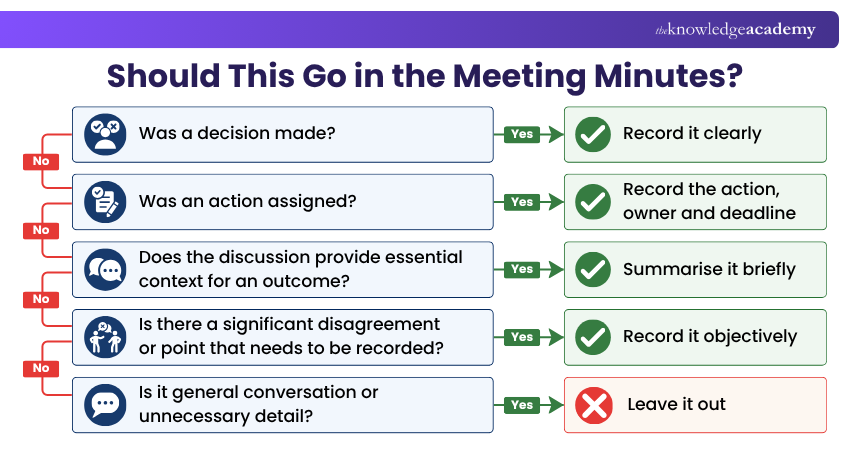
Minute Taking Checklist
Use this checklist as a quick process for your next meeting:
Before the Meeting
Review the agenda Understand the meeting purpose Review relevant previous minutes or supporting documents Prepare your note-taking structure
During the Meeting
Listen actively Capture important discussion points Clearly mark decisions Record agreed actions Identify action owners and deadlines where stated Ask for clarification when necessary Keep the notes objective
After the Meeting
Review your notes promptly Clarify uncertain information Organise the minutes logically Remove unnecessary detail Check decisions and actions for accuracy Maintain a clear and consistent format Handle and share the minutes appropriately
Before finalising your Meeting Minutes, ask:
Can a reader quickly identify what was discussed, what was decided, what needs to happen next and who is responsible?
If yes, your minutes are likely serving their core purpose effectively.
Conclusion
Effective Minute Taking Techniques are all about preparation, active listening, selective summarisation, clear organisation and careful review. By focusing on the most important discussions, decisions and actions, you can create Meeting Minutes that provide a clear and useful record for everyone involved. With consistent practice, these techniques can make meetings easier to follow and agreed actions easier to manage.
Level up on your executive support expertise with our comprehensive range of PA and Secretarial Courses – Sign up now!
Frequently Asked Questions
Who is Responsible for Taking Meeting Minutes?

The responsibility for taking minutes typically falls to the minute-taker or company secretary. The chair leads the meeting and ensures it runs smoothly but does not usually take the minutes. Their responsibility is to review and approve the minutes, confirming that they accurately reflect the meeting’s proceedings.
What 8 Things Should the Minutes of a Meeting Include?
Meeting minutes should include these eight essential elements:
a) Date and time
b) Attendees
c) Previous minutes
d) Meeting agenda
e) Discussion summaries
f) Decisions made
g) Action items
h) Owners and deadlines
How Soon Should Meeting Minutes be Distributed After a Meeting?
Meeting Minutes should generally be prepared and shared as soon as reasonably practical after the meeting, following the organisation’s internal process. Prompt distribution helps the participants review outcomes and begin actions while the discussion is still fresh.
What is the Difference Between Meeting Notes and Meeting Minutes?
Meeting notes are usually informal records taken for personal reference, while Meeting Minutes are a more structured record of important discussions, decisions and agreed actions. Minutes may also follow an organisation’s established format and approval process.

Charlotte Wilson


Soft Skills and Business Training Manager
Charlotte Wilson is an expert in soft skills development, with over 14 years of experience helping individuals and teams improve communication, productivity and emotional intelligence in the workplace. Her training content is focused on enhancing interpersonal effectiveness and fostering positive, collaborative environments across all levels of an organisation.
View Detail

 If you wish to make any changes to your course, please


