


 Top Rated Course

We may not have the course you’re looking for. If you enquire or give us a call on 01344203999 and speak to our training experts, we may still be able to help with your training requirements.
Top 10 Deep Learning Techniques to Know in 2026
The Knowledge Academy 03 September 2026Discover ten important techniques, their applications and the factors that determine where each one fits.

Training Outcomes Within Your Budget!
We ensure quality, budget-alignment, and timely delivery by our expert instructors.
Table of Contents
Key Takeaways
1) Different Deep Learning Techniques suit different data structures, learning objectives and computational requirements.2) CNNs remain highly useful for spatial data, while Transformers have become important across language, vision and multimodal applications.3) Transfer Learning and Self-Supervised Learning can reduce dependence on large task-specific labelled datasets.4) Diffusion Models, VAEs and GANs all support generative tasks, but they learn and generate data in different ways.5) Choosing an approach requires considering the problem, data, desired output, available compute, and deployment constraints.
CNNs, Transformers, GANs, Autoencoders and Diffusion Models are all associated with Deep Learning, but they do not all represent the same type of technique. Some are architectures, some are training approaches, and others are designed for particular learning or generation tasks.
The useful question is not simply, “Which technique is most advanced?” It is, “Which technique fits the task?”
Image recognition, language modelling, anomaly detection, generative AI and sequential decision-making all place different demands on a model. Knowing the strengths, limitations, and typical applications of the leading techniques makes it easier to understand where each one belongs.
What are Deep Learning Techniques?
Deep Learning Techniques are methods used to design, train or apply neural networks with multiple processing layers. These layers progressively learn useful representations from data, allowing models to identify increasingly complex patterns.
Deep Learning can work with structured and unstructured information, including images, text, audio, video, time-series data and graphs. The underlying idea is representation learning, where multiple layers transform raw inputs into increasingly useful features for tasks such as prediction, classification, generation or decision-making.

Top 10 Deep Learning Techniques
The following ten approaches represent a mixture of established foundations and techniques that are particularly useful for understanding modern Deep Learning.
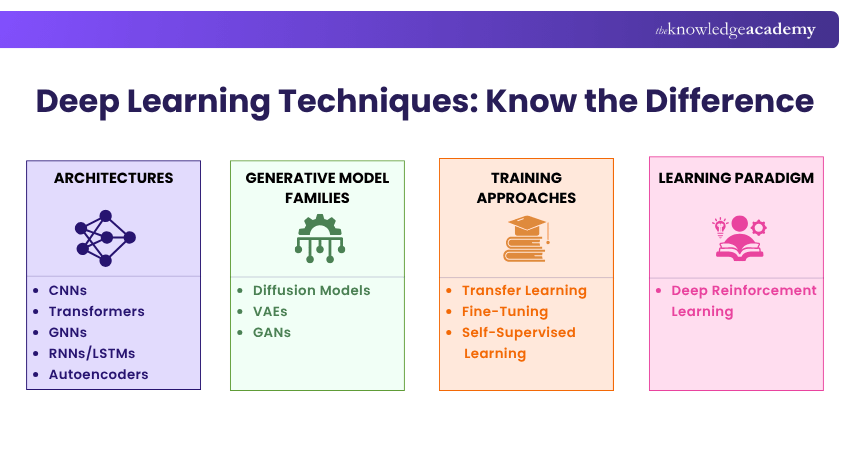
Quick Clarification
Architecture: Defines how the neural network is organised. Examples include CNNs, Transformers, and GNNs.Mechanism: Controls how information is processed within an architecture. Attention is a common example.Training approach: Describes how existing or unlabelled knowledge is used during learning. Transfer Learning and Self-Supervised Learning fit here.Learning paradigm: Defines how the system learns from its environment or feedback. Deep Reinforcement Learning is an example.
1) Convolutional Neural Networks (CNNs)
Convolutional Neural Networks (CNNs) are designed to recognise spatial patterns in data. Their convolutional layers apply learned filters that identify features such as edges, shapes and textures.
As information passes through deeper layers, these basic features are combined into more complex representations, making CNNs particularly effective for visual tasks.
Common applications: Image classification, object detection, medical imaging, visual inspection and image segmentation.
Consideration: CNNs are strong at local spatial patterns but may be less suitable when broader contextual relationships are the main requirement.
2) Transformers with Attention Mechanisms
Transformers use Attention mechanisms to identify relationships between different parts of an input. Attention allows the model to assign greater importance to information that is most relevant to the current task.
Unlike traditional recurrent architectures, Transformers can process many parts of a sequence in parallel. This has made them highly effective across language, vision and multimodal applications.
Common applications: Language modelling, translation, document analysis, computer vision, speech and multimodal AI.
Consideration: Large Transformer models can require substantial memory and computing resources.
3) Transfer Learning and Fine-Tuning
Transfer Learning reuses knowledge from a model that has already been trained on another task or dataset. Instead of learning everything from scratch, the model starts with useful pretrained representations.
Fine-Tuning is one common way of applying Transfer Learning. It adapts some or all of the pretrained model's parameters using task-specific data so the model performs better in the new domain.
Common applications: Image classification, NLP, speech recognition and specialist applications of pretrained models.
Consideration: Results depend on how closely the pretrained knowledge relates to the new task and how carefully the model is fine-tuned.
4) Self-Supervised Learning
Self-Supervised Learning enables models to learn from data without requiring manually created labels for every example. The training data itself is used to generate learning signals.
A model might predict hidden information, reconstruct missing content, or learn similarities between related examples. The resulting representations can then support other downstream tasks.
Common applications: Foundation-model pretraining, language processing, computer vision, speech and representation learning.
Consideration: It reduces reliance on labeled data but can still require large datasets and significant computing resources.
5) Diffusion Models
Diffusion Models are generative models that learn to reverse a gradual noise process. During training, data is progressively corrupted while the model learns how to recover the original structure.
During generation, the model can start with noise and repeatedly refine it into a meaningful output. This approach has become particularly important in generative media.
Common applications: Image generation, image editing, synthetic data and other generative media tasks.
Consideration: Generation can require multiple iterative steps, increasing inference time and computational cost.
6) Autoencoders and Variational Autoencoders (VAEs)
Autoencoders learn to compress input data into a smaller latent representation and then reconstruct the original information. They typically contain an encoder and a decoder.
Variational Autoencoders extend this idea by learning a probabilistic latent space, making them useful for representation learning and generative tasks.
Common applications: Anomaly detection, denoising, dimensionality reduction, representation learning and data generation.
Consideration: VAEs provide structured latent representations, but generated outputs can be less detailed than those produced by some other generative approaches.
7) Generative Adversarial Networks (GANs)
Generative Adversarial Networks use two competing neural networks: a generator and a discriminator. The generator creates synthetic samples while the discriminator attempts to distinguish them from real data.
As both networks improve, the generator learns to produce increasingly realistic outputs. This adversarial process has made GANs influential in synthetic image generation.
Common applications: Image synthesis, image-to-image translation, super-resolution, and synthetic data creation.
Consideration: GANs can be difficult to train and may experience problems such as instability or mode collapse, where the generator produces a limited variety of outputs.
8) Recurrent Neural Networks (RNNs) and LSTMs
Recurrent Neural Networks are designed for sequential data and use information from previous processing steps when handling later inputs. This allows them to model dependencies across a sequence.
Long Short-Term Memory (LSTM) networks are specialised RNNs that use gated memory mechanisms to retain important information across longer sequences.
Common applications: Time-series forecasting, speech processing, sensor data, and other sequential tasks.
Consideration: Standard RNNs and LSTMs process sequence information sequentially, making them harder to parallelise than Transformers. This can reduce training efficiency on long or large-scale sequences.
9) Graph Neural Networks (GNNs)
Graph Neural Networks are designed for data represented as connected entities. They learn from both individual nodes and the relationships or edges between them.
By combining information from neighbouring parts of a graph, GNNs can identify patterns that would be difficult to capture when each data point is treated independently.
Common applications: Recommendation systems, fraud detection, molecular modeling, knowledge graphs, and social networks.
Consideration: Very large or densely connected graphs can create significant memory and computational challenges.
10) Deep Reinforcement Learning
Deep Reinforcement Learning combines reinforcement learning with deep neural networks. An agent interacts with an environment, takes action, and learns from the rewards or penalties it receives.
Deep networks allow the agent to work with complex inputs and large state spaces, making the approach suitable for difficult sequential decision-making problems.
Common applications: Robotics, game-playing agents, control systems, resource allocation, and autonomous decision-making.
Consideration: Training can require many interactions, and poorly designed reward functions may encourage unintended behaviour.
Turn neural network concepts into practical skills with our Neural Networks with Deep Learning Training - Register now!
How to Choose the Right Deep Learning Technique?
A task may match more than one Deep Learning approach. The visual below provides a quick starting point based on the type of data and learning objective.
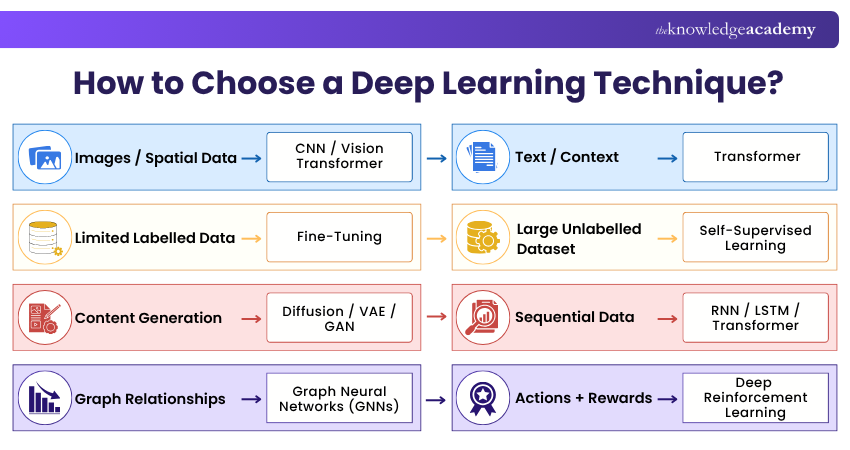
After identifying suitable candidates, evaluate them using the following factors:
1) Define the Objective: Identify whether the task involves classification, prediction, generation, representation of learning or sequential decision-making.
2) Identify the Data Structure: Match the technique to the form of data being processed. CNNs suit spatial data, Transformers suit context-rich sequences, GNNs handle relational data, and RNNs or LSTMs can support time-dependent sequences.
3) Assess Data Availability: Consider how much labelled data is available. Transfer Learning and Fine-Tuning can help when task-specific data is limited, while Self-Supervised Learning is useful when large amounts of unlabelled data are available.
4) Check Resource Requirements: Estimate the computing power, memory, and training time available. Large Transformers and Diffusion Models may require considerably more resources than smaller specialised architectures.
5) Consider Deployment Conditions: Account for where the model will operate, such as the cloud, an edge device or a mobile application, along with latency and model-size constraints.
6) Test Before Committing: Compare suitable approaches to representative data using relevant performance, efficiency and reliability measures before selecting the final technique.
Trainer’s Insight
A benchmark winner is not automatically the best production choice. A slightly less accurate model may be more suitable if it requires less compute, responds faster or is easier to deploy and maintain.
Conclusion
Deep Learning has developed into an ecosystem of specialised architectures and learning approaches rather than a single model type. Understanding the data, desired outcome and operating constraints makes it far easier to select or combine Deep Learning Techniques effectively.
From neural networks to real AI solutions with our Deep Learning with TensorFlow Training – Join now!
Frequently Asked Questions
Is Deep Learning the Same as a Neural Network?

Not exactly. A neural network is a computational model made from connected processing units and layers. Deep Learning generally refers to neural networks with multiple representation-learning layers and the methods used to train and apply them.
Can several Deep Learning Techniques Be Used in the Same Model?
Yes. Modern systems often combine techniques. For example, a Transformer can be pretrained using Self-Supervised Learning and then adapted to a specialist task using Transfer Learning and Fine-Tuning.
Do Deep Learning Models Always Require Huge Datasets?
No. Training large models from scratch can require substantial data, but Transfer Learning, Fine-Tuning and pretrained representations can make useful Deep Learning possible with much smaller task-specific datasets.

The Knowledge Academy


Global Training Provider
The Knowledge Academy is a world-leading provider of professional training courses, offering globally recognised qualifications across a wide range of subjects. With expert trainers, up-to-date course material, and flexible learning options, we aim to empower professionals and organisations to achieve their goals through continuous learning.


 If you wish to make any changes to your course, please


