


We may not have the course you’re looking for. If you enquire or give us a call on 01344203999 and speak to our training experts, we may still be able to help with your training requirements.
15 Team Leadership Skills for Effective Team Management
ByThe Knowledge AcademyLast updated on: 13 November 2026
Effective team leadership combines clear communication, trust, delegation and sound decision-making to achieve shared goals. Explore how these skills strengthen collaboration, improve performance and help leaders navigate workplace challenges.

What You'll Learn
1. Understand how communication and active listening help leaders clarify expectations and address team concerns.2. Explore how delegation, shared goals and decision-making help leaders coordinate responsibilities.3. Learn how emotional intelligence, coaching and feedback support team development.4. Discover practical ways to strengthen leadership skills through feedback, experience and reflection.
Why do some teams thrive under pressure while others struggle despite having equally talented people? The difference often lies in how they are led. Effective team leadership goes beyond assigning tasks; it involves helping people work together, navigate challenges and bring out their strengths.
However, unclear expectations, poorly distributed responsibilities and communication gaps can quickly undermine these efforts. If left unresolved, such problems can result in missed deadlines, workplace conflicts and declining motivation.
So, what makes an effective team leader? Let's explore the skills that matter most and practical ways to develop them.
Essential Team Leadership Skills
Strong team leadership relies on a combination of interpersonal, organisational and decision-making abilities. These skills help leaders coordinate responsibilities, support team members and encourage effective teamwork.
Here are 15 skills that help put effective team leadership into practice:
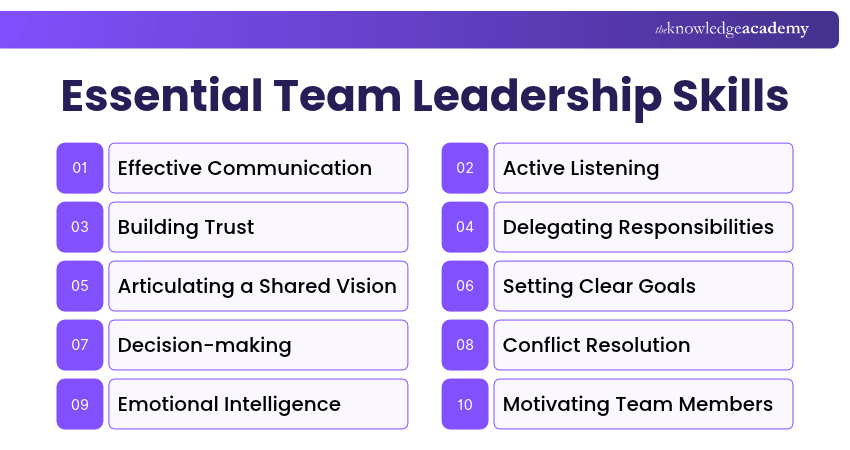
1) Effective Communication
Effective communication helps team leaders explain expectations, share important information and keep everyone informed about their responsibilities. Leaders should communicate instructions clearly, choose appropriate channels and ensure team members understand what is expected.
For example, a short team meeting can establish daily priorities, while a written summary can clarify deadlines and individual responsibilities.

2) Active Listening
Active listening involves giving team members your full attention and understanding their views before responding. A leader who listens carefully can recognise concerns, identify valuable suggestions and understand challenges that might otherwise go unnoticed.
For example, asking follow-up questions during a one-to-one discussion can help uncover the underlying cause of a team member's difficulties.
3) Building Trust
When trust is established, team members are more willing to express their opinions, raise concerns and seek support. Leaders build trust by treating people fairly, being transparent about decisions and respecting different perspectives.
For example, encouraging employees to report potential problems without fear of unfair criticism can help teams identify issues before they escalate.
4) Delegating Responsibilities
Delegation involves assigning tasks to suitable team members while providing the authority and resources needed to complete them. Effective leaders consider individual strengths, workloads and development opportunities when distributing responsibilities.
For example, a leader can assign a client presentation to a team member with strong communication skills while providing clear expectations, appropriate decision-making authority and the resources needed to deliver it.
5) Articulating a Shared Vision
A shared vision helps team members understand the broader purpose behind their work and how their contributions support organisational success. Leaders should communicate this purpose in a way that connects everyday responsibilities with meaningful outcomes.
For example, a customer service leader can explain how improving response quality contributes to stronger customer relationships and business reputation.
6) Setting Clear Goals
Clear goals provide direction and help team members understand what successful performance looks like. Leaders should establish realistic, measurable objectives with defined responsibilities and timeframes.
For example, instead of asking a team to improve customer service, a leader can set a specific target for reducing average response times while maintaining service quality over an agreed period.
Trainer's Insight
Even well-defined goals can become unrealistic when priorities, workloads or resources change. Regular progress reviews help leaders recognise these changes early and adjust expectations before they affect team performance.
7) Decision-making
Decision-making involves evaluating available information, considering alternatives and selecting an appropriate course of action. Effective leaders balance different viewpoints with practical constraints, such as time, resources and potential risks.
For example, when a project faces unexpected delays, a leader can assess critical tasks, available resources and deadlines before deciding which activities to prioritise.
8) Conflict Resolution
Disagreements can arise from competing priorities, different working styles or misunderstandings. Conflict resolution helps leaders address these situations fairly and prevent disagreements from affecting teamwork.
For example, when two employees disagree about task ownership, a leader can facilitate a discussion, clarify responsibilities and work towards a fair resolution.
9) Emotional Intelligence
Emotional intelligence involves recognising and managing your own emotions, understanding others' emotional responses and adapting your behaviour appropriately. It helps leaders respond thoughtfully to stressful situations and remain sensitive to the experiences of team members.
For example, noticing that an employee may be overwhelmed and checking in with them can help a leader adjust their approach and provide appropriate support without making assumptions.
10) Motivating Team Members
Motivation helps team members remain engaged, committed and interested in their responsibilities. Effective leaders recognise that individuals respond to different incentives, including meaningful work, achievement and professional recognition.
For example, acknowledging someone's contribution to a successful project can reinforce positive performance and encourage continued commitment.
11) Coaching and Mentoring
Coaching and mentoring help team members develop their abilities and prepare for future responsibilities. Coaching generally focuses on helping individuals improve specific capabilities, while mentoring can provide broader professional guidance based on experience.
For example, a leader can coach an employee to improve their presentation skills and mentor another colleague by sharing guidance on long-term career development.
12) Providing Constructive Feedback
Constructive feedback gives employees a clear picture of their strengths and the aspects of their work that need attention. Leaders should offer feedback promptly, use specific examples and address work-related behaviours rather than personal traits.
For example, instead of saying a report needs improvement, a leader can explain which sections require clearer evidence and suggest practical changes.
13) Personal Accountability
Personal accountability means taking responsibility for decisions, commitments and outcomes. Accountable leaders acknowledge mistakes, address problems and demonstrate the standards they expect from others.
For example, if a project deadline is missed because of an unrealistic schedule, a leader should review the planning process and take responsibility for making improvements.
14) Adaptability
Adaptability allows leaders to respond effectively when circumstances, priorities or project requirements change. It involves reassessing plans, considering alternatives and helping team members adjust without losing sight of important objectives.
For example, when an urgent client request changes project priorities, an adaptable leader can reorganise resources and explain the revised approach to the team.
15) Self-Awareness
Self-awareness involves understanding your strengths, limitations and how your behaviour influences others. Self-aware leaders recognise personal biases, reflect on their reactions and identify areas where their leadership approach needs improvement.
For example, a leader who notices they become impatient during challenging meetings can practise responding more calmly and giving others sufficient time to contribute.
Remember
Your intentions and your team's experience of your leadership are not always the same. A leadership approach that works well for one team member might need adjusting for another.
Strengthen your communication, decision-making and team management skills with our Leadership and Management Training - Sign up now!
How to Improve Your Team Leadership Skills
Developing leadership abilities requires consistent practice, reflection and a willingness to learn from experience.
Here are five practical ways to strengthen your skills:
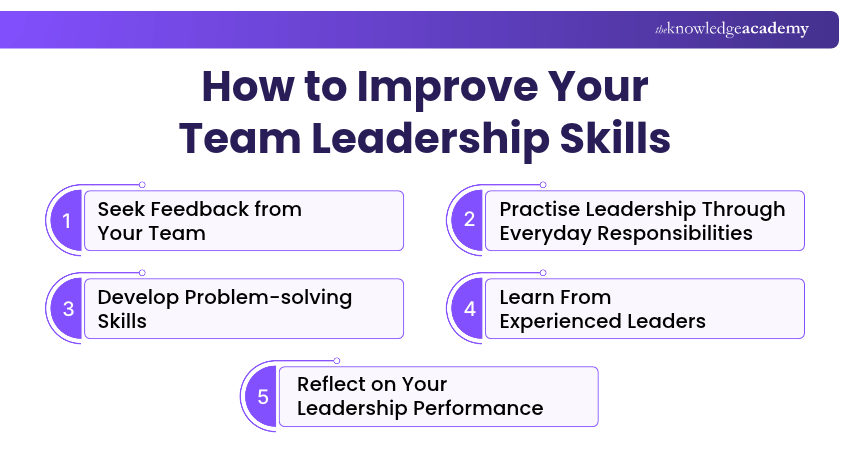
1) Seek Feedback from Your Team: Ask colleagues about your leadership approach and identify specific behaviours that could improve teamwork.
2) Practise Leadership Through Everyday Responsibilities: Take opportunities to coordinate tasks, lead discussions and support colleagues in completing shared activities.
3) Develop Problem-solving Skills: Identify recurring team problems, discuss possible solutions with colleagues and evaluate the results of your decisions.
4) Learn From Experienced Leaders: Observe how effective managers handle difficult conversations, organise responsibilities and guide teams through challenges.
5) Reflect on Your Leadership Performance: Regularly review your decisions, recognise what worked well and set personal improvement goals.
Quick Self-Check
Think about your most recent team project:1. Did everyone understand their responsibilities?2. Did team members feel comfortable raising concerns?3. Did you provide enough support without excessive supervision?4. What is one leadership behaviour you would improve next time?
Strong team leadership develops through everyday decisions, interactions and a willingness to improve. By applying these skills consistently, learning from experience and addressing unhelpful leadership habits, you can create a more supportive environment where teams can work effectively towards common objectives.
Build the confidence to lead teams, manage performance and support professional growth with our Leadership Courses - Sign up today!

The Knowledge Academy develops accessible learning content across Project Management, IT, Cybersecurity, Data Science, Business Analysis, HR, Accounting and Finance, Leadership and Health and Safety. Its resources combine subject research with clear explanations to help professionals build practical knowledge across a wide range of disciplines.
View Detail

 If you wish to make any changes to your course, please


