


We may not have the course you’re looking for. If you enquire or give us a call on 01344203999 and speak to our training experts, we may still be able to help with your training requirements.
Home
 Resources
IT Security & Data Protection
Top Skills of Ethical Hackers: Build Expertise in Cybersecurity
Resources
IT Security & Data Protection
Top Skills of Ethical Hackers: Build Expertise in Cybersecurity
Top Skills of Ethical Hackers: Build Expertise in Cybersecurity
ByThe Knowledge AcademyLast updated on: 12 November 2026
Explore the top skills of Ethical Hackers, from networking, Linux and programming to penetration testing, cloud security and analytical thinking. These technical and professional abilities help identify vulnerabilities, assess security risks and strengthen cybersecurity defences.
At a Glance
Ethical hacking requires technical expertise, practical testing skills and responsible security practices. Here are the key areas:
1. Core Technical Skills: Build knowledge of networking, operating systems and programming to understand how systems work and where vulnerabilities may exist.2. Security Assessment Skills: Learn to identify, evaluate and validate security weaknesses through vulnerability assessments and penetration testing.3. Advanced Security Skills: Develop expertise in web applications, databases, cloud environments and reverse engineering for specialised security assessments.4. Analytical and Reporting Skills: Strengthen problem-solving abilities to investigate security risks, interpret findings and recommend appropriate solutions.5. Practical Skill Development: Improve your abilities through authorised testing environments, hands-on exercises and continuous learning.
Every year, organisations and individuals face cyber threats that can potentially lead to financial losses, data breaches and operational disruptions. However, hacking is not always associated with malicious activities.
Some security professionals use authorised testing techniques to identify weaknesses in computer systems and help organisations strengthen their defences. Known as Ethical Hackers, these professionals play an important role in identifying security risks and protecting digital assets.
But what skills do they need to carry out these responsibilities effectively? In this blog, we will explore the top skills of Ethical Hackers and practical ways to develop them. Let's get started!
Top Skills for Ethical Hackers
Ethical hacking involves using authorised security testing techniques to identify vulnerabilities in computer systems, networks and applications. Ethical Hackers require a combination of technical expertise, analytical thinking and problem-solving abilities to evaluate security weaknesses and recommend appropriate measures.
Here are the key skills that can help Ethical Hackers perform different types of security assessments effectively:
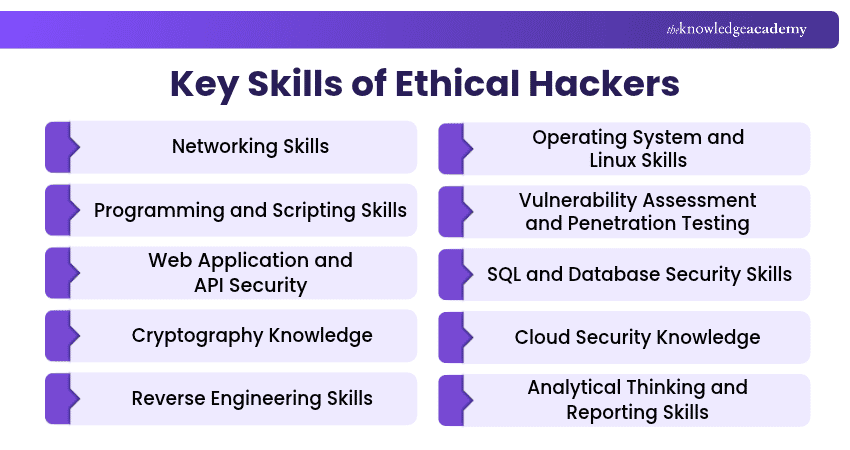
1) Networking Skills
Networking is one of the most important skills for an Ethical Hacker. Understanding how computers and devices communicate helps them identify potential security weaknesses and assess network configurations. Important areas include:
a) Understanding Network Protocols: Knowledge of protocols such as TCP, UDP, HTTP, HTTPS and DNS helps Ethical Hackers understand data communication and identify potential security risks.
b) Packet Analysis: Analysing network packets using tools such as Wireshark helps professionals examine traffic patterns and identify suspicious or insecure communications.
c) Firewalls and Routers: Understanding firewall rules, routing and network segmentation helps Ethical Hackers assess how networks control traffic and restrict unauthorised access.
d) Network Security Tools: Familiarity with tools such as Nmap helps professionals examine authorised networks, identify exposed services and assess potential weaknesses.

2) Operating System and Linux Skills
Ethical Hackers must understand how different operating systems work, particularly Windows and Linux. Knowledge of system configurations, user permissions, processes and security settings helps them identify potential vulnerabilities.
Linux skills are especially valuable because many security assessment tools operate in Linux environments. Ethical Hackers use command-line utilities to examine system configurations, analyse logs and perform network-related tasks. Understanding Linux permissions, scripting and system administration also helps them assess security weaknesses more effectively.
3) Programming and Scripting Skills
Programming skills help Ethical Hackers understand how software works and identify weaknesses in its code or behaviour. Languages such as Python, JavaScript, Bash and PowerShell are useful for automating repetitive tasks, analysing information and creating customised testing scripts.
Knowledge of programming also helps professionals understand application logic, investigate security vulnerabilities and communicate technical findings to developers. While advanced programming expertise is not necessary for every role, strong scripting abilities can make security assessments more efficient.
4) Vulnerability Assessment and Penetration Testing
Vulnerability assessment and penetration testing are essential skills for identifying and evaluating security weaknesses. Ethical Hackers use structured testing methods to examine systems, networks and applications for vulnerabilities that attackers could potentially exploit.
Vulnerability assessments focus on identifying and evaluating weaknesses, while penetration testing involves controlled attempts to demonstrate whether identified weaknesses can be exploited and assess their potential impact. Professionals must conduct these activities within an authorised scope, document findings and recommend suitable security improvements.
Trainer's Insight
Finding a vulnerability is only the beginning of a security assessment. Ethical Hackers must also determine its potential impact within the approved testing scope. For example, an exposed service may appear risky, but its actual significance depends on the system's configuration, accessibility and the information it could expose.
5) Web Application and API Security
Web applications and Application Programming Interfaces (APIs) can contain vulnerabilities that expose sensitive information or allow unauthorised actions. Ethical Hackers must understand how these technologies work and how security weaknesses can affect them.
Important areas include authentication, authorisation, session management, input validation and API access controls. Familiarity with vulnerabilities such as SQL injection, Cross-site Scripting (XSS), Cross-site Request Forgery (CSRF) and broken object-level authorisation in APIs helps professionals assess application security and recommend appropriate safeguards.
Build stronger defences behind every website by signing up for the Web Application Security Training today!
6) SQL and Database Security Skills
SQL and database security knowledge helps Ethical Hackers understand how applications store, retrieve and protect information. They need to be familiar with database queries, user permissions, authentication mechanisms and common security weaknesses.
For example, understanding SQL injection helps professionals identify insecure database interactions during authorised security assessments. They also examine database access controls and configurations to identify risks involving unauthorised access or data exposure. These skills help organisations strengthen database security and protect sensitive information.
7) Cryptography Knowledge
Cryptography plays a crucial role in protecting sensitive information and securing digital communications. Ethical Hackers should understand encryption, hashing, digital signatures and common cryptographic protocols.
This knowledge helps them identify weaknesses such as outdated algorithms, insecure configurations or poor encryption key management. By assessing how cryptographic techniques are implemented, Ethical Hackers can recommend improvements that support data confidentiality, integrity and secure communication.
8) Cloud Security Knowledge
As organisations increasingly use cloud services, Ethical Hackers must understand the security risks associated with cloud environments. Knowledge of platforms such as Microsoft Azure and Google Cloud can help professionals assess relevant configurations and access controls.
Important areas include identity and access management, storage permissions, network configurations and the shared responsibility model. Understanding these concepts helps Ethical Hackers identify potential misconfigurations and assess security risks within authorised cloud environments.
9) Reverse Engineering Skills
Reverse engineering involves analysing software to understand its internal structure, functionality and behaviour. Ethical Hackers may use this technique to investigate applications, examine compiled code and observe software behaviour during execution to identify potential security weaknesses.
These specialised skills are particularly useful when assessing software without access to its original source code or investigating unfamiliar applications. Knowledge of programming, assembly language and software analysis tools can help professionals understand how applications operate and where vulnerabilities may exist.
10) Analytical Thinking and Reporting Skills
Ethical Hackers encounter complex security challenges involving interconnected systems, multiple security controls and evolving threats. Strong analytical and problem-solving abilities help them investigate unusual behaviour, identify underlying weaknesses and evaluate potential risks.
Reporting skills are equally important. After completing an assessment, Ethical Hackers must document their findings, explain the potential impact and recommend appropriate remediation measures. Clear reports help technical teams and organisational stakeholders understand security concerns and prioritise improvements.
How to Develop Ethical Hacking Skills?
Developing ethical hacking skills requires continuous learning, technical practice and an understanding of responsible security testing. Here are some effective ways to strengthen your abilities and prepare for practical cybersecurity challenges:
a) Build a Strong Technical Foundation: Start by learning networking, operating systems, programming and cybersecurity fundamentals. These provide the knowledge needed to identify vulnerabilities and understand security risks.
b) Practise in Authorised Testing Environments: Gain hands-on experience using cybersecurity labs, simulated networks and intentionally vulnerable applications. Practise security testing techniques only within approved environments.
Pro Tip
Keep a learning journal for every authorised security lab you complete. Record the testing objective, tools used, observations and lessons learned. Reviewing these notes over time can help you identify recurring mistakes, measure progress and build stronger problem-solving habits.
a) Learn Security Testing Methodologies: Study recognised resources and learn structured approaches to identifying vulnerabilities, assessing risks and validating findings within authorised testing boundaries.
b) Develop Reporting and Documentation Skills: Practise documenting vulnerabilities, their potential impact and recommended solutions. Clear reports help organisations understand security risks and prioritise corrective actions.
c) Pursue Relevant Training and Certifications: Consider ethical hacking courses and practical certifications to strengthen your knowledge. Structured training can help you gain practical experience and demonstrate your technical abilities.
Explore vulnerabilities effectively and strengthen your testing expertise with the Ethical Hacking Training now!

The Knowledge Academy develops accessible learning content across Project Management, IT, Cybersecurity, Data Science, Business Analysis, HR, Accounting and Finance, Leadership and Health and Safety. Its resources combine subject research with clear explanations to help professionals build practical knowledge across a wide range of disciplines.
View Detail

 If you wish to make any changes to your course, please


