


 Top Rated Course

We may not have the course you’re looking for. If you enquire or give us a call on 01344203999 and speak to our training experts, we may still be able to help with your training requirements.
Presentation Skills: What are They and How to Improve Them?
Charlotte Wilson 05 September 2026Presentation skills shape how effectively you communicate ideas and connect with an audience. Discover the skills that matter and practical ways to improve them.

Training Outcomes Within Your Budget!
We ensure quality, budget-alignment, and timely delivery by our expert instructors.
Table of Contents

Key Takeaways
1. Presentation skills combine verbal and non-verbal communication to help speakers communicate ideas effectively.2. Strong presentations rely on clear communication, structure, storytelling, body language and audience engagement.3. Effective presenters adapt their tone, pace and delivery according to their audience and situation.4. Visual aids should support your message rather than distract the audience from it.5. Presentation skills can be strengthened through preparation, practice, feedback and self-review.
Your presentation is ready
Your slides look polished
You know the topic inside out
But when you stand in front of the audience, you realise that people are paying more attention to your slides than you. The problem is not necessarily your knowledge. It is how that knowledge is being presented.
As bestselling author and professional speaker Lilly Walters put it, “The success of your presentation will be judged not by the knowledge you send but by what the listener receives.”
This is where Presentation Skills make the difference. They help you organise your message, communicate with confidence, engage your audience and respond effectively when things do not go exactly as planned. Let’s explore the skills that can help you become an effective presenter.
What are Presentation Skills?
Presentation skills are a combination of abilities that help individuals communicate information, ideas or messages effectively to an audience. They involve more than simply speaking in front of people. Verbal communication, non-verbal communication and audience engagement all contribute to effective presentation delivery.
These skills can be useful in professional, academic and personal situations, including:
a) Business meetings
b) Sales pitches
c) Training sessions
d) Public speeches
e) Academic presentations
f) Project proposals

Why are Presentation Skills Important?
Strong presentation skills can help people communicate information effectively, influence decisions and build confidence in different situations. Here are some key reasons why presentation skills are important:
1) Support Career Development: Professionals frequently need to explain ideas, present proposals or communicate results. Strong presentation skills can help them communicate their expertise in these situations.
2) Build Credibility: Clear and confident communication can help presenters demonstrate knowledge and establish credibility with colleagues, clients and other stakeholders.
3) Strengthen Leadership Communication: Leaders often need to communicate goals, explain decisions and motivate teams. Presentation skills can help them communicate their vision clearly and encourage people to work towards shared objectives.
4) Influence Decisions: Presentations can be used to communicate recommendations, proposals and evidence. A well-structured presentation can make an argument easier for an audience to understand and evaluate.
5) Improve Teaching and Learning: Teachers, trainers and other educators use presentations to explain information and make complex ideas easier to understand.
6) Develop Public Speaking Confidence: Preparing and practising presentations can help individuals grow more comfortable speaking in front of groups.
7) Improve Professional Communication: Presentation skills can also strengthen broader communication abilities by encouraging people to organise ideas, listen to feedback and adapt messages for different audiences.
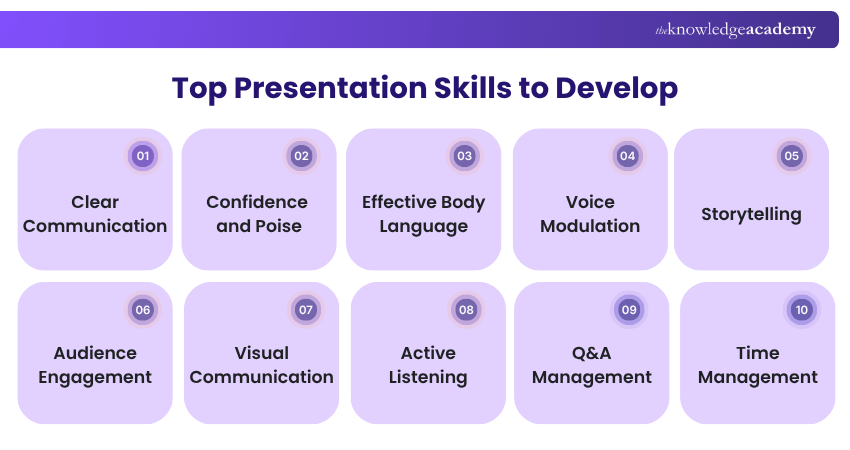
Top Presentation Skills to Develop
Delivering an effective presentation requires a combination of communication, preparation and audience management skills. Here are some of the most important presentation skills to develop:
1) Clear Communication
Clear communication is the ability to express ideas in a concise and understandable way. Presenters should organise their thoughts carefully and avoid unnecessary jargon or complicated explanations that could confuse their audience.
Pro Tip
Before preparing your presentation, complete this sentence: “If my audience remembers only one thing, it should be…” Use your answer to guide the rest of your content.
2) Confidence and Poise
Confidence helps presenters communicate their ideas with greater authority. Feeling nervous does not automatically mean a presentation will be unsuccessful. Preparation, familiarity with the subject and regular practice can make nervousness easier to manage. The aim is not to appear perfect, but to remain composed enough to communicate effectively.
3) Effective Body Language
Body language contributes significantly to how a presentation is perceived. An open posture, natural gestures and appropriate facial expressions can reinforce the speaker's message and help communicate confidence. Avoid movements that unnecessarily distract attention from what you are saying.
4) Voice Modulation
Speaking in the same tone and pace throughout a presentation can make it difficult to maintain attention. Effective presenters vary elements such as tone, pitch and pace to add emphasis and interest to their delivery. Strategic pauses can also give the audience time to process important information.
5) Storytelling
Stories can make information easier to relate to and remember. Presenters may use relevant anecdotes, examples, case studies or experiences to illustrate their ideas and create an emotional connection with the audience. The story should always support the main message rather than becoming a distraction from it.
Trainer Insight
Your verbal and non-verbal communication should reinforce each other. Clear words combined with appropriate eye contact, posture and gestures can make your message more convincing.
6) Audience Engagement
A presentation should not feel like information is simply being delivered to an audience. Presenters can maintain engagement by asking questions, inviting opinions or using appropriate interactive activities. Paying attention to audience reactions can also indicate when an explanation needs to be clarified or adjusted.
Find your voice and command the room. Sign up for our Public Speaking Course now!
7) Visual Communication
Slides, charts, images and videos can make information easier to understand when used appropriately. Visual aids should be relevant, easy to interpret and directly connected to the speaker's message. They should support the spoken content rather than overwhelm it.
8) Active Listening
Listening is important even when you are the person presenting. Audience questions, reactions and feedback can provide clues about whether your message is being understood. Active listening helps presenters adjust their delivery or explanation where necessary.
9) Q&A Management
Q&A management involves handling audience questions clearly and confidently. Anticipate likely questions where possible, listen to each question fully and provide concise, relevant answers. If you do not know an answer, acknowledge it rather than providing information you cannot verify.
10) Time Management
Effective presenters respect the allocated time. Rehearsing beforehand can help determine whether the presentation contains too much information and identify sections that need to be shortened. Allow sufficient time for important points and, where appropriate, audience questions.
11) Adaptability
Not every presentation will unfold exactly as planned. An audience may react differently than expected, technology may fail or the available time may suddenly change. Adaptability enables presenters to adjust their approach without losing sight of their core message.
12) Subject Knowledge
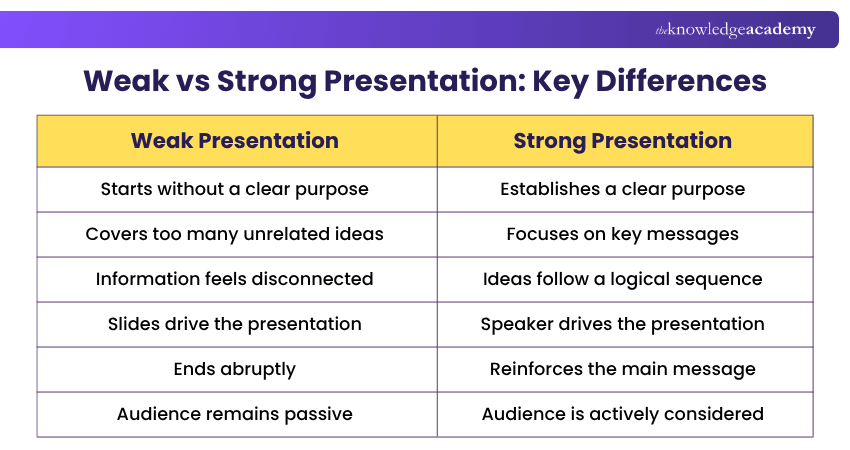
Strong subject knowledge helps presenters explain ideas accurately and respond to relevant questions with confidence. Understanding your topic beyond the information shown on your slides also makes it easier to provide examples, clarify complex points and adapt explanations to audience needs. A well-structured presentation makes it more convenient for the audience to follow the speaker's ideas:
A simple structure may include:
Opening → Context → Key Points → Evidence or Examples → Summary → Conclusion
How to Improve Your Presentation Skills?
Improving presentation skills requires more than simply giving more presentations. Effective improvement comes from identifying weaknesses, practising deliberately and reviewing your performance. Here are practical ways to boost your presentation skills:
1) Understand Your Audience
Before creating your presentation, consider who will be listening. Ask yourself:
1) What does the audience already know?
2) What do they need to learn?
3) Why does the topic matter to them?
4) What action should they take afterwards?
Having a strong grasp of these factors can help you choose the appropriate level of detail, language and examples.
2) Practise Regularly
Practise helps you grow more familiar with your content and reduces dependence on slides or scripts. Practise aloud rather than simply reading through the material silently. This makes it easier to identify awkward sentences, unclear transitions and timing problems.
3) Record Yourself Presenting
Recording a practice session allows you to review your performance from the audience's perspective. Pay attention to:
1) Speaking pace
2) Vocal variety
3) Eye contact
4) Body language
5) Repetitive gestures
6) Filler words
Pro Tip
Watch your recording once without sound to assess your body language. Then listen without watching to evaluate your pace, clarity, pauses and vocal delivery.
4) Ask for Constructive Feedback
Practise in front of colleagues, friends or other trusted people and ask for specific feedback. Instead of asking, “Was it good?”, ask questions such as:
1) Was my main message clear?
2) Which section was difficult to follow?
3) Did anything feel unnecessary?
4) Was my speaking pace comfortable?
5) Which part was most memorable?
Specific questions usually produce more useful feedback.
5) Rehearse Within the Allocated Time
Time the entire presentation during practice. If you regularly exceed the limit, prioritise the most important information rather than simply trying to speak faster. Leave some flexibility for pauses, transitions and audience interaction.
6) Review Every Presentation
After presenting, consider:
1) What worked well?
2) Where did I struggle?
3) How did the audience respond?
4) What should I change next time?
Small improvements after every presentation can gradually strengthen your overall ability.
Presentation Preparation Checklist
Before presenting, ask yourself:
Do I understand my audience? Is my main message clear? Does the content follow a logical structure? Are my slides simple and relevant? Have I rehearsed aloud? Can I finish within the allocated time? Have I prepared for likely questions? Am I using notes as prompts rather than a script? Have I checked the equipment and environment where appropriate? Do I have a strong opening and conclusion?
Conclusion
Presentation skills help you communicate ideas clearly, confidently and effectively across professional, academic and personal settings. From storytelling and body language to audience engagement and preparation, each skill contributes to stronger delivery. With deliberate practice, constructive feedback and regular self-review, you can continue improving your ability to inform, engage and connect with any audience.
Want to leave a lasting impression with your next big presentation? Sign up for our Presentation Skills Course now!
Frequently Asked Questions
Should You Memorise a Presentation Word for Word?

Not necessarily. Memorising every word can make it difficult to recover if you forget part of the script. Instead, learn the structure, key messages and transitions so you can explain them naturally. Understand and internalise key points rather than depending entirely on word-for-word recall.
What Should You do if Your Mind Goes Blank During a Presentation?
Pause briefly, refer to your key points or slide and return to the main idea you were explaining. Using a small number of keywords or prompts can make it easier to recover your train of thought.
What Should You do if Your Mind Goes Blank During a Presentation?
Keep slide text focused on information that genuinely supports the audience's understanding. Use concise headings, keywords, data or relevant visuals rather than turning slides into a transcript of your speech.
Is it Better to Practise a Presentation Alone or in Front of Others?
Both can be useful. Practising alone helps you refine your content, timing and delivery, while presenting to another person can provide feedback and make the rehearsal closer to the real experience.

Charlotte Wilson


Soft Skills and Business Training Manager
Charlotte Wilson is an expert in soft skills development, with over 14 years of experience helping individuals and teams improve communication, productivity and emotional intelligence in the workplace. Her training content is focused on enhancing interpersonal effectiveness and fostering positive, collaborative environments across all levels of an organisation.
View Detail

 If you wish to make any changes to your course, please


