


We may not have the course you’re looking for. If you enquire or give us a call on 01344203999 and speak to our training experts, we may still be able to help with your training requirements.
Essential Minute Taking Skills Every Professional Should Know
ByNaveena VenkatesanLast updated on: 17 September 2026
Turning a fast-moving discussion into a structured record takes a specific set of skills. Explore the skills that can make minute taking more accurate, organised, and effective.

A meeting ends, everyone leaves, and a few days later someone asks, “What did we actually decide?” If nobody can remember the answer, an important part of the meeting has already been lost.
Good minute taking prevents this. It is not about writing down every word. It is about knowing what matters, what was agreed, and what needs to happen next.
But capturing the right details while a discussion is moving quickly is not always easy. So, what skills can help you keep up without losing what matters? Let’s find out!
What are Minute Taking Skills?
Minute taking skills are the abilities used to listen to meeting discussions, identify important information, and record it in a clear and structured way. They involve more than simply writing notes.
A minute taker needs to distinguish key decisions, action points, responsibilities, deadlines, and important discussion points from information that does not need to appear in the final record. This makes it easier for attendees and other stakeholders to review decisions, follow up on actions, and maintain accountability after the meeting.

Why are Minute Taking Skills Important?
Meetings often involve multiple discussions, decisions, and responsibilities. Without a clear record, important information can easily be forgotten, misunderstood, or overlooked.
Strong minute taking skills help create a reliable reference that attendees can use after the meeting. They can support:
1) Clear Decision Records: Document what was agreed during the meeting.
2) Action Tracking: Record tasks, responsibilities, and relevant deadlines.
3) Shared Understanding: Provide attendees with a common reference for what was discussed and agreed.
4) Accountability: Make agreed responsibilities easier to follow up.
5) Meeting Continuity: Provide context for discussions that continue in future meetings.
The Next-day Test
Imagine someone who missed the meeting reads your minutes the next day.
Can they understand:
What was discussed?What was decided?Who needs to act?What happens next?If they can, your minutes are doing their job.
Essential Minute Taking Skills
Effective minute taking starts with knowing how to listen, identify important information, and turn it into a clear record. Here are the core skills every minute taker should develop:
1) Active Listening
Active listening involves giving full attention to the discussion and understanding what is being communicated.
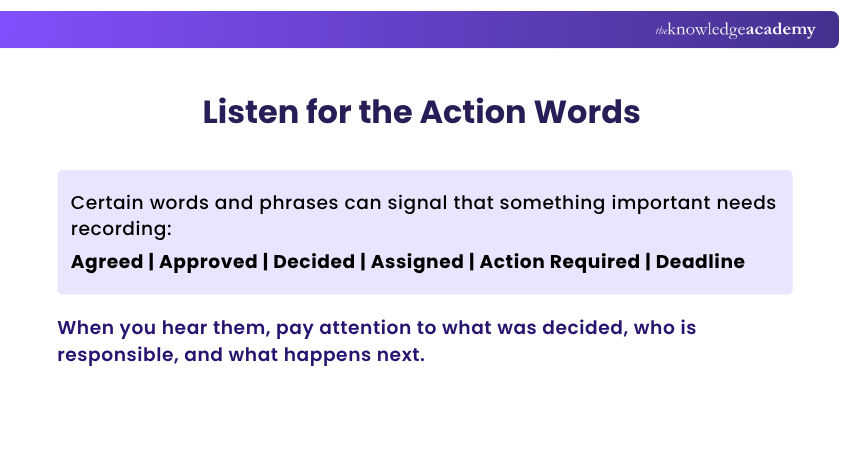
Rather than trying to capture every sentence, listen for information that affects the meeting outcome, including decisions, actions, deadlines, responsibilities, and important changes.
2) Concise Note-taking
Trying to write everything down can make it difficult to keep up with a fast-moving discussion.
Concise note-taking means capturing key information using short phrases, keywords, abbreviations, or symbols. After the meeting, these notes can be refined and organised into clear meeting minutes.
3) Effective Summarisation
A ten-minute discussion may result in only one important decision. Effective summarisation involves reducing lengthy conversations into their essential points and outcomes without changing the meaning.
The aim is to give readers enough context to understand what happened without reproducing the entire conversation.
Trainer’s Insight:
The best minutes are not always the longest. A short record that clearly captures decisions and actions can be more useful than several pages of unnecessary discussion.
4) Attention to Detail
Names, dates, figures, deadlines, and responsibilities need to be recorded accurately. Paying close attention to these details can prevent confusion later and ensure important actions are not assigned to the wrong person or recorded with an incorrect deadline.
5) Objective Writing
Meeting minutes should provide a neutral account of what happened. Avoid personal opinions, assumptions, or emotional descriptions. Focus instead on the relevant facts, decisions, actions, and outcomes of the discussion.
Advanced Minute Taking Skills
Once the core skills are in place, advanced minute taking skills can help professionals handle longer, faster, and more complex meetings. Those skills include:
1) Structured Organisation
Well-organised minutes allow readers to find important information quickly. Where appropriate, follow the meeting agenda and use consistent headings, numbered sections, action lists, or other formatting to create a logical flow.
2) Time Management
Minute taking does not end when the meeting finishes. Minute takers need to manage their time during the meeting while also allowing enough time afterwards to review notes, clarify information, prepare the minutes, and distribute them within the required timeframe.
3) Adaptability
Meetings do not always follow the agenda. Discussions may move unexpectedly, new topics may arise, or several people may speak in quick succession.
A skilled minute taker can adjust their approach while continuing to identify and capture the information that matters.
Improve your note-taking speed and capture spoken information accurately with our Shorthand Training - Join now!
4) Clarification Skills
Sometimes an action, responsibility, or decision may not be completely clear. When appropriate, a simple question such as “Can I confirm who is responsible for that action?” can prevent uncertainty from appearing in the final minutes.
5) Handling Complex Discussions
In meetings where several people contribute, topics overlap, or discussions move quickly, keeping track of the conversation can become challenging.
Skilled minute takers can follow these discussions while identifying key viewpoints, decisions, actions, and changes in direction without allowing unnecessary detail to overwhelm their notes.
How to Improve Your Minute Taking Skills?
Strong minute taking skills develop through preparation, practice, and regular review. A few simple habits before, during, and after a meeting can make your notes clearer and easier to turn into useful meeting minutes.
1) Review the Agenda Beforehand
Read the agenda before the meeting to understand the topics and expected flow. This helps you prepare for important discussions and anticipate what information may need to be recorded.
2) Prepare a Template
Set up sections for agenda items, key points, decisions, actions, owners, and deadlines before the meeting begins.
A ready-made structure lets you focus more on listening and less on organising your notes while people are speaking.
3) Develop Useful Abbreviations
Use simple abbreviations or symbols for terms that appear frequently during meetings. Keep them clear and consistent so your notes remain easy to understand afterwards.
4) Separate Actions from Discussions
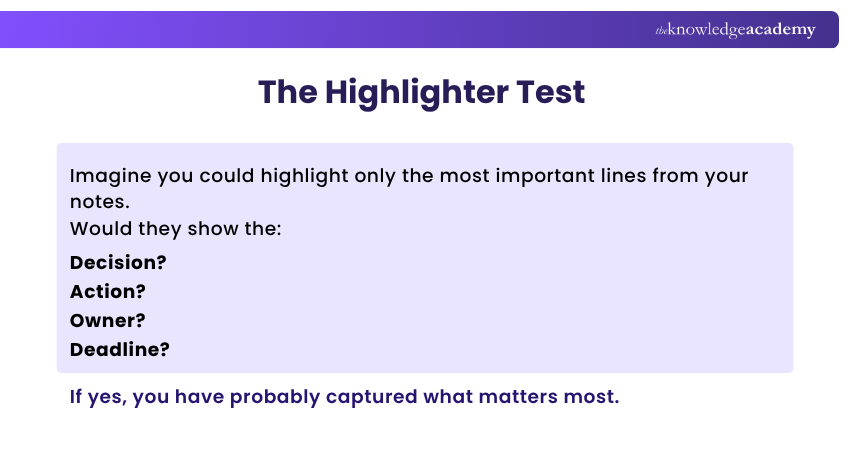
Make decisions and action items stand out in your working notes. You could use headings, symbols, or separate columns so they are easy to identify when preparing the final minutes.
5) Review Your Notes Promptly
Review your notes soon after the meeting while the discussion is still fresh. This makes it easier to clarify shorthand, add necessary context, and identify anything that may be missing.
Common Trap:
Trying to make your working notes grammatically perfect can slow you down. Capture the meaning first and polish the language when preparing the final minutes.
Common Minute Taking Mistakes to Avoid
Even experienced minute takers can miss important details or record too much information. Avoiding these common mistakes can help keep meeting minutes clear, accurate, and useful:
1) Trying to Record Everything: Focus on key discussions, decisions, and actions instead of capturing every word.
2) Missing Action Owners: When an action is assigned, clearly record who is responsible for completing it.
3) Adding Personal Opinions: Keep meeting minutes factual and neutral without adding assumptions or personal views.
4) Using Unclear Abbreviations: Use shortcuts that remain easy to understand when you review your notes later.
5) Waiting too Long to Draft: Prepare the minutes promptly while the meeting and context are still fresh.
6) Losing the Meeting Structure: Organise the minutes around the agenda or agreed meeting structure so information is easy to find.
Strengthen your administrative, organisational, and professional support skills with our PA and Secretarial Training - Join now!

Naveena Venkatesan is a Content Editor with 2+ years of experience in content writing, editing and linguistic quality assurance. Her research, fact-checking and editorial experience enable her to develop accurate, accessible resources across Business Skills, Human Resources, and Accounting and Finance.
View Detail

 If you wish to make any changes to your course, please


