


We may not have the course you’re looking for. If you enquire or give us a call on 01344203999 and speak to our training experts, we may still be able to help with your training requirements.
Top 15 Integration Architect Skills for Career Success
ByThe Knowledge AcademyLast updated on: 11 November 2026
Explore 15 essential Integration Architect skills, from API management and cloud integration to security, testing and technical leadership. Learn how these capabilities support reliable system integration and discover practical ways to develop them.
What You'll Learn
1. What Integration Architects do and how they connect enterprise applications, services and data.2. Which technical skills support integration design, API management and event-driven communication.3. How cloud integration, data transformation and security contribute to reliable solutions.4. Why testing, observability and DevOps practices matter throughout the integration lifecycle.5. How to develop communication, problem-solving and leadership skills needed for integration projects.
Imagine if your favourite apps, cloud platforms and business systems couldn't communicate. Sounds chaotic, right? This is where Integration Architects come in, connecting technologies and ensuring information flows smoothly across organisations.
But designing effective integration solutions takes more than technical knowledge. It requires understanding business needs, making informed design decisions and balancing performance, security and scalability. Let's explore the essential skills behind effective integration architecture.
Essential Integration Architect Skills
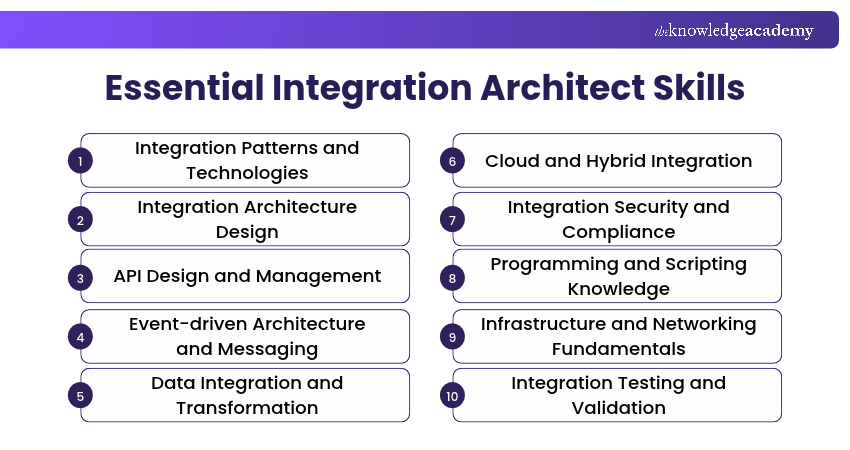
Integration Architects need a diverse set of skills to design, develop and oversee solutions that connect applications, data and business processes. Here are 15 essential Integration Architect skills:
1) Integration Patterns and Technologies
Integration Architects must understand different integration methods, patterns and technologies used to connect applications and systems. These include point-to-point integration, hub-and-spoke architecture, publish-subscribe messaging and event-driven integration.
They also need familiarity with middleware, message brokers, Extract, Transform, Load (ETL) tools and integration platforms. Understanding these approaches helps them select suitable solutions based on communication requirements, system dependencies and performance needs.

2) Integration Architecture Design
Integration architecture design involves creating a structured approach for connecting applications, data sources and enterprise systems. Integration Architects must understand how different components interact and ensure that the overall architecture meets business and technical requirements.
They need to define integration principles, interfaces, workflows and system dependencies. Knowledge of architectural approaches such as Service-Oriented Architecture (SOA) and microservices helps them design solutions that support interoperability, maintainability and future changes.
3) API Design and Management
Application Programming Interfaces (APIs) allow different applications to exchange information and access services. Integration Architects need strong API design and management skills to support effective communication between systems.
They should understand REST, SOAP, GraphQL, HTTP methods, status codes and data formats such as JSON and XML. They also need knowledge of API versioning, documentation, lifecycle management and monitoring. Tools and platforms such as Apigee, MuleSoft Anypoint Platform and WSO2 API Manager can support API management and governance.
4) Event-driven Architecture and Messaging
Event-driven architecture allows systems to communicate and respond when specific events occur. Instead of relying entirely on direct requests, applications can publish events and exchange messages asynchronously through queues, topics and event brokers.
Integration Architects should understand messaging patterns, event producers, consumers and message delivery behaviour. Familiarity with technologies such as Apache Kafka, RabbitMQ and Azure Service Bus helps them design loosely coupled systems that can handle changing workloads and temporary service disruptions.
5) Data Integration and Transformation
Data integration and transformation skills help Integration Architects connect different data sources and ensure that information moves between systems in a consistent and usable format.
They need to understand data mapping, transformation rules, validation, synchronisation and data quality. Knowledge of ETL processes and Master Data Management (MDM) is also valuable when integrating enterprise data. These skills help organisations maintain consistency across applications and reduce errors caused by incompatible data structures.
6) Cloud and Hybrid Integration
Cloud and hybrid integration involves connecting applications and services across cloud platforms and on-premises environments. Integration Architects should be familiar with platforms such as Amazon Web Services (AWS), Microsoft Azure and Google Cloud.
Knowledge of services such as Azure Logic Apps, AWS Lambda and Cloud Run functions can support different integration and event-processing requirements. They also need to understand how to integrate Software as a Service (SaaS) applications, including Salesforce, Workday and Shopify, with other business systems.
7) Integration Security and Compliance
Integration security is essential because connected systems often exchange sensitive business and customer information. Integration Architects must understand how to protect data, applications and communication channels from unauthorised access and security threats.
Important skills include authentication, authorisation, encryption, secure API communication and access control. They should also understand security technologies such as OAuth 2.0, OpenID Connect and Transport Layer Security (TLS), along with relevant data protection and compliance requirements.
8) Programming and Scripting Knowledge
Although Integration Architects are not always responsible for writing production code, programming knowledge helps them understand how integration components are developed and implemented.
They should be familiar with programming or scripting languages such as Java, Python, JavaScript or C#, depending on the organisation's technology stack. Understanding code structure, error handling, debugging and version control allows them to review implementations and provide technical guidance to Developers.
9) Infrastructure and Networking Fundamentals
Integration solutions depend on networks, servers, operating systems and other infrastructure components. Integration Architects need a sound understanding of these technologies to design reliable connections between systems.
They should be familiar with networking concepts such as DNS, TCP/IP, HTTP, HTTPS, firewalls and load balancing. Knowledge of Linux, Unix-like environments, cloud infrastructure and command-line tools can also help them understand deployment requirements and troubleshoot connectivity issues.
Become a pro at integrating applications, data and technologies seamlessly by signing up for the Enterprise Integration Practitioner Training now!
10) Integration Testing and Validation
Testing helps verify that connected applications exchange data correctly and perform as expected. Integration Architects need to understand testing methods and how to define appropriate validation requirements.
They should be familiar with integration testing, API testing, contract testing, system testing and performance testing. Tools such as Postman and SoapUI can help test API requests, responses and service behaviour.
11) Reliability and Observability
Reliability and observability skills help Integration Architects design systems that remain dependable and can be monitored effectively. Since integrated applications often depend on external services, failures or delays in one system may affect others.
Integration Architects need to understand error handling, retries, timeouts, circuit breakers and message processing behaviour. They should also be familiar with logging, metrics, tracing and alerting techniques to help teams identify and investigate integration issues.
Trainer Insight
A successful integration should handle temporary network disruptions, service outages and duplicate messages without causing unnecessary data loss or inconsistent results. Architects should consider retries, idempotency, monitoring and recovery mechanisms during the design stage rather than after deployment.
12) Deployment and DevOps Practices
Integration Architects need to understand how integration solutions are deployed, configured and maintained across different environments. Knowledge of DevOps practices helps them support consistent deployment and collaboration between development and operations teams.
They should be familiar with Continuous Integration and Continuous Delivery (CI/CD), version control, automated testing and configuration management. Understanding containerisation and deployment automation can also help them evaluate modern integration environments.
13) Technical Documentation and Governance
Technical documentation helps teams understand how integration solutions are designed, implemented and maintained. Integration Architects must be able to create and review clear documentation that supports development, testing and future system changes.
This includes architecture diagrams, API specifications, data mappings, interface definitions and technical design decisions. They also need to establish integration standards and governance practices to maintain consistency across projects.
14) Stakeholder Communication and Requirements Analysis
Integration Architects work with Business Analysts, Developers, IT teams and business stakeholders to understand integration requirements. Strong communication skills help them gather information, explain technical concepts and ensure that proposed solutions support organisational goals.
They need to identify business needs, clarify system limitations and translate requirements into technical designs. Presentation, negotiation and active listening skills are also useful when discussing architectural decisions and resolving conflicting expectations.
15) Problem-solving and Technical Leadership
Integration projects often involve complex systems, changing requirements and unexpected technical challenges. Integration Architects need strong problem-solving skills to analyse issues, evaluate possible solutions and make informed architectural decisions.
They may also provide technical leadership by guiding development teams, reviewing designs and encouraging consistent engineering practices. Their role involves balancing performance, cost, security, maintainability and business priorities when recommending solutions.
Did You Know?
An Integration Architect in the UK can earn an average yearly salary of £72K, with Leeds, London and Birmingham being the highest-paying cities.
How to Improve Your Integration Architect Skills?
Developing Integration Architect skills requires continuous learning and practical experience. Whether you are an aspiring Integration Architect or an experienced IT professional, the following approaches can help strengthen your abilities.
1) Build a Strong Technical Foundation: Develop knowledge of APIs, databases, networking, programming and integration patterns to understand how connected systems operate.
2) Gain Practical Integration Experience: Work on projects involving application integration, data transformation, cloud services or messaging technologies to apply architectural concepts.
3) Learn Cloud and Integration Platforms: Explore platforms such as AWS, Microsoft Azure, MuleSoft or Boomi to understand different integration capabilities and deployment approaches.
4) Practise Architecture Design: Create system diagrams, define API contracts and evaluate integration patterns for different business scenarios.
5) Develop Security and Testing Knowledge: Learn secure integration practices, API testing methods, observability techniques and common approaches to handling integration failures.
6) Strengthen Communication and Leadership: Practise gathering requirements, presenting technical solutions and collaborating with professionals from different teams.
7) Stay Updated with Industry Practices: Follow developments in cloud integration, API management, messaging systems and architectural design to keep your knowledge relevant.
Integration Architecture Review Checklist
Before approving an integration design, check whether the following requirements have been addressed:□ Confirm the integration's business requirements and system dependencies.□ Select suitable API, messaging or data integration patterns.□ Define data formats, mappings and validation requirements.□ Review authentication, authorisation and data protection controls.□ Plan error handling, monitoring, retries and recovery processes.□ Verify integration testing and production deployment requirements.□ Document interfaces, design decisions and operational responsibilities.
Gain insight into stakeholder engagement with the Information Architecture Training – Join now!

The Knowledge Academy develops accessible learning content across Project Management, IT, Cybersecurity, Data Science, Business Analysis, HR, Accounting and Finance, Leadership and Health and Safety. Its resources combine subject research with clear explanations to help professionals build practical knowledge across a wide range of disciplines.
View Detail

 If you wish to make any changes to your course, please


