


We may not have the course you’re looking for. If you enquire or give us a call on 01344203999 and speak to our training experts, we may still be able to help with your training requirements.
Essential Financial Analyst Skills for Career Success
ByOlivia TaylorLast updated on: 21 October 2026
Financial Analyst skills combine financial knowledge, analytical thinking, technical proficiency, and communication abilities. Explore the essential skills, from financial statement analysis and modelling to forecasting, risk assessment, and presenting financial insights.

The Gist
1. Financial Analysts combine analytical thinking, financial knowledge and sound judgement to support informed decisions.2. Financial statement analysis, modelling and forecasting help assess business performance and future outcomes.3. MS Excel, programming and automation simplify financial calculations, data analysis and reporting.4. Statistical analysis and risk management help identify uncertainties and evaluate financial risks.5. Strong communication, practical experience and continuous learning support career growth.
A company's revenue has increased, but its cash flow is declining. Is the business growing successfully, or could there be financial problems beneath the surface?
The intricate world of finance demands individuals who can navigate complex data, decipher trends, and confidently make strategic decisions. As businesses strive to stay competitive and investors seek reliable insights, Financial Analyst skills have become more critical than ever.
These skills extend beyond working with numbers. They bring together financial knowledge, analytical judgement, technical tools, and clear communication to turn complex information into useful business insights. Let’s learn more about it!
Essential Financial Analyst Skills
Financial Analysts require a diverse skill set to analyse financial data effectively, evaluate investment opportunities, and provide recommendations to clients or management. Here are the skills required for a Financial Analyst:
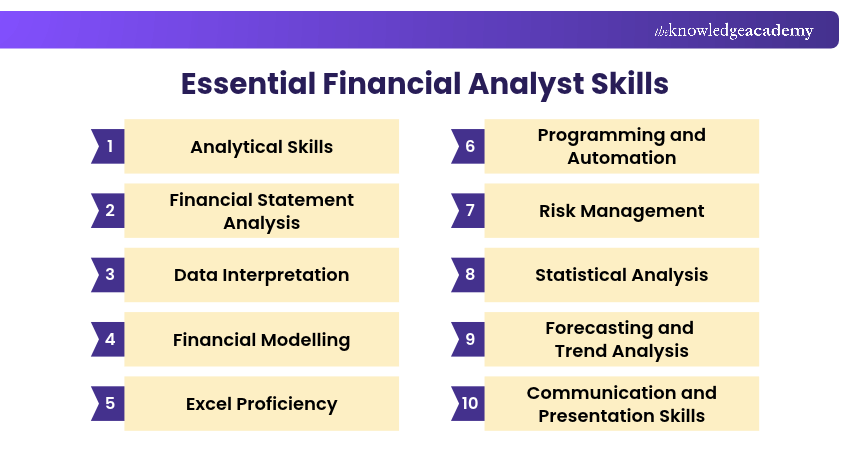
1) Analytical Skills
Analytical skills form the foundation of a Financial Analyst's expertise. In a field driven by data, these skills are the compass that guides professionals through the intricate world of financial information. These skills help analysts break down complex problems, examine evidence, compare alternatives, and reach conclusions that support financial decisions.
Key components include:
a) Data Analysis: Data analysis involves breaking down complex financial datasets into understandable information. Financial Analysts examine large volumes of data to identify patterns, trends, outliers and relationships that may influence financial performance and business decisions.
b) Critical Thinking: Critical thinking is the engine that drives effective decision-making. Financial Analysts are adept at scrutinising data from multiple angles, questioning assumptions, and considering their findings' micro and macro implications. This skill enables them to provide insightful recommendations that align with overarching business objectives.
c) Scenario Analysis: Analytical skills empower Financial Analysts to conduct scenario analysis, a technique crucial for risk assessment and strategy formulation. By modelling different scenarios based on various assumptions, analysts can assess potential outcomes, identify financial risks, and support contingency planning.
d) Comparative Analysis: Financial Analysts excel in comparative analysis, which involves benchmarking a company's performance against industry peers or historical data. This practice provides valuable insights into a company's strengths, weaknesses, and improvement areas, guiding decision-makers toward informed actions.
e) Quantitative Proficiency: Numerical aptitude is a cornerstone of analytical skills. Financial Analysts can manipulate and interpret quantitative data, applying statistical techniques to derive meaningful conclusions. This enables them to quantify risks, evaluate investment opportunities, and project future financial performance.
f) Business and Industry Awareness: Financial Analysts need to understand how industry trends, competition, economic conditions and business models influence financial performance. This knowledge helps them interpret data accurately and make recommendations that reflect real-world business conditions.

2) Financial Statement Analysis
Financial statement analysis involves examining a company's financial reports to evaluate its performance, financial position, and cash flow. It provides a foundation for understanding how a business generates revenue, manages resources, and meets its financial obligations.
The three primary financial statements are:
a) Income Statement: Displays revenue, expenses and profit or loss over a particular period. Analysts use it to examine profitability and operating performance.
b) Balance Sheet: Presents assets, liabilities and equity at a particular date. It helps assess the company's financial position and capital structure.
c) Cash Flow Statement: Shows cash inflows and outflows from operating, investing and financing activities. It helps analysts understand how cash is generated and used.
Financial Analysts also use techniques such as ratio analysis, horizontal analysis and vertical analysis to interpret these statements. Important financial ratios include profitability ratios, liquidity ratios, leverage ratios and efficiency ratios. These measures can help analysts compare performance across periods and businesses.
3) Data Interpretation
Data interpretation helps Financial Analysts understand financial information, identify meaningful patterns and draw conclusions that support business decisions. It involves evaluating data within its financial and economic context to understand what the numbers indicate about a company's performance and potential risks.
Let's explore the various facets that encompass this vital skill:
a) Data Contextualisation: Effective data interpretation begins with contextualisation. Financial Analysts understand that data is not just a series of numbers; it's a narrative that tells the story of a company's financial health, market trends, and economic influences. By considering business operations, industry conditions and economic developments, analysts can explain financial results and their implications for the organisation.
b) Key Metric Identification: Not all data points are created equal. Skilled Financial Analysts possess the ability to identify the key metrics that truly matter in a given analysis. Analysts can extract valuable insights that drive decision-making by focusing on these critical indicators.
c) Trend Recognition: One of the pivotal roles of data interpretation is recognising trends. Financial Analysts meticulously sift through historical data to identify patterns. These patterns include revenue fluctuations, expense trends, or market cycles. They also examine what these changes reveal about business performance.
d) Correlation and Causation: Data interpretation delves into the relationships between various data points. Financial Analysts assess correlations to identify whether variables move together. However, correlation alone does not establish that one variable causes changes in another. Establishing causation requires additional evidence and careful analysis.
e) Visual Representation: Data visualisation is an integral part of interpretation. Skilled Financial Analysts leverage charts, graphs, and infographics to turn complex data sets into easily digestible visuals. Visual representation also helps in conveying insights to non-technical stakeholders effectively.
f) Predictive Insights: Data interpretation isn't limited to the past; it extends into the future. Financial Analysts can make informed predictions about future financial trends by scrutinising historical data. These predictions guide strategic decision-making and risk assessment.
4) Financial Modelling
Financial modelling is the cornerstone of strategic decision-making for Financial Analysts. It involves creating mathematical representations of a company's financial performance, often projecting future scenarios based on various assumptions.
This skill empowers analysts to explore potential outcomes, analyse risks, and make well-informed choices. With the aid of financial modelling software, professionals can improve the efficiency and consistency of their analyses, provided that the underlying data, formulas and assumptions are checked carefully.
Let's dive into the key components that comprise this indispensable skill:
a) Scenario Building: Constructing simulations that explore multiple potential outcomes based on different assumptions.
b) Cash Flow Projections: Estimating future cash inflows and outflows to support financial planning and liquidity management.
c) Valuation Models: Estimating a company's or asset's value using methods such as Discounted Cash Flow (DCF) analysis and comparable company analysis.
d) Sensitivity Analysis: Assessing the impact of changing variables on outcomes to understand potential risks.
e) Capital Budgeting: Evaluating investment decisions by analysing their long-term financial implications.
f) Risk Assessment: Incorporating financial risk factors into models to evaluate potential losses, uncertainties and their impact on financial outcomes.
Trainer's Insight
A financial model is only as reliable as the data and assumptions behind it. Even a technically accurate model can produce misleading forecasts if its assumptions are unrealistic. Before relying on the results, test how changes in revenue, costs or interest rates affect the outcome. This helps identify potential risks and supports more informed financial decisions.
5) Excel Proficiency
Microsoft Excel is one of the most widely utilised tools in financial analysis. It allows analysts to organise financial information, perform calculations, develop models and present results in a structured format. Financial Analysts commonly use Excel for:
a) Financial Calculations: Using formulas and functions to calculate financial ratios, growth rates, margins and other performance measures.
b) Data Organisation: Sorting, filtering and structuring large datasets for analysis.
c) Pivot Tables: Summarising financial information to identify patterns and compare different business segments.
d) Lookup Functions: Using functions such as XLOOKUP or INDEX and MATCH to retrieve information across datasets.
e) Scenario Analysis: Examining how different assumptions influence financial outcomes through tools such as What-If Analysis.
f) Charts and Dashboards: Presenting financial performance through visual reports that are easier to interpret.
g) Model Auditing: Checking formulas, tracing dependencies and identifying errors that could affect financial conclusions.
Learn to turn financial assumptions into actionable insights with the Financial Modelling and Forecasting Training now!
6) Programming and Automation
In financial analysis, programming and automation have emerged as valuable capabilities, particularly for analysts working with large datasets, recurring reports or complex quantitative models. Financial Analysts who can harness the power of code and automation tools gain a competitive edge in processing vast amounts of data, optimising workflows, and extracting actionable insights.
Let's explore the key elements that make up this crucial skill set.
a) Coding Proficiency: Financial Analysts skilled in programming languages like Python, R, or SQL can expedite data analysis and manipulation. By utilising these programming languages, analysts can create scripts that automate repetitive tasks, resulting in less time spent manually handling data.
b) Data Extraction and Cleaning: Automated scripts can retrieve data from permitted sources, including financial databases and authorised web interfaces, streamlining data collection. Furthermore, programming allows for data cleaning and transformation, helping improve the consistency and reliability of information used for analysis.
c) Data Visualisation: Programming skills complement data visualisation tools. Analysts can create interactive dashboards and visualisations using libraries like Matplotlib and D3.js. This enhances the communication of insights to stakeholders and facilitates an insightful understanding of complex data sets.
d) Model Development: Programming supports the creation of sophisticated financial models. Analysts can develop intricate models for risk assessment, portfolio optimisation, and forecasting, although more sophisticated models do not necessarily produce more accurate results.
e) Automation of Reports: Automation not only speeds up analysis but also report generation. Financial Analysts can create templates that auto-populate with the latest data, reducing manual reporting effort while retaining the need for data validation and review.
f) Machine Learning Integration: Proficiency in programming facilitates the integration of Machine Learning (ML) techniques into financial analysis. This empowers analysts to build predictive models that adapt to changing market conditions, although their reliability depends on data quality, suitable methodology and ongoing validation.
Myth vs Fact
Myth: Every Financial Analyst must know advanced programming to succeed.Fact: Programming requirements depend on the role. Many Financial Analysts primarily use Excel and financial reporting software, while Python, SQL and R can be particularly valuable for data-intensive analysis, automation and quantitative finance.
7) Risk Management
Risk management techniques stand at the core of a Financial Analyst's skill set, allowing them to navigate uncertainties and safeguard assets in a volatile financial world. These techniques enable analysts to identify potential pitfalls, assess their impact, and formulate risk mitigation strategies.
Let's understand the key components that constitute this critical skill:
a) Risk Identification: Identifying potential risks in financial decisions, market fluctuations, and economic changes.
b) Quantitative Analysis: Using statistical methods to quantify risks' likelihood and potential impact.
c) Scenario Analysis: Projecting how different scenarios might affect financial outcomes to strategise proactively.
d) Stress Testing: Subjecting portfolios or models to extreme scenarios to gauge their resilience.
e) Contingency Planning: Supporting the development of contingency plans by analysing potential financial disruptions and estimating the resources needed to respond.
Strengthen your financial thinking and shape business success with the Financial Management Course today!
8) Statistical Analysis
Statistical analysis is a crucial skill for Financial Analysts, enabling them to uncover hidden trends, correlations, and patterns within financial data. This skill involves applying statistical techniques to quantitative data, facilitating more informed decision-making.
Key sub-topics within statistical analysis include:
a) Descriptive Statistics: Financial Analysts use mean, median, and standard deviation measures to summarise and describe data distributions.
b) Correlation Analysis: This technique helps analysts understand the relationships between variables, without assuming that observed relationships necessarily establish causation.
c) Regression Analysis: Regression models allow analysts to estimate relationships between variables and develop predictions, subject to the model's assumptions and limitations.
d) Hypothesis Testing: Analysts use hypothesis tests to evaluate statistical claims and make inferences about larger populations using sample data.
e) Time Series Analysis: Time series techniques help analysts analyse data points collected over time, making them invaluable for financial forecasting and trend analysis.
f) Monte Carlo Simulation: This technique uses repeated random sampling to estimate a range of possible financial outcomes, helping analysts assess uncertainty and potential risks.
9) Forecasting and Trend Analysis
Forecasting and trend analysis are crucial elements of a Financial Analyst's toolkit, allowing them to estimate future financial outcomes and identify emerging opportunities or risks. This skill involves utilising historical data to identify patterns and extrapolate trends, providing insights for strategic decision-making.
Key sub-topics within forecasting and trend analysis include:
a) Time Series Forecasting: Financial Analysts use time series techniques, such as moving averages and exponential smoothing, to forecast future values based on historical data points.
b) Regression Analysis for Trends: Analysts use regression models to identify relationships between financial variables, estimate trends and support forecasts based on historical data.
c) Seasonal Adjustments: Adjusting for seasonal variations helps analysts understand recurring patterns and make forecasts that account for predictable seasonal fluctuations.
d) Qualitative Factors: Incorporating qualitative data, like market trends and industry developments, can improve the relevance of forecasts by accounting for external influences that historical data alone may not capture.
e) Forecast Accuracy Evaluation: Comparing actual financial results with forecasts to identify deviations, assess forecasting accuracy and improve future projections.
10) Communication and Presentation Skills
Financial Analysts must be able to communicate their findings clearly to managers, investors, clients and other stakeholders. Even technically accurate analysis may have limited value if decision-makers cannot understand its implications.
Important communication and presentation skills include:
a) Financial Reporting: Preparing concise reports that explain financial performance, significant changes and potential risks.
b) Data Storytelling: Turning financial figures into a clear explanation of what has happened, why it matters and what actions may be considered.
c) Presentation Skills: Using relevant charts, tables and visualisations to communicate complex financial information.
d) Stakeholder Communication: Explaining findings in a way that suits the audience's level of financial knowledge.
e) Active Listening: Understanding management or client objectives before carrying out financial analysis.
f) Recommendation Development: Presenting evidence-based conclusions while clearly communicating assumptions, limitations and uncertainties.
Keep This in Mind
Strong Financial Analyst skills aren't just about working with numbers or building complex models. Reliable analysis depends on accurate data, realistic assumptions and sound judgement. The real value comes from turning financial findings into clear insights that support better business decisions.
Learn risk analysis and make confident financial moves with the Financial Risk Management Certification Training today!

Olivia Taylor makes complex financial subjects easier for professionals to understand and apply. Her content connects accounting principles with the practical requirements of financial control, organisational planning and responsible decision-making.
View Detail

 If you wish to make any changes to your course, please


