


We may not have the course you’re looking for. If you enquire or give us a call on 01344203999 and speak to our training experts, we may still be able to help with your training requirements.
Home
 Resources
IT Security & Data Protection
Essential Cyber Security Skills Every Professional Should Develop
Resources
IT Security & Data Protection
Essential Cyber Security Skills Every Professional Should Develop
Essential Cyber Security Skills Every Professional Should Develop
ByNilotpal SarmahLast updated on: 17 September 2026
Build a strong foundation in Cyber Security with key skills for identifying vulnerabilities, managing risks and protecting critical digital assets.
One unusual login.
One unexpected attachment.
One misconfigured account.
Sometimes, that is all it takes for a security issue to begin.
Cyber Security professionals need to recognise these warning signs, understand what they mean, and know how to respond. Doing this effectively requires more than knowing security tools. It demands a combination of technical expertise, analytical thinking, communication, and adaptability. This blog explores the essential Cyber Security Skills and practical ways to develop them. So, read on!
What are Cyber Security Skills?
Cyber Security Skills are the technical, analytical, and interpersonal abilities used to protect systems, networks, applications, and data from security threats. They help professionals identify vulnerabilities, detect suspicious activity, manage risks, respond to incidents and strengthen an organisation's overall security.
These skills range from network security, cloud security, and incident response to problem-solving, communication, and attention to detail. The skills required can vary depending on whether a professional works in security operations, penetration testing, security engineering, governance, risk management, or another Cyber Security area.

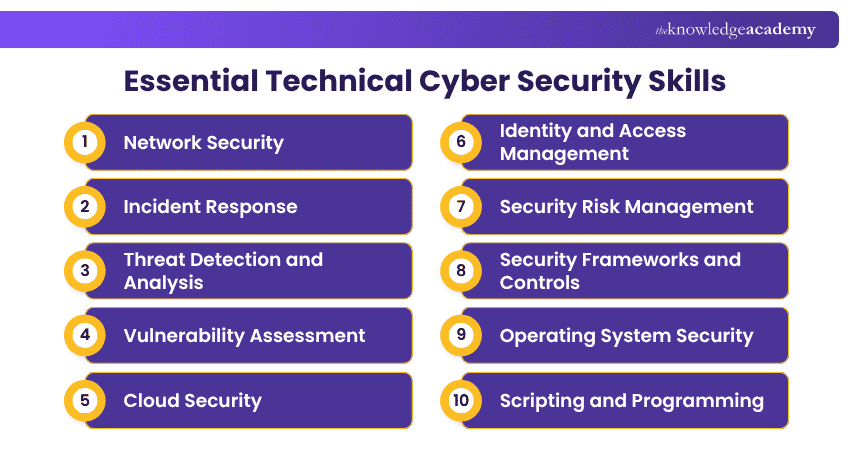
Essential Technical Cyber Security Skills
Technical skills provide the foundation for identifying, investigating, and addressing security risks. The following capabilities are valuable across many Cyber Security roles:
1) Network Security
Network security involves protecting connected systems and the information travelling between them. Professionals should understand network architecture, protocols, firewalls, secure configurations, segmentation, and monitoring.
Knowledge of wired and wireless networks can also help professionals identify suspicious activity and understand how attackers could attempt to access organisational systems.
2) Incident Response
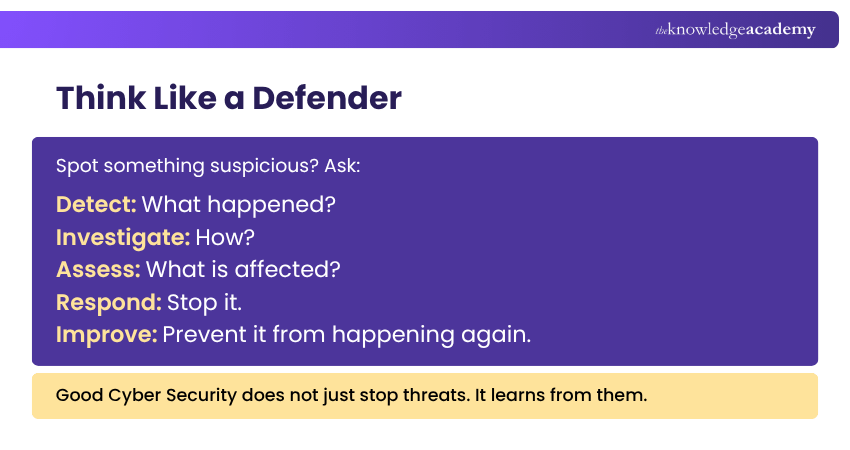
Incident response involves preparing for, identifying, containing, investigating and recovering from Cyber Security incidents, followed by reviewing lessons learned. Effective response can help limit disruption and reduce the potential impact of an attack.
Professionals may need to analyse suspicious activity, contain affected systems, remove malicious elements, support recovery, and document what happened to reduce the likelihood of similar incidents.
Improve your readiness to address cyber threats through Incident Response Training – Register today!
3) Threat Detection and Analysis
Threat detection involves identifying activity that could indicate an attempted or successful security compromise. Professionals need to examine alerts, logs, system behaviour, and other security information to distinguish genuine threats from normal activity.
Threat analysis then helps determine what happened, which systems could be affected, and what action should be taken.
4) Vulnerability Assessment
Vulnerability assessment involves identifying and evaluating weaknesses in systems, applications, networks, and configurations.
Professionals need to understand how vulnerabilities could affect an organisation and prioritise them according to factors such as severity, exposure, and potential business impact.
5) Cloud Security
Cloud security focuses on protecting applications, infrastructure, identities, and data hosted in Cloud environments.
Useful skills include managing access controls, reviewing configurations, monitoring activity, protecting sensitive information, and understanding the security responsibilities associated with Cloud services.
6) Identity and Access Management
Identity and Access Management (IAM) helps ensure that the right users and systems have appropriate access to resources.
Cyber Security professionals should understand concepts such as authentication, authorisation, permissions, privileged access, and the principle of least privilege. Effective IAM can reduce the risks created by excessive or unauthorised access.
7) Security Risk Management
Security risk management involves identifying potential threats and vulnerabilities, assessing their likelihood and impact, and deciding how risks should be addressed.
This skill helps professionals prioritise security efforts and concentrate resources on risks that could have the greatest impact on important organisational assets.
Safeguard data, systems, and organisational operations with Cyber Security Risk Management Training – Sign up soon!
8) Security Frameworks and Controls
Security frameworks provide structured approaches for managing Cyber Security risks, while security controls are specific safeguards designed to reduce those risks.
Understanding policies, standards, frameworks, and technical or administrative controls can help professionals implement security measures consistently and support organisational requirements.
9) Operating System Security
Cyber Security professionals should understand how operating systems manage users, permissions, processes, files, services, and system configurations.
Knowledge of environments such as Windows, Linux, and macOS can help professionals recognise insecure configurations, investigate suspicious behaviour, and strengthen endpoint security.
10) Scripting and Programming
Scripting and programming knowledge can help Cyber Security professionals automate repetitive tasks, analyse information, interact with systems, and support security testing.
Languages and tools such as Python, PowerShell, and Bash can be particularly useful for automation and security operations. Programming knowledge can also help professionals understand how software vulnerabilities arise.
Build advanced Cyber Security expertise with our Certified Cyber Security Professional (CCS-PRO) Training - Join today!
Essential Soft Skills for Cyber Security
Technical knowledge helps professionals understand security problems, but soft skills influence how effectively they analyse situations, make decisions, and work with others.
1) Analytical Thinking
Analytical thinking helps Cyber Security professionals examine complex information systematically. They may need to compare security events, recognise unusual patterns, connect different pieces of evidence, and determine what requires further investigation.
2) Problem-solving
Security incidents rarely arrive with an obvious solution. Problem-solving helps professionals identify the cause of an issue, consider different responses, and select practical ways to reduce or remove the risk.
3) Attention to Detail
Small details can be important in Cyber Security. An unusual login, unexpected process, configuration change, or abnormal network request could provide valuable information during an investigation.
Attention to detail helps professionals recognise anomalies that might otherwise be overlooked.
4) Communication
Cyber Security professionals often communicate with people who have different levels of technical knowledge.
Clear communication helps them explain risks, incidents, policies, and recommended actions without unnecessary technical complexity. It is particularly important when security information needs to support business decisions.
5) Collaboration
Protecting an organisation is rarely the responsibility of one security professional. Cyber Security teams frequently work with IT, development, compliance, management, and other departments.
Collaboration helps these teams share information, coordinate responses, and implement security measures effectively.
6) Adaptability
Cyber threats, technologies, and working environments continue to change. Professionals need to adjust their approaches as new vulnerabilities, attack methods, security tools, and organisational requirements emerge.
Moreover, adaptability makes it easier to respond to unfamiliar situations without relying entirely on previous solutions.
7) Continuous Learning
Cyber Security requires ongoing learning because technologies, vulnerabilities, threats, and defensive practices continue to evolve.
Regularly developing new knowledge can help professionals maintain relevant skills and become more comfortable working with changing security challenges.
Did You Know?
A Cyber Security professional does not need to know everything across all security domains. Roles can specialise in areas such as Cloud security, incident response, security engineering, governance, risk management, or penetration testing.The goal is to build strong foundations and then deepen the skills most relevant to your chosen direction.
How to Develop Your Cyber Security Skills?
Building Cyber Security Skills requires a combination of knowledge and practical application. Here are several ways to strengthen your abilities:
1) Build Strong IT Fundamentals
Start with networking, operating systems, Cloud concepts, databases, and basic scripting. Understanding how digital systems work makes it easier to recognise how they can be secured.
2) Practise in Safe Environments
Use authorised labs and controlled environments where you can safely practise security tasks. This could include analysing logs, configuring security controls, examining vulnerabilities, or responding to simulated incidents.
3) Take Cyber Security Training
Structured training can provide a clear learning path from fundamental concepts to more specialised Cyber Security areas. It can also help you understand how different skills can connect in practical environments.
4) Work on Practical Projects
Apply your knowledge through projects rather than relying entirely on theory. You could configure a secure test network, analyse sample security logs, practise system hardening, or create an incident response scenario.
Practical projects can also help you identify areas where your knowledge needs further development.
5) Pursue Relevant Certifications
Cyber Security certifications can provide structured pathways for developing knowledge in particular security areas.
Choose certifications according to your experience, career direction, and the Cyber Security domain you want to develop rather than collecting credentials without a clear objective.
6) Follow Cyber Security Developments
Stay informed about emerging vulnerabilities, attack techniques, defensive technologies, and changes in security practices.
Following reputable security organisations, technical documentation, advisories, and professional communities can help you understand how the field is evolving.
7) Review Your Skill Gaps
Periodically assess which areas you understand confidently and which require more practice. Instead of trying to develop every Cyber Security Skill simultaneously, identify a few weaknesses and create specific learning goals around them.
Pro Tip
Learn about the system before trying to secure it. Understanding how networks, operating systems, applications, and Cloud environments normally behave makes unusual activity much easier to recognise.
Recognise cyber threats and build safer digital habits with our Cyber Security Awareness Training - Join today!

Nilotpal Sarmah is a Senior Content Writer with 11+ years of overall experience spanning engineering, operations and content development. His technical knowledge and extensive writing experience enable him to simplify specialised topics across IT and Tech, Business Skills, Project Management, Health and Safety, and ISO and Compliance.
View Detail

 If you wish to make any changes to your course, please


