


We may not have the course you’re looking for. If you enquire or give us a call on 01344203999 and speak to our training experts, we may still be able to help with your training requirements.
Top 10 Backend Developer Skills You Need to Master
ByThe Knowledge AcademyLast updated on: 31 October 2026
Discover the essential Backend Developer skills, from programming languages and database management to API development, security and performance optimisation.
Before We Dive In
1. Languages such as Python, Java and JavaScript help Backend Developers build reliable server-side applications.2. SQL, NoSQL databases and APIs enable efficient data storage, retrieval and communication between applications.3. Secure coding, authentication, authorisation and optimisation help protect applications and improve their efficiency.4. Testing, debugging, version control and communication skills support reliable development and effective teamwork.5. Hands-on projects, framework knowledge and deployment experience help developers strengthen their backend development expertise.
You place an order on an e-commerce website. Within seconds, the system checks product availability, calculates the total, processes the request and confirms your purchase. But what makes all these operations happen behind the scenes? The answer lies in backend development.
To make these processes work smoothly, Backend Developers rely on programming, database management, API development and security skills. These abilities help them build reliable applications, manage data and handle requests efficiently. In this blog, we explore the essential Backend Developer skills and practical ways to improve them.
Top 10 Essential Backend Developer Skills
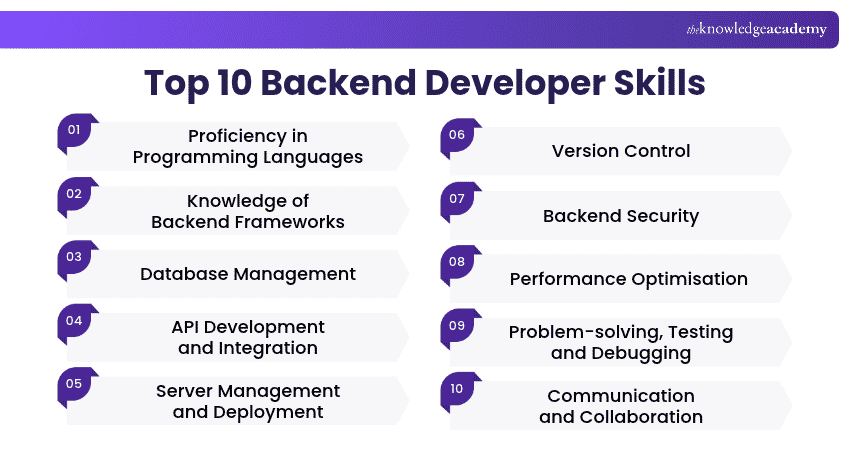
Backend Developers need a combination of technical knowledge, analytical thinking and professional skills to build and maintain server-side applications. Here's a quick glimpse into these skills:
1) Proficiency in Programming Languages
Programming languages form the foundation of backend development. They enable developers to write application logic, process requests, manage data and implement server-side functionality. A Backend Developer should understand programming concepts such as variables, functions, data structures, error handling and asynchronous operations where relevant.
Some commonly used backend programming languages include:
a) Python: Python is widely used for backend development because of its readable syntax and extensive libraries. Frameworks such as Django, Flask and FastAPI support the development of web applications and APIs.
b) Java: Java is commonly used for enterprise applications and large backend systems. Its ecosystem includes frameworks such as Spring Boot, which helps developers build server-side applications and services.
c) JavaScript and TypeScript: JavaScript can run on servers through Node.js, a JavaScript runtime environment. TypeScript adds static type checking and other language features that support the development and maintenance of larger applications.
d) PHP: PHP is used for server-side web development and supports frameworks such as Laravel. It is commonly associated with content management systems and dynamic websites.
e) Ruby: Ruby is a general-purpose programming language known for its expressive syntax. Ruby on Rails is a web application framework that provides conventions and reusable functionality for developing backend applications.
2) Knowledge of Backend Frameworks
Backend frameworks provide reusable components, conventions and tools that simplify application development. They help developers organise code and implement common functionality such as routing, request handling, data validation and database integration. Some popular backend frameworks include:
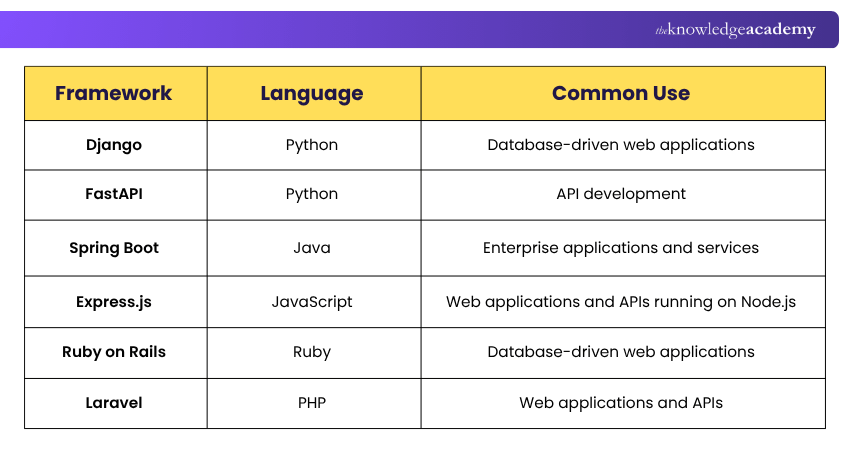
Knowledge of frameworks helps developers write organised and maintainable code while reducing the need to build common functionality from scratch.
3) Database Management
Database management involves storing, organising, retrieving and updating information used by applications. Backend Developers need to understand how databases work, how information is structured and how queries can be written efficiently.
They should also understand relational databases such as PostgreSQL and MySQL, alongside non-relational databases such as MongoDB, and know when each approach is appropriate. Important database skills include:
a) Database Design: Creating suitable schemas, tables or collections and defining relationships.
b) SQL and Querying: Retrieving, inserting, updating and deleting information.
c) Indexing: Improving access to frequently queried data where appropriate.
d) Data Integrity: Maintaining accurate and consistent information.
e) Transactions: Managing related database operations so they meet required consistency guarantees.
For example, an e-commerce application may store customer information, products and orders in a relational database. Backend Developers create queries to retrieve product details and update order records.
4) API Development and Integration
Application Programming Interfaces (APIs) allow different applications or software components to communicate. Backend Developers create APIs to receive requests, process information and return responses. APIs are widely used in websites, mobile applications and systems that exchange data with third-party services.
Essential API development skills include:
a) HTTP Methods: Understanding operations such as GET, POST, PUT, PATCH and DELETE.
b) Request and Response Handling: Processing incoming data and returning appropriate results.
c) Data Validation: Checking requests before processing or storing information.
d) Error Handling: Returning meaningful error messages and appropriate HTTP status codes.
e) API Documentation: Explaining available endpoints, parameters and expected responses.
f) Integration: Connecting applications to internal or external services.
Common API technologies and approaches include REST, SOAP and GraphQL. REST is an architectural style, SOAP is a messaging protocol, and GraphQL is a query language supported by a corresponding API execution model.
Example: Product API
A shopping application may request information about a particular product.
API Request

Example JSON Response

The front-end can use this response to display the product's name, price and availability.
5) Server Management and Deployment
Server management involves configuring and maintaining the environments in which backend applications run. Backend Developers should understand how applications are hosted, configured, deployed and monitored. Important skills include:
a) Server Configuration: Setting up runtime environments, required dependencies and application settings.
b) Deployment: Publishing application updates to testing or production environments.
c) Cloud Fundamentals: Understanding how hosting, networking, storage and cloud services support application deployment.
d) Monitoring: Reviewing application logs, resource usage and service health to identify problems.
e) Maintenance: Applying relevant updates and maintaining operational reliability.
f) Containerisation: Understanding how containers package applications and dependencies to support consistent deployment across environments.
g) CI/CD: Using automated workflows to build, test and deploy application changes more consistently.
For example, a Backend Developer deploying an application may configure environment variables, connect the application to a database and use a CI/CD pipeline to run tests before deployment. They can then monitor the application to verify that it operates correctly.
Learn how Java drives modern web development in the Web Development Using Java Training – Sign up now!
6) Version Control
Version control allows developers to track changes to source code and collaborate on software projects. Git is a distributed version control system that records changes in repositories and supports workflows involving branches, commits and merges. Platforms such as GitHub, GitLab and Bitbucket provide repository hosting and collaboration features.
Important version control skills include:
a) Commits: Recording meaningful changes to the codebase.
b) Branching: Developing features or fixes without directly modifying the main development branch.
c) Merging: Combining changes from different branches.
d) Conflict Resolution: Resolving incompatible changes made by different contributors.
e) Code Reviews: Examining proposed changes before integrating them.
For example, a Backend Developer implementing a new login feature can create a separate Git branch, commit the changes and submit a pull request for review.
7) Backend Security
Backend security involves protecting applications, systems and data against unauthorised access and other security threats. Backend Developers must understand secure coding principles and implement appropriate safeguards throughout the development process.
Essential security skills include:
a) Authentication: Verifying the identity of users or systems accessing an application.
b) Authorisation: Checking whether an authenticated user or system has permission to perform a particular action.
c) Input Validation: Checking incoming information and handling untrusted input safely.
d) Secure Data Handling: Protecting sensitive information through appropriate encryption, access restrictions and data-handling practices.
e) Secret Management: Keeping passwords, API keys and credentials out of publicly accessible code and configuration.
f) Dependency Security: Maintaining libraries and frameworks and addressing relevant vulnerabilities.
Trainer Insight: Authentication vs Authorisation
Authentication verifies who a user is, while authorisation determines what they can access. A successful login does not mean someone should be able to view every account or modify every record. Backend systems must check permissions for protected operations and resources.
8) Performance Optimisation
Performance optimisation involves improving how efficiently backend applications respond to requests and use computing resources. Developers examine application behaviour to identify slow operations, unnecessary processing and resource constraints.
Important performance skills include:
a) Code Efficiency: Reducing unnecessary computations and improving application logic.
b) Database Query Performance: Investigating slow queries and evaluating suitable indexes or query changes.
c) Caching: Reusing appropriate data to reduce repeated processing or database requests.
d) Resource Monitoring: Examining CPU usage, memory consumption and other performance indicators.
e) Scalability: Designing systems to handle changing workloads.
f) Load Testing: Evaluating application behaviour under expected or increased demand.
For example, an online store experiencing slow product searches may discover that a frequently executed database query is inefficient. The developer can examine its execution plan, review suitable indexes and test whether the changes improve response times.
9) Problem-solving, Testing and Debugging
Backend Developers regularly investigate errors, unexpected application behaviour and problems involving data or server-side logic. Strong problem-solving skills help developers understand these issues, identify their causes and implement reliable solutions.
Important abilities include:
a) Debugging: Examining code, logs and execution behaviour to identify the source of an error.
b) Root-cause Analysis: Investigating why a problem occurred rather than treating only its symptoms.
c) Unit Testing: Testing individual functions or components in isolation.
d) Integration Testing: Verifying that components such as APIs, databases and services work together correctly.
e) Regression Testing: Checking that changes have not disrupted previously working functionality.
f) Documentation: Recording important findings, solutions and technical decisions.
For example, if an API returns an incorrect order total, a developer may reproduce the issue, inspect the relevant calculations and compare the results with the database records.
Backend Debugging Checklist
Use this checklist when investigating backend errors.□ Reproduce the error consistently□ Check relevant logs and error messages□ Identify the failing component or operation□ Verify inputs, database queries and configuration□ Apply the fix and test the affected behaviour□ Run regression tests and document the resolution
10) Communication and Collaboration
Backend Developers often work with Front-end Developers, Testers, Designers, Project Managers and other technical professionals. Communication skills help developers understand requirements, explain technical decisions and coordinate development activities.
Important communication abilities include:
a) Requirements Understanding: Clarifying application behaviour, business rules and technical expectations.
b) Team Collaboration: Coordinating with other developers and stakeholders.
c) Technical Documentation: Creating API documentation, technical notes and other useful development records.
d) Code Reviews: Providing constructive feedback and explaining implementation decisions.
e) Progress Communication: Sharing project updates, identifying blockers and discussing technical challenges.
For example, when integrating a front-end application with an API, backend and Front-end Developers must agree on request formats, response structures and error-handling behaviour.
Portfolio Challenge: Build a Task Management API
Build a Task Management API to demonstrate your practical backend development skills. Follow these steps:□ Create an Application: Develop a system that allows users to register, log in and manage their tasks.□ Integrate a Database: Store and manage user information and task records.□ Implement Security: Add authentication and access controls so users can access and modify only the tasks they are authorised to manage.□ Test Functionality: Write tests to verify that important operations work correctly.□ Document API Endpoints: Explain how different API endpoints work and how to use them.□ Deploy the Application: Publish the completed project to a suitable hosting environment.
Skills Demonstrated: Programming, Database Management, API Development, Security, Testing and Deployment.
Developing strong Backend Developer skills requires programming knowledge, database expertise, API development and secure coding practices. Testing, optimisation and communication are equally important for building reliable applications. Start with core concepts, practise through real projects and gradually expand your technical knowledge.
Gain skills for creating visually appealing and interactive websites with our Front-End Web Development Course – Join now!

The Knowledge Academy develops accessible learning content across Project Management, IT, Cybersecurity, Data Science, Business Analysis, HR, Accounting and Finance, Leadership and Health and Safety. Its resources combine subject research with clear explanations to help professionals build practical knowledge across a wide range of disciplines.
View Detail

 If you wish to make any changes to your course, please


