


We may not have the course you’re looking for. If you enquire or give us a call on 01344203999 and speak to our training experts, we may still be able to help with your training requirements.
Top Administrative Assistant Skills Employers Look For
ByThe Knowledge AcademyLast updated on: 03 November 2026
From communication and organisation to problem-solving and Microsoft 365 proficiency, explore the essential Administrative Assistant skills that help professionals manage daily office tasks with confidence.
It's 9 am. Three meetings need scheduling, an important client is waiting for a response and several documents require updating.
How does an Administrative Assistant handle it all?
The key lies in knowing what needs immediate attention, staying calm under pressure and adapting when plans change. While these situations are common in administrative roles, handling them effectively takes preparation and practical experience. Let's discover the skills needed by Administrative Assistants to succeed in this role.
Top Skills for an Administrative Assistant
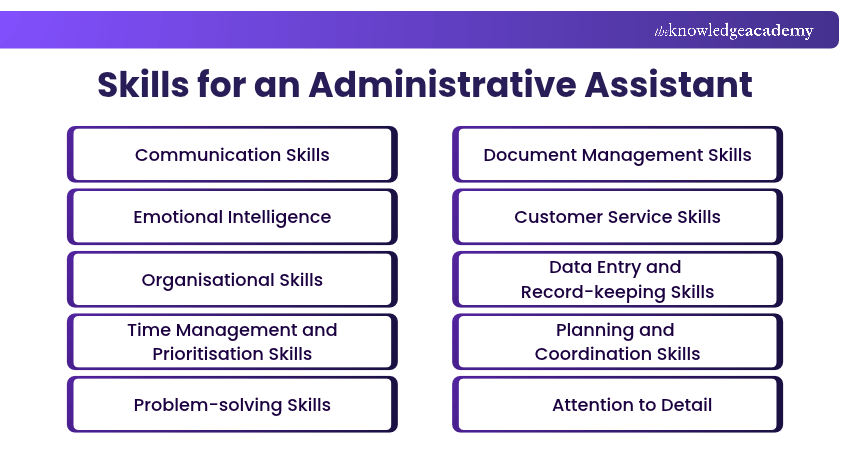
Administrative Assistants need a combination of practical and interpersonal skills to handle workplace responsibilities effectively. From coordinating daily activities to responding to unexpected requests, each skill plays an important role in maintaining efficient office operations. Here are the key skills employers look for in an Administrative Assistant:
1) Communication Skills
Administrative Assistants regularly interact with managers, colleagues, clients and suppliers, making clear and professional communication essential. They must be able to share information accurately, respond to enquiries and convey messages effectively, both verbally and in writing.
Active listening, asking relevant questions and adapting communication styles to different audiences are equally important for avoiding misunderstandings and maintaining positive working relationships.
2) Emotional Intelligence
Emotional intelligence helps Administrative Assistants understand and manage their emotions while responding thoughtfully to others. It is particularly useful when handling difficult conversations, supporting colleagues and remaining composed under pressure.
Empathy, self-awareness and emotional regulation also help maintain positive workplace relationships and resolve misunderstandings professionally.
To enhance your emotional intelligence, you can:
a) Be aware of your own emotions and how they affect your behaviour and performance.
b) Learn to regulate your emotions and express them appropriately.
c) Communicate your concerns respectfully while acknowledging the feelings and perspectives of others.
d) Seek feedback and constructive criticism and learn from your mistakes.
3) Organisational Skills
Keeping track of appointments, documents, office supplies and administrative requests requires strong organisational skills. Administrative Assistants must maintain orderly filing systems, coordinate daily activities and ensure important information is easily accessible.
Good organisation also helps them manage changing workloads, reduce delays and support colleagues without overlooking essential responsibilities.
To boost your organisational skills, you can:
a) Use tools such as calendars, planners, folders and labels to organise your tasks and files.
b) Develop daily, weekly, and monthly task lists, prioritising them based on urgency and significance.
c) Set clear, achievable goals and break larger tasks into smaller, manageable steps.
Pro Tip:
Use tools such as Microsoft Planner or Trello to track deadlines, recurring responsibilities, and pending requests. A centralised dashboard can help you identify competing priorities and prevent important administrative tasks from being overlooked.
4) Time Management and Prioritisation Skills
Administrative Assistants often work on several assignments with different deadlines. They need to assess which tasks require immediate attention, allocate time appropriately and adjust schedules when priorities change.
Effective time management involves planning ahead, setting realistic deadlines and communicating potential delays. These abilities help maintain productivity without compromising the quality of work.
5) Problem-solving Skills
Unexpected challenges are common in administrative work, whether a meeting room becomes unavailable, a document contains incorrect information or an urgent request disrupts existing plans.
Administrative Assistants need to identify problems, consider practical solutions and take appropriate action. Knowing when to resolve an issue independently and when to seek guidance is equally important.
To develop your problem-solving skills, you can:
a) Define the problem clearly and gather relevant information.
b) Consider various solutions and assess their advantages and disadvantages.
c) Select the best solution and implement it in a timely and effective manner.
Find better solutions to everyday challenges with Problem Solving Course – Register now!
6) Document Management Skills
Administrative Assistants are often responsible for creating, formatting, organising and retrieving workplace documents. This includes maintaining consistent file names, following document control procedures and ensuring colleagues can access the correct versions.
Familiarity with digital filing systems and shared document platforms is particularly useful for maintaining accurate records and supporting efficient information management. Commonly used platforms include Microsoft SharePoint, OneDrive, Google Drive and Dropbox, which support document storage, file sharing and collaboration.
7) Customer Service Skills
Administrative Assistants are often among the first people visitors, customers or external contacts interact with. They may answer enquiries, provide information, direct individuals to the appropriate department or help resolve routine concerns.
Strong customer service skills involve patience, professionalism and an understanding of organisational procedures. Handling enquiries appropriately contributes to a positive experience and supports the organisation's reputation.
To strengthen your customer service skills, you can:
a) Greet visitors and respond to enquiries politely and professionally.
b) Listen carefully to understand customer needs and concerns.
c) Provide accurate information or direct enquiries to the appropriate person.
d) Handle complaints calmly and follow organisational procedures.
8) Data Entry and Record-keeping Skills
Accurate record-keeping helps organisations maintain reliable information for daily operations and decision-making. Administrative Assistants may update employee details, customer records, inventory lists or financial spreadsheets.
This requires careful data entry, consistent formatting and routine verification. They must also follow organisational procedures for storing, updating and retaining records, particularly when working with sensitive information.
9) Planning and Coordination Skills
Planning and coordination skills help Administrative Assistants organise office activities, coordinate resources and ensure that administrative arrangements are completed efficiently.
This may involve arranging equipment, preparing meeting materials, communicating requirements and following up on outstanding tasks. Effective coordination helps different teams work together and reduces operational disruptions.
To develop your planning and coordination skills, you can:
a) Identify the resources, people and materials required for each activity.
b) Coordinate meeting rooms, equipment and necessary documents in advance.
c) Communicate changes promptly to everyone involved.
d) Maintain checklists to monitor arrangements and outstanding tasks.
10) Attention to Detail
Small mistakes in meeting schedules, reports or official correspondence can create unnecessary confusion. Administrative Assistants must carefully review documents, verify information and maintain accurate records before sharing them.
Attention to detail is particularly important when processing financial information, updating databases or handling confidential documents, where even minor inaccuracies may have significant consequences.
To increase your attention to detail, you can:
a) Review your work carefully before submitting or sending it and use tools such as spell checkers, grammar checkers and calculators to help you.
b) Double-check any facts, figures or names used in your work and verify their sources and reliability.
c) Follow the relevant instructions, guidelines and standards to ensure your work meets organisational requirements.
Trainer's Insight:
Attention to detail becomes more effective when supported by structured processes. Consistent file naming, document version control, and verification checklists can reduce errors, particularly when handling large volumes of records or coordinating information across departments.
11) Adaptability and Flexibility
Administrative responsibilities can change throughout the working day as urgent requests arise, meetings are rescheduled or organisational priorities shift. Administrative Assistants must be comfortable adjusting their approach without losing sight of existing commitments.
Adaptability also involves learning new software, following updated procedures and responding constructively to changes in workplace practices. Being open to feedback and willing to take on unfamiliar tasks can further help them adapt to evolving workplace demands.
12) Microsoft 365 Proficiency
Microsoft 365 proficiency involves using productivity applications to manage documents, spreadsheets, presentations, emails and workplace collaboration. Administrative Assistants frequently use Microsoft Word to prepare documents, Excel to organise data, PowerPoint to create presentations, Outlook to manage emails and calendars, and Teams to support communication. Proficiency in these tools helps improve accuracy and efficiency.
To improve your Microsoft 365 proficiency, you can:
a) Practise creating and formatting professional documents in Microsoft Word.
b) Learn essential Excel functions, including sorting, filtering and basic formulas.
c) Use Outlook to organise appointments, calendars and emails.
d) Explore Microsoft Teams and PowerPoint for collaboration and presentations.
13) Calendar Management and Scheduling Skills
Effective calendar management requires more than arranging appointments. Administrative Assistants must coordinate availability, account for scheduling conflicts, arrange suitable meeting spaces and communicate changes to participants.
They may also need to consider different time zones when organising meetings with international colleagues or clients. Accurate scheduling helps prevent overlapping commitments and ensures meetings run according to plan.
14) Discretion and Confidentiality
Administrative Assistants may have access to sensitive business information, employee records, financial documents and private correspondence. They must understand which information can be shared, who is authorised to access it and how confidential records should be handled. Exercising discretion also means avoiding inappropriate workplace discussions and following organisational policies for protecting personal and business information.
15) Interpersonal Skills
Building positive professional relationships is an important part of administrative work. Administrative Assistants frequently interact with individuals who have different responsibilities, communication preferences and expectations.
Strong interpersonal skills help them build trust, collaborate with colleagues and maintain constructive working relationships. These abilities are particularly valuable when supporting different departments, resolving minor workplace disagreements and working towards shared objectives.
Keep This in Mind
Becoming a successful Administrative Assistant isn't about mastering every skill at once. It is about recognising your strengths, identifying areas for improvement and continuously developing abilities that match workplace expectations. Whether it is improving communication, becoming more confident with digital tools or learning to manage competing priorities, even small improvements can make a meaningful difference.
Learn how to provide exceptional executive support with our PA and Secretarial Courses – Join now!

The Knowledge Academy develops accessible learning content across Project Management, IT, Cybersecurity, Data Science, Business Analysis, HR, Accounting and Finance, Leadership and Health and Safety. Its resources combine subject research with clear explanations to help professionals build practical knowledge across a wide range of disciplines.
View Detail

 If you wish to make any changes to your course, please


