


 Top Rated Course

We may not have the course you’re looking for. If you enquire or give us a call on 01344203999 and speak to our training experts, we may still be able to help with your training requirements.
Top 30 UML Interview Questions And Answers
Sienna Roberts 20 January 2026Prepare for your UML interview with key questions on system modeling and diagrams to showcase your expertise in software design and architecture. These questions cover basics like class and sequence diagrams, plus advanced topics such as deployment and profiles. Clear, structured answers show confidence and help you stand out.
Training Outcomes Within Your Budget!
We ensure quality, budget-alignment, and timely delivery by our expert instructors.
Table of Contents

Ever struggled to explain how a system works without drawing it out? Unified Modeling Language (UML) makes it easier by turning those pieces into visuals that everyone can see and connect with. That’s why preparing for UML Interview Questions is about more than theory; it’s about showing ideas through clear, visual stories.
In this blog, we’ll simplify UML Interview Questions with answers you can actually relate to. From basics and goals to class, sequence, and activity diagrams with real-world uses, you’ll learn to explain designs clearly and impress interviewers with confidence.
Table of Contents
1) Commonly Asked UML Interview Questions
a) What is UML?
b) What are the characteristics of UML?
c) What is the goal of UML?
d) What are the main goals of OO analysis and design?
e) Explain sequence diagrams in UML
f) Can you explain the structure of a class diagram?
g) Explain the purpose of UML in Software Development
h) How do you use UML to create a class diagram?
i) What is an association in a UML class diagram?
j) What is a Class Diagram?
2) Conclusion
Commonly Asked UML Interview Questions
Preparing for an interview often means facing questions that test both your basics and your ability to apply concepts in real situations. To make it easier, here are some commonly asked UML Interview Questions with clear, simple answers. These will help you explain ideas confidently and connect with interviewers.
What is UML?

Unified Modeling Language (UML) is a standard visual language used in Software Engineering to model and design software systems. It is especially useful for object-oriented design and shows how different parts of a system interact.

What are the characteristics of UML?
a) UML is standardised, flexible, and visual
b) It can model both structure and behaviour
c) It supports object-oriented principles
d) It is language-independent and works with any technology
e) Simple enough for business teams yet detailed for developers
What is the goal of UML?
The goal of UML is to provide a standard visual language that simplifies the modeling of complex systems. It helps both technical and non-technical stakeholders communicate clearly, understand system design, and plan software development before coding begins.
What are the main goals of OO analysis and design?
Object-oriented analysis and design focus on solving real-world problems and turning them into practical software. Their goals can be summed up as:
a) Model real-world problems
b) Design flexible, adaptable solutions
c) Reuse components effectively
d) Capture needs and build working systems for better programming outcomes
Explain sequence diagrams in UML?
A sequence diagram represents how objects interact over time by mapping the order of messages between them. I like using it to explain workflows such as login or order processing because it helps teams and stakeholders clearly see step-by-step interactions.
Can you explain the structure of a class diagram?
A class diagram has three sections: the class name, attributes, and operations. Relationships like inheritance or associations connect classes. I see it as the system’s skeleton, which shows static structure and dependencies clearly before development begins.
Explain the purpose of UML in Software Development?
UML’s purpose is to simplify design and communication. In development, it helps teams plan before coding, spot risks early, and share ideas across technical and non-technical groups. I often compare it to sketching a house before construction, as it saves time and reduces costly mistakes.

How do you use UML to create a class diagram?
a) Identify key classes from requirements
b) Add attributes and operations
c) Map relationships such as associations or inheritance
d) Refine with multiplicity or roles
This process turns requirements into a model for team discussion and refinement.
What is an association in a UML class diagram?
An association shows how two classes are linked. For example, a Teacher teaches Students. It’s drawn as a line between classes, sometimes with multiplicity. I see it as explaining how objects in the system know or interact with each other.
What is a Class Diagram?
A class diagram represents a type of UML diagram that illustrates the static structure of a system. It includes classes, attributes, operations, and their relationships. I describe it as a system’s skeleton, which helps both teams and stakeholders understand design choices.
What is the purpose of Class Diagrams?
The purpose of class diagrams is to visualise and design the system structure. They clarify how classes connect and depend on each other. I often use them to ensure teams align on design decisions before coding starts, which avoids confusion later.
Gain knowledge about creating the best software using patterns and principles. Join our Software Design and Architecture Training now!
What is an Object Diagram?
An object diagram shows instances of classes at a specific point in time. It’s like taking a snapshot of objects and their links. I use it to validate a class diagram, making sure the system design behaves as expected with real examples.
What does a Component Diagram represent?
A component diagram shows how software modules or components are organised and interact. I think of it as the system’s big blocks, showing dependencies between services, APIs, or databases. It’s especially useful for architects and developers working on large projects.
How is inheritance represented in UML?
In UML, inheritance is shown with a solid line and a closed arrow pointing from the subclass to the superclass. I describe it as saying this class reuses features from another class. It highlights hierarchy and promotes reusability in designs.
Can you explain the purpose of a UML sequence diagram?
The goal of a sequence diagram is to show how objects interact step by step. It highlights the order of messages clearly. I use it to validate scenarios like a login process, so everyone understands the logic before coding starts.
How do you represent an exception in a UML sequence diagram?
Exceptions are modelled using alternative or break frames with guard conditions. For example, an ‘[error]’ path branches the flow differently. I like it because it captures what happens when something goes wrong, ensuring the design accounts for both normal and error cases.
What is the difference between synchronous and asynchronous messages in UML?
A synchronous message means the sender waits for a reply before moving on, like making a phone call and waiting for the answer. It shows a direct link between two actions.
An asynchronous message means the sender does not wait and continues, like sending an email. UML uses different arrow styles to show this difference clearly.
How do you represent aggregation in UML, and what is its significance?
Aggregation is shown with a hollow diamond at the container class end. It represents a whole-part relationship where parts can exist independently. For example, a library contains books, but books also exist elsewhere. I use it to highlight logical grouping without full ownership.
How do you represent design patterns using UML, and why is it important?
Design patterns are modelled with class or sequence diagrams to show reusable structures. UML makes patterns easy to share and understand, like Singleton or Observer. I think it’s important because it standardises how we explain proven solutions across different teams and projects.
Can you explain the concept of a UML profile and how it is used in modeling?
A UML profile customises UML for specific domains. It uses stereotypes, tags, and constraints. I describe it as tailoring UML’s language to industries like Systems Engineering or business modeling, so the diagrams better match the unique needs of those areas.
How do you represent inheritance in a class diagram?
In a class diagram, inheritance is a line with a closed arrow pointing from the child class to the parent. It shows that subclasses inherit attributes and methods. I use it to make hierarchies and relationships clear while avoiding repetition.
Enhance Software Developer & Engineering skills to gain an edge in the IT market. Join our Analysis & Design Using UML Training now!
How do you represent an association in a class diagram?
Associations are shown as straight lines between classes, sometimes with labels or multiplicity. For example, a doctor treats patients, which shows how the two classes interact. I find this useful to make object collaboration easier to explain in discussions.
What is a UML diagram stereotype, and how is it used?
A stereotype adds custom meaning to UML, written in «guillemets». For example, marking a class as «controller». I like stereotypes because they make diagrams more expressive, helping tailor models to specific business or technical domains without changing UML’s core rules.
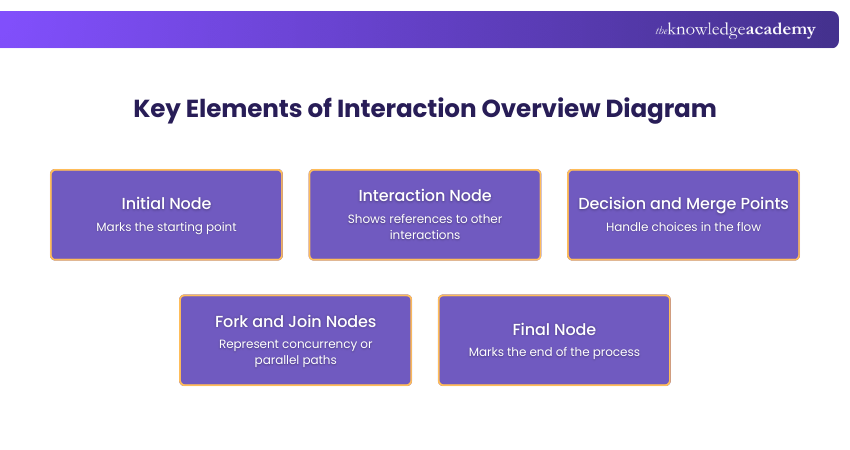
What are the key elements of an interaction overview diagram?
An interaction overview diagram combines activity flow with interaction diagrams. It uses initial nodes, decision points, interaction nodes, and final nodes. I describe it as a roadmap that connects multiple smaller interactions into one big picture of system behaviour.
What is the purpose of Deployment Diagrams?
Deployment diagrams show how software components run on hardware. They include nodes like servers and devices, plus the components deployed on them. I think they’re important because they connect software design to real infrastructure, which helps teams plan deployments better.
What is the purpose of interaction diagrams?
Interaction diagrams, like sequence or communication diagrams, show how objects work together. Their purpose is to model dynamic behaviour. I use them to clarify workflows, making scenarios easy to discuss with teams and ensuring the logic is sound before coding begins.
How do you represent concurrency in UML. and what are the different types of concurrency?
In UML, concurrency is represented using forks, joins, and parallel regions within diagrams such as activity diagrams or state machines. These notations show that multiple activities can occur at the same time.
The main types of concurrency include process-level concurrency, where independent processes run in parallel, and thread-level concurrency, where multiple threads share resources within a single process.
What is a Composite Structure Diagram in UML Modeling?
A composite structure diagram shows the internal parts of a class and how they collaborate. I describe it as opening up a component to see what’s inside. It’s helpful when explaining complex behaviours and showing how parts work together internally.
Can you explain the difference between a UML state machine diagram and a UML activity diagram?
A UML state machine diagram focuses on the different states of an object and how it transitions between them during its lifecycle. In contrast, a UML activity diagram models workflows and processes, showing the sequence of activities. State machines highlight object behaviour over time, while activity diagrams emphasise task flow within a system.
How do you use UML to model a business process and what are the different types of diagrams involved?
To model a business process in UML:
a) Use Case Diagrams: To capture goals and show what users want to achieve
b) Activity Diagrams: To map workflows and process steps
c) Sequence Diagrams: To show detailed interactions between objects
Together, these provide both the overall view and detailed steps for business processes.

 If you wish to make any changes to your course, please


