




We may not have the course you’re looking for. If you enquire or give us a call on 01344203999 and speak to our training experts, we may still be able to help with your training requirements.
Microsoft SQL Server Books: Top Recommendations
ByThe Knowledge AcademyLast updated on: 24 November 2026
Microsoft SQL Server books help database developers, administrators, and data professionals strengthen their SQL skills. Explore the best books covering T-SQL, database management, automation, and performance tuning for both beginner and experienced professionals.
Quick Preview
1. SQL Fundamentals: Explore books covering T-SQL basics and good database design practices.2. Professional Learning: Discover resources on SQL Server 2025, window functions, XML, JSON and automation.3. Advanced Topics: Explore query optimisation, database security, cloud migration and analytical workloads.4. Recent Publications: Find updated books alongside established titles.5. Choosing the Right Book: Select resources based on your experience, responsibilities and learning goals.
Choosing the right Microsoft SQL Server book can be tricky. Should you start with T-SQL fundamentals, explore database management, or dive into advanced performance tuning? With so many options available, finding a book that matches your skills and goals can feel overwhelming.
That's where this blog comes in! We've rounded up the top Microsoft SQL Server books covering everything from query writing and database automation to security and optimisation. Explore these recommendations to find your next valuable read.
Top Microsoft SQL Server Books
Choosing a Microsoft SQL Server book starts with understanding your learning goals. Some resources introduce T-SQL fundamentals, while others explore database administration and newer platform capabilities.
The following recommendations cover different experience levels and technical responsibilities. Let's look at them below:

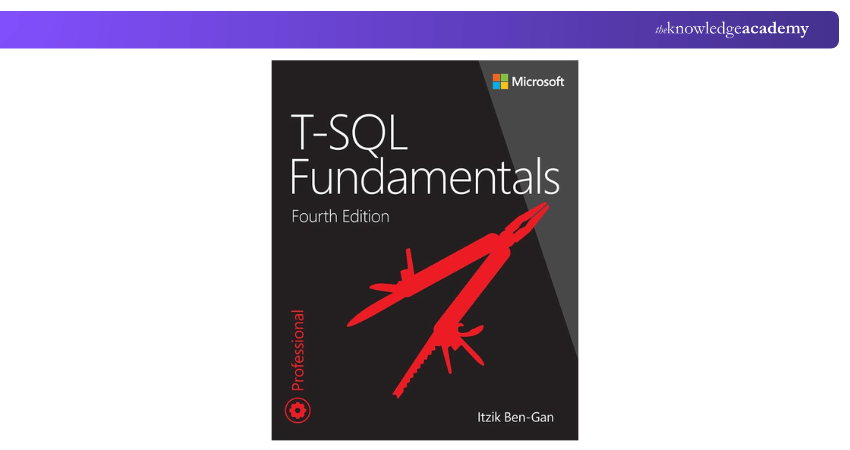
1) T-SQL Fundamentals by Itzik Ben-Gan
Edition: Fourth Edition (2023)
T-SQL Fundamentals introduces Transact-SQL, the language used to query and modify data in Microsoft SQL Server. It explains how T-SQL statements work and why understanding logical query processing matters when writing reliable code.
The fourth edition includes SQL Server 2022, Azure SQL Database, and Azure SQL Managed Instance coverage.
Key Topics Covered:
a) Logical Query Processing: Understand the logical stages involved in processing SQL queries.
b) Query Construction: Retrieve information using joins, subqueries and table expressions.
c) Data Modification: Work with INSERT, UPDATE, DELETE, and MERGE statements.
d) Transactions and Concurrency: Understand transaction behaviour and concurrent data access.
Target Audience: Beginners, aspiring SQL developers and professionals who have basic relational database knowledge.
Benefits and Takeaways: Professionals develop a foundation in writing correct T-SQL statements. Practical exercises reinforce querying concepts and help build confidence in working with relational data.
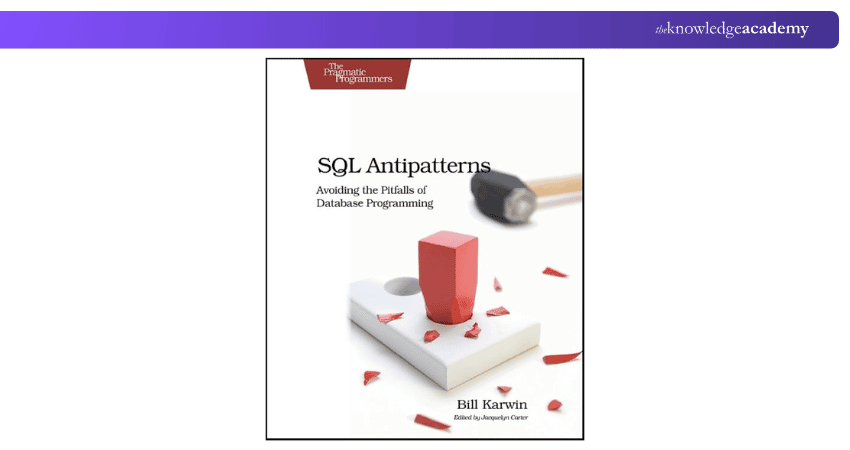
2) SQL Antipatterns, Volume 1 by Bill Karwin
Publication Year: 2022
SQL Antipatterns, Volume 1: Avoiding the Pitfalls of Database Programming examines common mistakes in relational database design and application development. Rather than explaining SQL syntax, the book identifies approaches that initially appear convenient but create problems as applications evolve.
Its examples largely use standard SQL, with some MySQL-specific syntax. Although it is not a dedicated SQL Server resource, many of its relational database principles can be applied to SQL Server.
Key Topics Covered:
a) Relational Modelling: Recognise problems involving relationships, keys and table structures.
b) Data Integrity: Understand the consequences of missing or inappropriate constraints.
c) SQL Programming: Identify practices that make queries unnecessarily complicated.
d) Application Security: Examine SQL injection and safer database programming approaches.
Target Audience: Database developers and programmers with basic SQL knowledge who want to improve their design practices.
Benefits and Takeaways: This book helps readers recognise avoidable mistakes in database applications. It encourages better design decisions that support data integrity, maintainability and reliability.
Pro Tip: Match Your Reading to Your Daily Responsibilities
Choose books based on the tasks you regularly perform rather than their popularity. A resource aligned with your immediate work challenges will often provide more practical value than one covering topics outside your role.
3) SQL Server 2025 Unveiled by Bob Ward
Publication Year: 2025
SQL Server 2025 Unveiled: The AI-Ready Enterprise Database with Microsoft Fabric Integration examines the architecture and capabilities of SQL Server 2025.
Written by Bob Ward, a Principal Architect on Microsoft's Azure data team, the book explains the platform's evolving role in AI-enabled applications, cloud-connected environments and enterprise data management.
Key Topics Covered:
a) AI Capabilities: Explore how SQL Server 2025 supports AI-related database applications, including vector-based capabilities.
b) Developer Enhancements: Examine newer database engine features and development capabilities, including JSON and regular expression support.
c) Azure Arc Integration: Understand how Azure Arc supports the management of SQL Server environments.
d) Microsoft Fabric: Explore integration between SQL Server and Fabric analytics services.
Target Audience: SQL Server developers, database administrators, and Architects planning to adopt or evaluate SQL Server 2025.
Benefits and Takeaways: Readers gain an understanding of SQL Server 2025's architecture and major enhancements. The explanations help professionals evaluate which newer capabilities are relevant to their database environments.
Learn to combine SQL precision with AI innovation by joining the SQL AI Developer Associate DP-800 Course now!
4) T-SQL Window Functions by Itzik Ben-Gan
Edition: Second Edition (2019)
T-SQL Window Functions: For Data Analysis and Beyond explores how window functions can perform calculations across related rows without collapsing them into a single grouped result. The book explains analytical query techniques and demonstrates how windowing capabilities can address complex data retrieval requirements.
Key Topics Covered:
a) Window Aggregates: Calculate running totals and other aggregate values across defined windows.
b) Ranking and Distribution: Assign rankings and calculate relative positions within datasets.
c) Offset Functions: Access values from preceding or following rows.
d) Window Optimisation: Examine the influence of partitioning, ordering and indexing on window-function performance.
Target Audience: SQL developers, Data Analysts, and database professionals familiar with fundamental T-SQL queries.
Benefits and Takeaways: Readers learn techniques for expressing analytical requirements more clearly in T-SQL. The book is particularly valuable for calculations involving rankings, trends, and comparisons across rows.
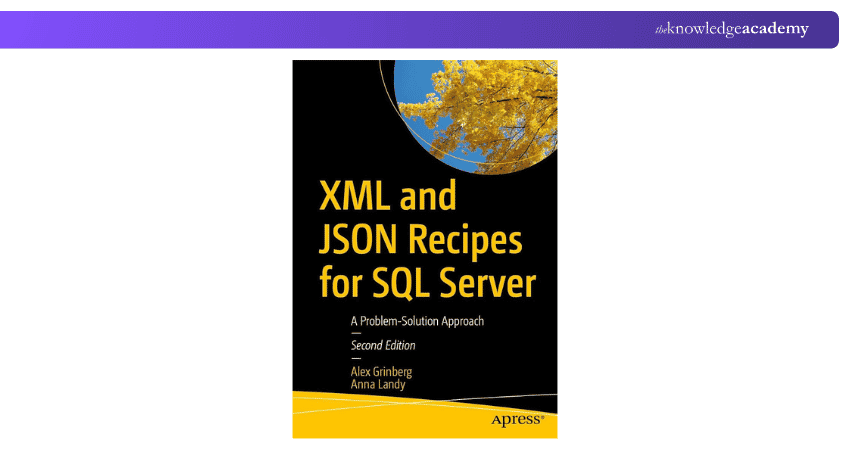
5) XML and JSON Recipes for SQL Server by Alex Grinberg and Anna Landy
Edition: Second Edition (2026)
XML and JSON Recipes for SQL Server: A Problem-Solution Approach explains how to create, query and transform XML and JSON data within SQL Server.
The updated edition includes functionality associated with SQL Server 2022 and SQL Server 2025, including the native JSON data type introduced in SQL Server 2025.
Key Topics Covered:
a) XML Querying: Use XML querying techniques, including XQuery and FLWOR expressions.
b) JSON Processing: Work with JSON documents using supported SQL Server functions and data types.
c) Data Transformation: Convert between relational results and XML or JSON representations.
d) System Diagnostics: Explore techniques for managing and querying semi-structured data efficiently.
Target Audience: SQL Server developers, database administrators and integration professionals working with XML or JSON data.
Benefits and Takeaways: Readers gain practical techniques for managing semi-structured data. The recipe-based approach provides examples that can be adapted to integration, automation, and database development tasks.
6) Expert Scripting and Automation for SQL Server DBAs by Peter A. Carter
Edition: Second Edition (2025)
Expert Scripting and Automation for SQL Server DBAs: Amplifying Productivity Through Automation focuses on reducing repetitive administration through scripting and automated processes.
It explains how SQL Server DBAs can combine PowerShell, database metadata, and administrative tools to manage multiple SQL Server instances more consistently.
Key Topics Covered:
a) PowerShell Scripting: Use PowerShell and SQL Server modules for administrative operations.
b) Automated Installation: Develop repeatable approaches to SQL Server instance deployment and configuration.
c) Metadata-driven Automation: Create administrative routines that use information stored in database environments.
d) Centralised Maintenance: Coordinate recurring maintenance and configuration activities.
Target Audience: SQL Server DBAs responsible for managing several databases or SQL Server instances.
Benefits and Takeaways: Readers learn practical approaches to reducing manual administration and standardising recurring tasks. The book supports the development of more maintainable database operations.
Learn advanced SQL techniques with the Advanced SQL Course - Register now!
7) SQL Server 2025 Query Performance Tuning by Grant Fritchey
Edition: Seventh Edition (2026)
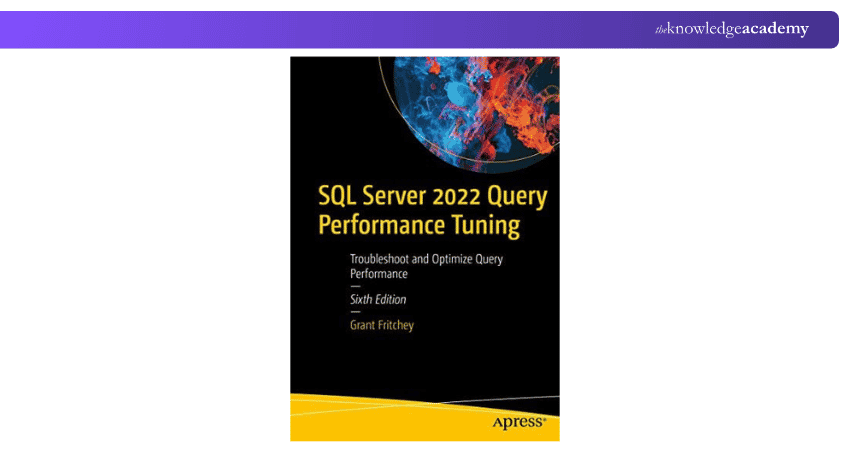
SQL Server 2025 Query Performance Tuning: Troubleshoot and Optimise Query Performance provides techniques for investigating inefficient queries and understanding SQL Server's execution behaviour.
The seventh edition incorporates SQL Server 2025 developments alongside established performance-tuning methods.
Key Topics Covered:
a) Execution Plans: Interpret how SQL Server executes queries and accesses data.
b) Query Store: Examine historical query behaviour and identify performance changes.
c) Statistics and Cardinality: Understand how data distribution influences query optimisation.
d) Blocking and Deadlocks: Investigate concurrency-related performance problems.
Target Audience: Experienced SQL Server developers, DBAs and performance engineers responsible for diagnosing slow database operations.
Benefits and Takeaways: Readers develop structured methods for investigating performance bottlenecks. The book helps professionals connect query behaviour with appropriate diagnostic and tuning decisions.
Trainer's Insight
A technique described as effective in a book may produce different outcomes in another environment. Professionals should consider workload characteristics, organisational requirements, and operating conditions before applying published recommendations.
8) The Expert's Guide to SQL Server by Venkata Reddy Pasam and Petchikumar Andiappan
Publication Year: 2026
The Expert's Guide to SQL Server: Tuning, Security, and Cloud Migration explores the technical responsibilities involved in maintaining secure, available and scalable SQL Server environments.
Although the book also addresses performance tuning, its broader infrastructure coverage makes it particularly relevant to administrators and Architects managing production databases.
Key Topics Covered:
a) Data Protection: Explore transparent data encryption, always encrypted and database access controls.
b) Backup and Recovery: Examine strategies for protecting and restoring SQL Server databases.
c) High Availability: Understand Always on Availability Groups, log shipping and related continuity techniques.
d) Cloud Migration: Review approaches involving Azure SQL and migration to Amazon Aurora PostgreSQL using Babelfish.
Target Audience: Experienced DBAs, cloud architects and infrastructure professionals responsible for enterprise SQL Server environments.
Benefits and Takeaways: Readers strengthen their understanding of database protection and infrastructure management. The book provides guidance on maintaining availability and planning database migrations.
9) Analytics Optimization with Columnstore Indexes in Microsoft SQL Server by Edward Pollack
Edition: Second Edition (2026)
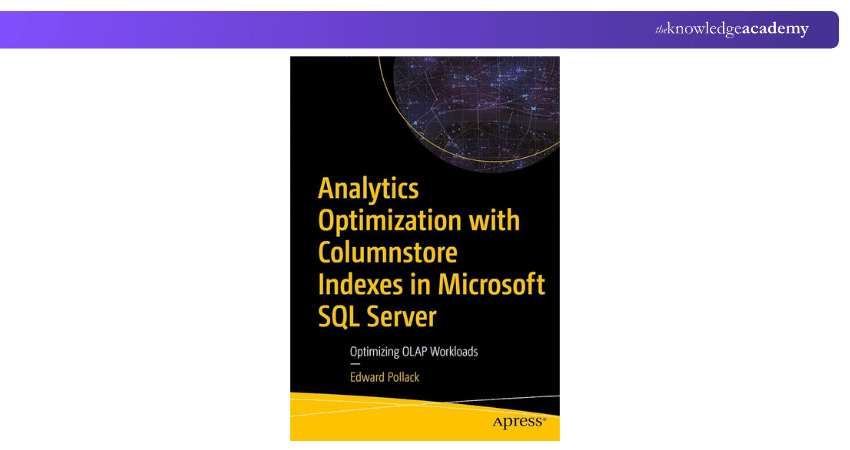
Analytics Optimization with Columnstore Indexes in Microsoft SQL Server focuses on improving analytical workloads through column-oriented storage and indexing.
The second edition covers SQL Server 2025 and Azure SQL, explaining how columnstore technology can help process large analytical datasets.
Key Topics Covered:
a) Columnstore Architecture: Understand column-oriented storage and its role in analytical processing.
b) Data Compression: Examine how columnstore indexes support compressed data storage.
c) Bulk Data Loading: Explore considerations for efficiently loading analytical datasets.
d) Index Maintenance: Understand techniques for managing columnstore indexes and their performance.
Target Audience: Database architects, BI professionals and SQL Server specialists responsible for analytical workloads.
Benefits and Takeaways: Readers gain specialised knowledge of columnstore indexing techniques. The book helps professionals assess how indexing and data-loading decisions affect analytical processing.
10) More SQL Antipatterns by Bill Karwin
Publication Year: 2026
More SQL Antipatterns: Avoid Common but Deadly Mistakes of Database Optimisation explores SQL practices that can undermine database performance and scalability.
Unlike the first volume, which focuses on database programming and design mistakes, this companion book concentrates on optimisation decisions and performance-related misconceptions.
Its examples use PostgreSQL and Python, so SQL Server professionals should adapt platform-specific implementations.
Key Topics Covered:
a) Complex Query Design: Understand mistakes associated with joins and other query constructions.
b) Database Scaling: Evaluate approaches to handling increasing data volumes and workloads.
c) Denormalisation: Examine situations where changing relational structures can influence performance.
d) JSON Storage Decisions: Assess trade-offs when using JSON columns in relational databases.
Target Audience: Experienced SQL developers, database architects and professionals interested in performance-aware database design.
Benefits and Takeaways: Readers develop a more critical understanding of common SQL optimisation advice. The book encourages evaluating performance decisions against actual application requirements rather than relying on assumptions.
Build practical skills in creating and managing database reports with the SQL Server Reporting Services (SSRS) Training - Join now!

The Knowledge Academy develops accessible learning content across Project Management, IT, Cybersecurity, Data Science, Business Analysis, HR, Accounting and Finance, Leadership and Health and Safety. Its resources combine subject research with clear explanations to help professionals build practical knowledge across a wide range of disciplines.
View Detail

 If you wish to make any changes to your course, please


