


We may not have the course you’re looking for. If you enquire or give us a call on +40 316317743 and speak to our training experts, we may still be able to help with your training requirements.
ISO 27001 Information Security Policy: An Overview
ByVishnu SankarLast updated on: 29 October 2026
An ISO 27001 information security policy outlines an organisation’s approach to protecting sensitive information, managing security risks and establishing its security commitments.
The Gist
1. An ISO 27001 information security policy defines an organisation's approach to protecting information and managing security risks.2. The policy supports the ISMS by establishing security commitments and providing direction for everyday security practices.3. Supporting policies cover specific areas such as access control, data protection, risk management and business continuity.4. Creating an effective policy involves identifying security requirements, obtaining management approval, communicating expectations and reviewing the policy regularly.
Who is responsible for protecting sensitive business information? What security expectations should employees follow? How can an organisation ensure everyone works towards the same security objectives?
These questions point to one essential requirement: a clearly defined information security policy. ISO 27001 provides a framework for establishing this policy as part of an organisation's Information Security Management System (ISMS) and helps create a culture of security awareness. In this blog, we’ll explore the ISO 27001 information security policy in detail. So, read on!
What is the ISO 27001 Information Security Policy?
An ISO 27001 information security policy is a formal document established by an organisation's top management to define its approach to protecting information and addressing security risks. It provides direction for the Information Security Management System (ISMS) and establishes commitments that guide security-related activities. The policy must also be communicated within the organisation and made available to relevant stakeholders where appropriate.
The policy aligns with three fundamental principles of information security:
a) Confidentiality: Ensuring information is accessible only to authorised individuals, systems or entities.
b) Integrity: Protecting information against unauthorised or improper modification to maintain its accuracy and completeness.
c) Availability: Ensuring authorised users can access information and systems when required.

Why is the ISO 27001 Information Security Policy Important?
The ISO 27001 information security policy plays a crucial role in guiding how an organisation manages and protects its information. Let’s look at the key reasons that emphasise its importance below:
a) Provides Clarity and Consistency: The ISO 27001 information security policy establishes a clear understanding of how information security is handled across the organisation, helping employees and stakeholders follow consistent security requirements and practices.
b) Forms the Foundation of the ISMS: The policy serves as a central reference point for the ISMS, providing direction for how risks are managed and information assets are protected.
c) Aligns Security with Daily Operations: The policy helps integrate information security into everyday business activities by providing direction for security-related decisions and practices.
d) Supports Audit and Compliance Requirements: The policy demonstrates top management's commitment to information security and provides evidence that the organisation has established a policy meeting relevant ISO 27001 requirements.
e) Builds Trust with Customers and Partners: Making the policy available to relevant stakeholders, where appropriate, demonstrates the organisation’s commitment to information security and helps build confidence in its approach to protecting sensitive information.
ISO 27001 Policy Requirements Checklist
Before finalising the policy, check whether it:
□ Aligns with the organisation's purpose□ Includes information security objectives or a framework for establishing them□ Commits to satisfying applicable information security requirements□ Commits to continual improvement of the ISMS□ Is maintained as documented information□ Is communicated within the organisation□ Is available to interested parties where appropriate
Common Policies Supporting ISO 27001 Information Security
An organisation's main information security policy may be supported by topic-specific policies covering different areas of information protection. These supporting policies provide more detailed guidance and help implement relevant controls within the ISMS. The following are common examples:
a) Access Control Policy: Defines how access to information systems and data is authorised, granted, reviewed and removed. It may cover user permissions, access approval and the principle of least privilege.
b) Data Protection Policy: Establishes rules for collecting, processing, storing and protecting personal and sensitive information. It may help organisations address applicable data protection obligations.
c) Data Retention Policy: Explains how long different categories of information should be retained based on business, legal and regulatory requirements, and how data should be securely deleted or disposed of when no longer required.
d) Asset Management Policy: Defines how information and associated assets, such as devices, software and storage media, are identified, recorded, protected and managed throughout their lifecycle.
e) Risk Management Policy: Outlines the organisation's approach to identifying, assessing, treating and monitoring information security risks.
f) Information Classification and Handling Policy: Defines categories for information based on sensitivity and establishes appropriate rules for storing, accessing, sharing and protecting it.
g) Security Awareness and Training Policy: Establishes expectations for information security awareness and training so employees understand relevant threats, responsibilities and secure working practices.
h) Acceptable Use Policy: Explains permitted and prohibited uses of organisational information systems, devices, networks and related resources.
i) Business Continuity Policy: Describes the organisation's approach to maintaining or restoring critical business activities during significant disruptions, including information security arrangements needed to support continuity.
j) Backup Policy: Defines expectations for backing up important information, protecting backup copies and testing recovery capabilities.
k) Malware Protection Policy: Establishes requirements for preventing, detecting and responding to malicious software through suitable technical and operational measures.
l) Change Management Policy: Sets expectations for assessing, approving, implementing and reviewing changes to information systems and supporting infrastructure.
m) Network Security Policy: Defines requirements for protecting network infrastructure and communications through appropriate network segmentation, secure configurations and security monitoring.
n) Information Transfer Policy: Establishes rules for securely transferring information within the organisation and to external parties using approved methods.
o) Secure Development Policy: Defines security expectations for software and system development, including secure design, testing and vulnerability management practices.
Trainer's Insight
Avoid generic templates. An information security policy should reflect the organisation's actual operations, information assets and security objectives. Copying another organisation's policy without adapting it can create commitments that do not match established practices or business requirements.
Develop the skills needed to support information security initiatives with ISO 27001 Foundation Training – Sign up soon!
How to Create an ISO 27001 Information Security Policy?
Creating an ISO 27001 information security policy requires organisations to understand their information security needs, establish appropriate commitments and communicate the approved policy. The following steps provide a practical approach to developing and maintaining the policy:
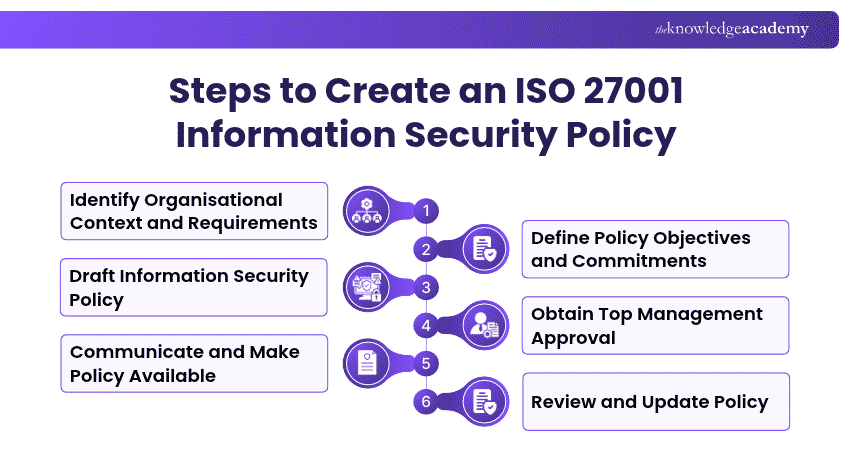
Step 1: Identify Organisational Context and Requirements
Review the organisation's activities, information assets, relevant stakeholders and applicable information security requirements. Consider the established ISMS scope and information security risks to ensure that the policy supports organisational needs.
Step 2: Define Policy Objectives and Commitments
Work with top management to identify the organisation's information security direction. Ensure the policy includes information security objectives or a framework for setting them, together with commitments to applicable requirements and the continual improvement of the ISMS.
Step 3: Draft Information Security Policy
Prepare the policy in clear, accessible language. Include the required commitments and any supporting information needed to communicate the organisation's approach. Avoid duplicating detailed operational instructions already addressed in topic-specific policies. Include appropriate document details, such as the policy title, version number and date, to support document control.
Step 4: Obtain Top Management Approval
Submit the draft policy to top management for review and approval. Confirm that the policy reflects the organisation's purpose and that its commitments can be supported through the ISMS.
Step 5: Communicate and Make Policy Available
Communicate the approved policy within the organisation using suitable channels, such as employee induction, internal documentation or awareness activities. Make the policy available to relevant stakeholders where appropriate. Also ensure that relevant personnel acknowledge the policy in accordance with the organisation's applicable policy controls.
Step 6: Review and Update Policy
Review the policy at planned intervals and when significant organisational or information security changes occur. Consider changes to business activities, legal requirements, security risks and the wider ISMS when deciding whether revisions are needed.
Pro Tip
Maintain a policy register as a central record of information security policies, document owners, approval details, versions and review dates. This helps organisations identify outdated documents and coordinate updates when security requirements change.
Become the professional who transforms security strategies into measurable business protection with the ISO 27001 Lead Implementer Training – Sign up now!

Vishnu Sankar is a Senior Content Writer with 5+ years of experience across content development, software development, web development and system administration. His technical background and professional training support his expertise in IT and Tech, while his extensive research and writing experience covers Project Management and Health and Safety.
View Detail

 If you wish to make any changes to your course, please


