


We may not have the course you’re looking for. If you enquire or give us a call on 01344203999 and speak to our training experts, we may still be able to help with your training requirements.
ISO 27001 Compliance: The Guide to Securing Your Data
BySubiksha ArulprakashLast updated on: 17 September 2026
ISO 27001 Compliance involves establishing, maintaining and continually updating an Information Security Management System (ISMS) to manage information security risks.
Let's say you discover that a critical security weakness has existed in your organisation for months. Nobody intentionally ignored it. The problem was that the responsibilities were unclear, risks were assessed in an inconsistent manner and security controls were managed separately.
This is where ISO 27001 Compliance can make a difference. Rather than treating Information Security as a collection of isolated activities, it provides a structured approach for identifying risks, implementing appropriate controls and continually improving how information is protected.
What is ISO 27001 Compliance?
ISO 27001 Compliance refers to aligning an organisation’s Information Security Management System (ISMS) with the requirements of ISO/IEC 27001. An ISMS provides a structured framework for identifying information security risks and determining appropriate treatments. The approach is risk-based rather than focused only on technology.
It considers people, processes and technology involved in protecting information and supports the confidentiality, integrity and availability of information. Organisations can use ISO 27001 to establish security policies, define responsibilities, assess risks, implement controls and monitor performance.
Why is ISO 27001 Compliance Important?
Information security threats can affect business operations, sensitive information, customer relationships and organisational reputation. ISO 27001 Compliance provides a systematic way to understand these risks and establish measures for managing them. Some key reasons organisations adopt ISO 27001 include:
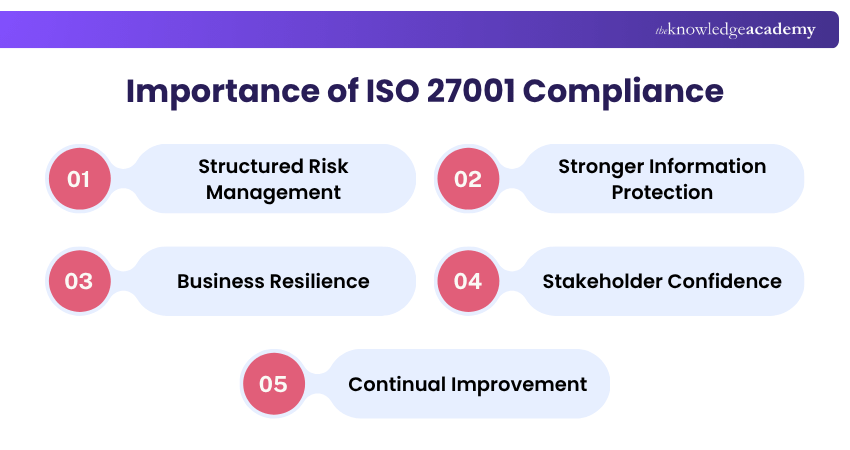
1) Structured Risk Management
ISO 27001 encourages organisations to identify, analyse and evaluate information security risks systematically. Organisations can then plan appropriate risk treatment based on their circumstances and risk criteria.
2) Stronger Information Protection
An ISMS helps organisations establish coordinated policies, processes and controls for protecting information rather than relying on disconnected security activities.
3) Business Resilience
Structured security processes, incident management and continuity-related measures can help organisations prepare for and respond to events that could disrupt information and business operations.
4) Stakeholder Confidence
A structured approach to Information Security can prove to the customers, partners and other stakeholders that information security risks are being actively managed.
5) Continual Improvement
ISO 27001 requires organisations to monitor and evaluate the effectiveness of their ISMS and address areas requiring improvement. This helps security practices adapt as risks and organisational circumstances change.
Core Principles of Information Security in ISO 27001
Confidentiality, integrity and availability are fundamental Information Security principles. They help organisations consider what information needs protection and what could happen if that protection fails.
1) Confidentiality
Confidentiality ensures information is accessible only to authorised individuals, systems or processes. Measures such as access management and appropriate handling procedures can help prevent unauthorised disclosure.
2) Integrity
Integrity focuses on maintaining the accuracy, completeness and reliability of information. Information should be protected against unauthorised or unintended alteration, destruction or manipulation.
3) Availability
Availability means authorised users can access the information, systems and services they need when required. Resilience, backups, recovery arrangements and appropriate system management can help support availability.
Trainer Insight
Do not treat ISO 27001 Compliance and certification as interchangeable. An organisation can align its ISMS with ISO 27001 requirements, while certification involves independent assessment by a certification body.
ISO 27001 Clauses
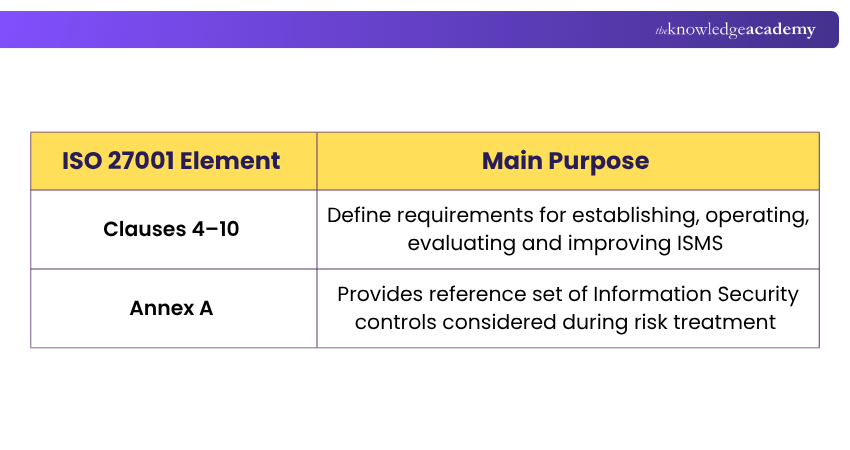
ISO 27001 Clauses 4 to 10 outline the core ISMS requirements, covering organisational context, leadership commitment, support, planning, operation, performance evaluation and continuous improvement. These policies embed information security into everyday business operations.
Clause 4: Context of the Organisation
This clause requires understanding internal and external factors, stakeholder expectations, and defining the ISMS scope. It ensures security efforts are shaped around real business needs rather than assumptions.
Clause 5: Leadership
Leadership must show commitment, set a clear direction for information security, and assign defined responsibilities. Without active involvement from top management, an ISMS struggles to gain organisational traction.
Clause 6: Planning
This clause focuses on assessing risks, defining treatments, and setting measurable security objectives. It ensures organisations plan proactively instead of reacting to security issues.
Clause 7: Support
Organisations need to provide resources while they need to develop staff skills and create awareness programs, and they need to keep documents safe. The ISMS requires this system to function properly according to its fundamental needs.
Clause 8: Operation
The clause describes two activities which include executing risk treatment plans and running security processes. The system makes sure that security controls get implemented correctly while it supervises all outsourced work activities.
Clause 9: Performance Evaluation
Organisations need to execute monitoring activities together with auditing work and conducting reviews to assess their ISMS system performance. The evaluations assist in finding existing weaknesses while they guarantee that decisions are based on solid proof.
Clause 10: Improvement
The clause demands organisations to fix problems while they need to resolve all non-conformities and proceed with their ISMS system improvements. The system needs to maintain its security practices through all risk changes.
EXTRA INSIGHT
An ISO 27001 Implementer in the UK can earn an average annual salary of £33K.
Key ISO 27001 Documentation Requirements
Documentation provides evidence of how the ISMS is designed, operated and evaluated. The exact documented information required can depend on the organisation and its ISMS, but important documentation can include:
1) ISMS scope
2) Information Security policy
3) Information Security objectives
4) Information Security risk assessment process
5) Information Security risk treatment process
6) Risk assessment and treatment results
7) Statement of Applicability
8) Evidence of competence where required
9) Monitoring and measurement results
10) Internal audit programme and results
11) Management review results
12) Records of nonconformities and corrective actions
Documentation should support the operation of the ISMS rather than exist simply to satisfy an audit.
Sign up for our ISO 27001 Internal Auditor Course and learn how to perform Internal Audits and secure ISMS – Join now!
ISO 27001 Annex A Controls
Annex A provides a reference set of Information Security controls that organisations consider as part of their risk treatment process. The controls are grouped into four themes:
1) Organisational Controls
These address organisational aspects of Information Security, including policies, responsibilities, information classification, supplier relationships, incident management, legal and contractual requirements and continuity considerations.
2) People Controls
People Controls address security responsibilities involving employees and other relevant personnel. They cover areas such as screening, terms of employment, awareness and training, responsibilities after termination or role changes and reporting security events.
3) Physical Controls
Physical Controls help protect information, facilities and equipment against physical threats. They address areas such as secure areas, physical entry, equipment protection, clear desk and screen practices and secure disposal or reuse of equipment.
4) Technological Controls
Technological Controls cover security measures involving systems and technology. Examples include access controls, authentication, malware protection, backups, logging, network security, Cryptography, secure development and vulnerability management.
Clauses vs Annex A: Quick Reference
ISO 27001 Implementation Process
Implementing ISO 27001 is not simply about adding security controls. Organisations need to build a functioning management system that connects risk, responsibilities, controls, documentation and continual improvement. Here are the key steps:
1) Understand Organisation & Establish Leadership Support
Identify the organisation’s context, relevant interested parties and Information Security requirements. Secure leadership commitment and lay down clear responsibilities for the ISMS.
2) Define the ISMS Scope
Determine the organisational boundaries, locations, processes, systems and information that will fall within the ISMS.
Pro Tip
Avoid making the ISMS scope unnecessarily broad or narrow. Define boundaries around the information, processes, locations and systems that genuinely need to be managed within the ISMS.
3) Conduct an Information Security Risk Assessment
Identify relevant risks and evaluate them using defined risk criteria. This provides the basis for deciding how each significant risk should be treated.
4) Develop the Risk Treatment Plan
Determine how identified risks will be addressed. Treatment may involve modifying, avoiding, sharing or retaining risks according to defined criteria and organisational requirements.
5) Determine and Implement Controls
Select appropriate controls based on risk treatment decisions. Annex A should be considered alongside any additional controls required by the organisation.
6) Prepare the Statement of Applicability
Document the controls considered necessary, explain why they are included and record the status of their implementation. Relevant Annex A exclusions should also be justified.
7) Establish Policies, Processes and Documentation
Develop and maintain the documented information required to operate the ISMS effectively and demonstrate how relevant requirements are addressed.
8) Monitor and Evaluate the ISMS
Measure and evaluate ISMS performance. Conduct internal audits and management reviews to determine whether the system is operating effectively and identify opportunities for improvement.
9) Address Nonconformities and Improve
Take corrective action where problems are identified and continually improve the suitability, adequacy and effectiveness of the ISMS.
10) Prepare for Certification
Organisations seeking certification can engage an appropriate certification body to independently assess whether their ISMS conforms to ISO 27001 requirements.
Common ISO 27001 Compliance Mistakes
Even well-designed security programmes can face problems if ISO 27001 is approached as a one-time exercise. Common mistakes include:
1) Treating compliance primarily as a documentation exercise
2) Selecting controls without linking them to identified risks
3) Defining an unclear or unsuitable ISMS scope
4) Failing to secure active leadership involvement
5) Overlooking employee competence and security awareness
6) Preparing for compliance activities only when an audit approaches
7) Failing to update the ISMS when risks or organisational circumstances change
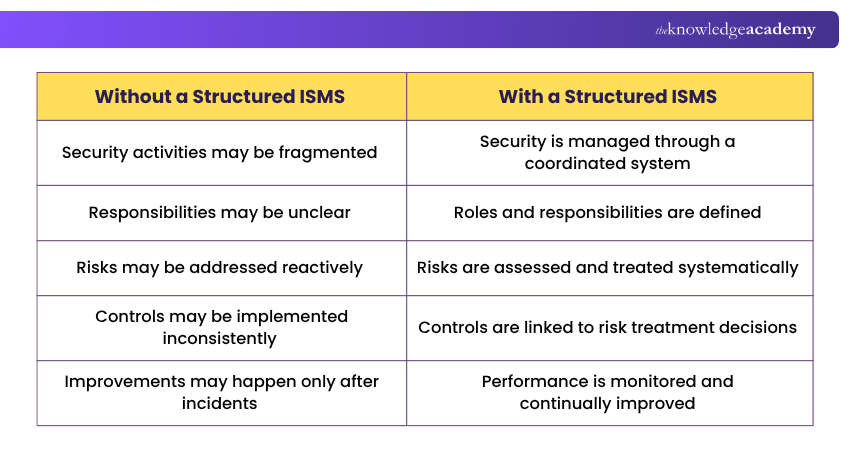
Here’s how ISO 27001 Compliance can make a big impact:
Who Needs ISO 27001 Compliance?
ISO 27001 can be used by organisations of different sizes and sectors. Its relevance depends largely on the information an organisation handles, its risks and the requirements of customers, regulators and other interested parties. It can be particularly relevant for organisations that:
1) Handle sensitive or confidential information
2) Provide services involving customer or business data
3) Depend heavily on information systems for operations
4) Work with customers that have defined Information Security requirements
5) Need a systematic approach to managing Information Security risks
6) Want to demonstrate structured Information Security practices
7) Are considering independent ISO 27001 certification
ISO 27001 is not universally mandatory. However, regulatory or customer requirements may make conformity particularly important in some circumstances.
Master the key aspects of Information Security with our range of ISO 27001 Courses - Sign up now!
How Much Does ISO 27001 Implementation Cost?
There is no single cost for implementing ISO 27001. The investment required varies considerably between organisations because implementation depends on the existing maturity and complexity of the ISMS.
Important cost drivers can include:
1) Organisation size and complexity
2) Scope of the ISMS
3) Number of locations and systems involved
4) Existing security maturity
5) Gaps identified during risk assessment and analysis
6) Technology or process changes required
7) Internal staff time and resources
8) Training requirements
9) External consultancy support, where used
10) Certification audit costs, if certification is pursued
11) Ongoing monitoring, auditing and improvement activities
ISO 27001 Compliance Checklist
Use the following quick checklist to assess whether the core elements of your ISMS are being addressed:
ISO 27001 Checklist:
Have you defined the scope of the ISMS? Have relevant interested parties and their requirements been identified? Is top management actively supporting the ISMS? Have Information Security risks been assessed? Is there a documented risk treatment approach? Have appropriate controls been determined and implemented? Is the Statement of Applicability maintained? Are relevant policies and procedures documented and communicated? Are employees appropriately trained and aware of their security responsibilities? Is ISMS performance monitored and evaluated? Are internal audits conducted? Are management reviews completed? Are nonconformities addressed through corrective action? Is the ISMS continually improved as risks and business requirements change?
Advance your career with our ISO 27001 Lead Auditor Course. Gain expertise in auditing and ensure top-notch data security. Join today!

Subiksha Arulprakash is a Copywriter with 5+ years of experience in content writing, editing, content development and digital marketing. Her experience researching and writing about Business Skills, ISO standards and compliance enables her to produce clear, accessible content for different audiences.
View Detail

 If you wish to make any changes to your course, please


