




We may not have the course you’re looking for. If you enquire or give us a call on 01344203999 and speak to our training experts, we may still be able to help with your training requirements.
Is the IOSH Managing Safely Exam Difficult?
ByThe Knowledge AcademyLast updated on: 26 November 2026
The IOSH Managing Safely exam is generally manageable with preparation and a practical understanding of workplace safety. The assessment typically includes a knowledge test and a practical workplace risk assessment. Explore the assessment format, common challenges and ways to prepare for both parts.
What’s in This Guide?
1. Exam Difficulty: Find out how challenging the IOSH Managing Safely exam is and which areas may require extra preparation.2. Assessment Format: Understand the knowledge test and practical workplace risk assessment.3. Preparation: Practise answering questions under timed conditions and work through a sample workplace risk assessment.4. Reassessment: Learn what to do if you need to resit the test or resubmit the project.
Workplace note: “Storage area unsafe. Take extra care.”
The next person to read it has three questions:
a) Which part of the storage area are you talking about?
b) What could happen to someone working there?
c) What needs to change before the next delivery?
A note can sound clear when you’ve seen the problem yourself. However, identifying a hazard is only the first step. You also need to explain the risks and suggest suitable controls. But how challenging is it to apply this knowledge during the IOSH Managing Safely assessment? Let's explore what candidates can expect and how preparation can help.
How Difficult is the IOSH Managing Safely Exam?
The IOSH Managing Safely exam is generally manageable if you understand the course material and can apply it to everyday workplace situations. IOSH designed the course for managers and supervisors across industries. The assessment asks you to demonstrate your understanding of practical safety principles, such as evaluating risk, selecting controls and investigating incidents.
The two components present different challenges. In the timed test, you need to read each question carefully and decide which principle applies. In the practical project, you have to explain your reasoning clearly enough for someone unfamiliar with the workplace to understand who could be harmed and why your proposed controls are suitable.

IOSH Managing Safely Assessment Format and Requirements
The IOSH Managing Safely assessment typically includes a knowledge test and a practical workplace risk assessment. These components evaluate delegates' understanding of safety principles and their ability to apply them in workplace situations.
Candidates should confirm the current pass marks, assessment instructions and practical submission deadline with their IOSH-approved training provider.
Knowledge Test
The test draws on course topics such as hazard identification, risk control, managers’ responsibilities, incident investigation and safety performance. Read the whole question before answering. A question about the most effective control, for instance, asks you to judge which option reduces the risk most effectively in the situation described.
Workplace Risk Assessment Project
For the project, you identify hazards linked to a workplace activity and explain who could be harmed and how. You then record existing controls, evaluate the risk and specify any further action required. Describe the activity and its location precisely so the assessor can see how your recommendations relate to the conditions you observed.
Delegates must successfully complete both assessment components to receive their IOSH Managing Safely certificate.
Understand the role of leadership in shaping safety culture with the IOSH Managing Safely Refresher Training – Register now!
How to Prepare for the IOSH Managing Safely Assessment?
Prepare for the IOSH Managing Safely assessment by putting the course principles into practice. This helps you build confidence in answering exam questions and making decisions about workplace risks.
Practising Exam Questions Under Timed Conditions
a) Complete a Timed Practice Set: Use the time limit in your course instructions and leave a few minutes to review any questions you marked for a second look.
b) Review Why You Lost Marks: Identify whether you misunderstood the topic, misread the question or rushed your answer. Use that pattern to guide your next revision session.
c) Explain Your Reasoning Aloud: For a scenario question, say why your chosen answer fits the situation. If you struggle to explain it, revisit the course principle and try a different scenario.
Pro Tip
Mix topics in one revision session: alternate between questions on responsibilities, incident investigation and safety performance. This helps you recognise which concept a question is testing when there’s no topic heading to guide you.
Working Through a Sample Workplace Risk Assessment
Take one familiar task and practise writing a single entry using the method taught on your course. For example, imagine a projector cable runs across the walkway in a meeting room.
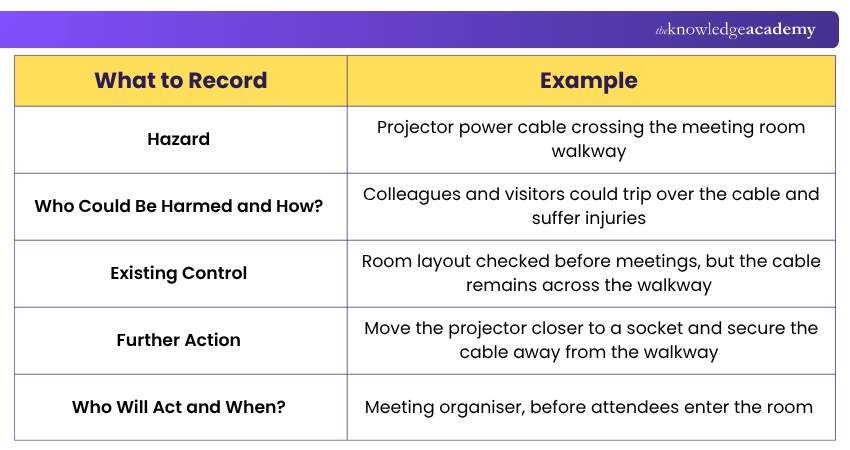
Use the course’s scoring method to rate the risk with the existing control in place. Then consider how your proposed action changes the risk rating. In this example, rerouting the cable removes it from the walkway and reduces the likelihood of a trip.
What Happens If You Fail the IOSH Managing Safely Assessment?
Contact your training provider to confirm which component you need to complete again. Depending on your result and the arrangements for your course, you may need to resit the knowledge test or revise and resubmit the practical project. Ask about the deadline, available attempts and any applicable fee when arranging reassessment.
If you receive feedback, use it to focus your next attempt. For a test resit, work through fresh questions on the topics you found difficult. For a project resubmission, check that each proposed action addresses the specific hazard and that the assessor can follow your reasoning.
Trainer's Insight
When reviewing your risk assessment, check whether each proposed control can be implemented and monitored. For example, a pre-use equipment checklist should identify who completes the checks and how reported defects will be addressed.
Find the right health and safety training for your role with the IOSH Courses - Register now!

The Knowledge Academy develops accessible learning content across Project Management, IT, Cybersecurity, Data Science, Business Analysis, HR, Accounting and Finance, Leadership and Health and Safety. Its resources combine subject research with clear explanations to help professionals build practical knowledge across a wide range of disciplines.
View Detail

 If you wish to make any changes to your course, please


