Who Should Attend This Ruby Programming Course?
This Ruby Programming Course is suitable for professionals looking to develop or strengthen their Ruby programming knowledge. It can benefit professionals working across software, web, application, and IT-related roles, such as:
- Software Developers
- Web Developers
- Application Programmers
- Full-Stack Developers
- Systems Analysts
- Ruby Developers
- Backend Developers
- IT Professionals
Prerequisites for the Ruby Programming Course
There are no formal prerequisites to attend this Ruby Programming Course. However, a basic knowledge of computers and programming would be beneficial for the delegates.
Ruby Programming Course Overview
Ruby is a dynamic, object-oriented programming language known for its readable syntax and flexible programming approach. This Ruby Programming Course introduces delegates to Ruby fundamentals, including variables, operators, control structures, classes, objects, arrays, hashes, file operations, and regular expressions.
Delegates will develop knowledge of object-oriented programming concepts such as inheritance, polymorphism, visibility, modules, mixins, and object scoping. They will also explore programming and method standards, UML, pattern matching, special variables, and other Ruby language features.
This 2-Day course offered by The Knowledge Academy develops a structured understanding of core Ruby programming concepts and techniques. Delegates will gain practical knowledge of writing and organising Ruby code, working with data structures and files, and applying object-oriented principles to Ruby programming tasks.
Ruby Programming Course Objectives
- To understand Ruby syntax, variables, operators, and language fundamentals
- To apply conditional statements, loops, and control structures in Ruby
- To understand classes, objects, methods, inheritance, and polymorphism
- To work with arrays, hashes, files, and Ruby input and output operations
- To understand object scoping, visibility, modules, mixins, and namespaces
- To apply strings, regular expressions, pattern matching, and Ruby language features
Learning Outcomes of this Ruby Programming Course
Upon completing this Ruby Programming Course, delegates will understand Ruby syntax, control structures, classes, objects, file operations, data structures, and regular expressions. They will also be able to apply object-oriented concepts such as inheritance, polymorphism, visibility, modules, and mixins when working with Ruby code.
Features of Ruby Programming
Ruby is designed to support efficient and flexible software development across a wide range of programming tasks. It helps developers write structured code while maintaining clarity and ease of use. Its key features include:
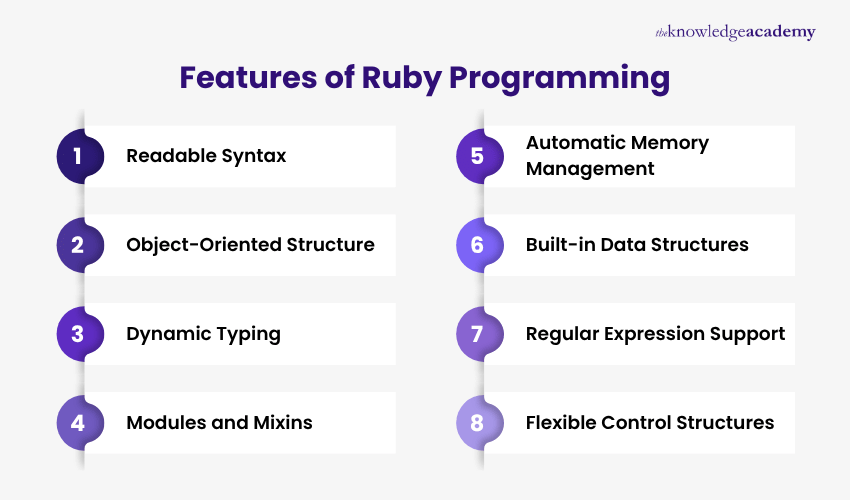
- Readable Syntax: Ruby uses clear and concise syntax that makes code easier to write and understand.
- Object-Oriented Structure: Everything in Ruby is treated as an object, supporting organised and reusable code.
- Dynamic Typing: Variables do not require fixed data type declarations, allowing greater coding flexibility.
- Modules and Mixins: These support code reuse without relying on traditional multiple inheritance.
- Automatic Memory Management: Ruby uses garbage collection to manage memory automatically.
- Built-in Data Structures: Arrays, hashes, strings, and other structures support efficient data handling.
- Regular Expression Support: Ruby provides pattern-matching capabilities for working with text.
- Flexible Control Structures: Conditionals, loops, and iterators help manage program flow effectively.





 If you miss out, enquire to get yourself on the waiting list for the next day!













 If you wish to make any changes to your course, please


