Who Should Attend this Apache Airflow Training Course?
This Apache Airflow Course is ideal for professionals seeking to design, schedule, and monitor data pipelines in modern data engineering environments. You should attend this Apache Airflow Training Course if you are:
- Data Engineer: Automating workflows and managing ETL pipelines with Airflow
- Data Analyst: Orchestrating data tasks and improving pipeline visibility
- DevOps Engineer: Integrating Airflow into CI/CD and cloud-based environments
- Software Engineer: Managing task dependencies and workflow execution in Python
- Business Intelligence Developer: Streamlining reporting processes using scheduled jobs
- Aspiring Data Professional: Gaining hands-on experience with a leading workflow orchestration tool
Prerequisites of the Apache Airflow Training Course
There are no formal prerequisites for attending this Apache Airflow Course. However, having some basic programming or scripting experience is recommended.
Apache Airflow Training Course Overview
Apache Airflow Training introduces the core concepts of workflow orchestration and its use in modern data engineering environments. It covers Airflow architecture, Airflow DAG, task lifecycles, operators, sensors, scheduling, security, monitoring, and deployment.
Delegates will develop skills in creating DAGs, managing dependencies, configuring connections, and monitoring pipelines. They also gain knowledge of operators, including the Airflow BaseOperator, alongside security, logging, and deployment concepts.
This 1-Day Apache Airflow Course by The Knowledge Academy enables delegates to build and manage Airflow workflows. They will be able to configure DAGs, handle dependencies, monitor pipelines, and support workflow operations.
Apache Airflow Training Course Objectives
- To understand Apache Airflow architecture and core components
- To create and manage DAGs and task dependencies
- To understand operators, sensors, hooks, and XComs
- To configure scheduling, variables, parameters, and connections
- To manage Airflow security, logging, and monitoring
- To understand deployment and administration using Docker and Kubernetes
After completing this Apache Airflow Course, delegates will have a structured understanding of how Apache Airflow supports workflow orchestration across modern data environments. They will be better prepared to build, monitor, troubleshoot, and administer Airflow workflows while supporting reliable pipeline operations.
Key Benefits of Learning Apache Airflow Course
Our Apache Airflow Training provides delegates with structured, practical learning to build their understanding of workflow orchestration in modern data engineering environments. Through guided learning and practical application, delegates gain experience in working with key Apache Airflow capabilities.
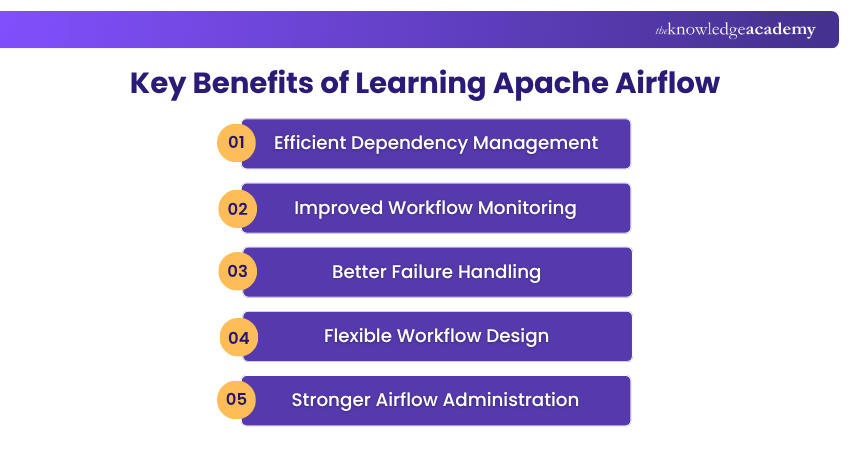
Key benefits of our Apache Airflow Course include:
- Efficient Dependency Management: Use DAGs and task relationships to control workflow order and manage dependencies effectively.
- Improved Workflow Monitoring: Apply Airflow logging, monitoring, metrics, UI, and CLI tools to track pipeline execution and identify issues.
- Better Failure Handling: Develop skills in managing task failures, dependencies, retries, and operational problems within workflows.
- Flexible Workflow Design: Use DAG authoring, dynamic task mapping, plugins, variables, and connections to build adaptable workflows.
- Stronger Airflow Administration: Gain practical knowledge of security, deployment, scheduler optimisation, queues, pools, and other administrative controls.





 If you miss out, enquire to get yourself on the waiting list for the next day!













 If you wish to make any changes to your course, please


