Who Should Attend this NEBOSH HSE Certificate in Process Safety Management Course?
This NEBOSH HSE Certificate in Process Safety Management (PSM) Course is suitable for individuals working in high-hazard industries where effective process safety management is important for reducing the risk of major accidents and incidents. The following professionals can benefit from this training:
- Health and Safety Professionals
- Process Operators and Supervisors
- Risk Assessment Professionals
- Quality Control Managers
- Managers and Executives in Process Industries
- Regulatory Compliance Officers
- Incident Investigators
Prerequisites for the NEBOSH HSE Certificate in Process Safety Management Course
There are no formal prerequisites to attend this NEBOSH HSE Certificate in Process Safety Management Training Course. However, a basic knowledge of health and safety issues would be beneficial.
NEBOSH HSE Certificate in Process Safety Management Course Overview
NEBOSH HSE Certificate in Process Safety Management Course develops essential knowledge of managing process safety risks. It covers Process Safety Leadership, risk management, hazard control, and fire and explosion protection.
Delegates will develop knowledge of Management of Change, permit-to-work systems, asset management, safe shift handovers, and safe start-up and shutdown. They will also learn to manage dangerous substances, bulk storage operations, fire risks, and emergency preparedness.
This 3-Day training by The Knowledge Academy enables delegates to apply Process Safety Management principles to real-world industrial environments, identify and control process hazards, and support safer operations.
NEBOSH HSE Certificate in Process Safety Management Course Objectives
- To know about the safe operation and maintenance of process plant
- To increase awareness of the hazards and risk potential of the sites
- To identify the root causes of the incident and appropriate solution
- To ensure the continual development of expertise with new laws
- To provide resources for projects and support risk assessment
- To meet any legal requirements to report and investigate
Delegates acquire a comprehensive skill set and knowledge base upon completing the NEBOSH HSE Certificate in Process Safety Management Course. They also possess expertise in process safety principles, regulatory compliance, risk assessment, asset management, safety-critical equipment, incident prevention, emergency response, and cultivating an organisation's robust process safety culture.
Benefits of the NEBOSH HSE Certificate in Process Safety Management
The NEBOSH HSE Certificate in Process Safety Management develops knowledge and skills for managing process risks, controlling major hazards, and supporting safer operations within process industries. The following are the benefits:
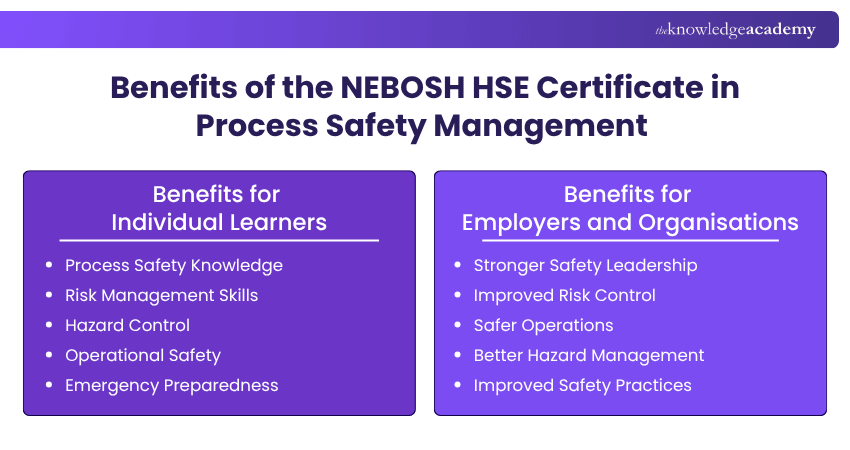
Benefits for Individual Learners
This qualification helps learners strengthen their Process Safety Management knowledge and develop skills that can be applied within process industry environments. The key benefits for individuals are:
- Process Safety Knowledge: Understand key Process Safety Management principles and systems.
- Risk Management Skills: Identify, assess, and manage risks within process operations.
- Hazard Control: Understand controls for dangerous substances, reaction hazards, fire, and explosions.
- Operational Safety: Learn about permit-to-work systems, shift handovers, start-up, and shutdown procedures.
- Emergency Preparedness: Develop knowledge of emergency planning and response to process incidents.
Benefits for Employers and Organisations
Developing process safety competence within the workforce can help organisations strengthen risk controls, operational practices, and preparedness for process-related incidents. The key benefits for organisations and employers are:
- Stronger Safety Leadership: Support effective Process Safety Leadership and worker engagement.
- Improved Risk Control: Strengthen the identification and management of process-related risks.
- Safer Operations: Support effective operating procedures, maintenance, and Management of Change.
- Better Hazard Management: Improve controls for fire, explosions, dangerous substances, and other process hazards.
- Improved Safety Practices: Strengthen permit-to-work, contractor management, and emergency preparedness processes.





 If you miss out, enquire to get
yourself
on the waiting list for the next day!
If you miss out, enquire to get
yourself
on the waiting list for the next day!













 If you wish to make any changes to your course, please


