Who should attend this Hadoop Big Data Certification Course?
This Hadoop Big Data Certification Course is suitable for a wide range of individuals who are interested in mastering the concepts and techniques related to Hadoop and Big Data. This course can be beneficial for a wide range of professionals, including:
- Data Professionals
- Software Developers
- Database Administrators
- System Administrators
- IT Professionals
- Business Analysts
- Project Managers
Prerequisites of the Hadoop Big Data Certification Course
There are no formal prerequisites for this Hadoop Big Data Course.
Hadoop Big Data Certification Training Course Overview
Big Data and Analytics Training has emerged as a critical domain. The Hadoop Big Data Certification Training introduces delegates to the world of Big Data and its relevance in modern business and technology landscapes. With data becoming the lifeblood of organisations, understanding and harnessing Big Data and Analytics is essential.
Proficiency in Big Data and Analytics Courses is essential for professionals such as Data Professionals, Software Developers, and IT Professionals. Mastering Big Data Analytics Courses can open doors to lucrative career opportunities and allow individuals to harness the power of data to make informed decisions.
This intensive 2-day Big Data Analytics Course by The Knowledge Academy, empowers delegates with the knowledge and practical skills necessary to navigate the complex landscape of Big Data. Through hands-on experience and expert guidance, delegates will gain the competence to process, analyse, and extract valuable insights from vast data sets.
Course Objectives
- To understand the fundamentals of Big Data and Analytics
- To employ Hadoop technology to manage and process large datasets
- To perform data analysis and gain insights from Big Data
- To explore real-world use cases and applications of Big Data Analytics
- To master the art of data visualisation for effective communication
- To develop practical problem-solving skills in Big Data scenarios
After completing the Hadoop Big Data Training Course, delegates will receive a certification in Hadoop Big Data Analytics, validating their expertise and enhancing their career prospects in the competitive world of Big Data and Analytics. This certification is a testament to their proficiency in handling and interpreting Big Data, making them valuable assets for the delegate's future.
Skills Gained from Hadoop Big Data Training
Hadoop Big Data Training in Dublin by The Knowledge Academy, a global training provider, equips learners with practical capabilities to work with large-scale data environments. It enables professionals to confidently manage, process, and analyse Big Data across distributed systems.
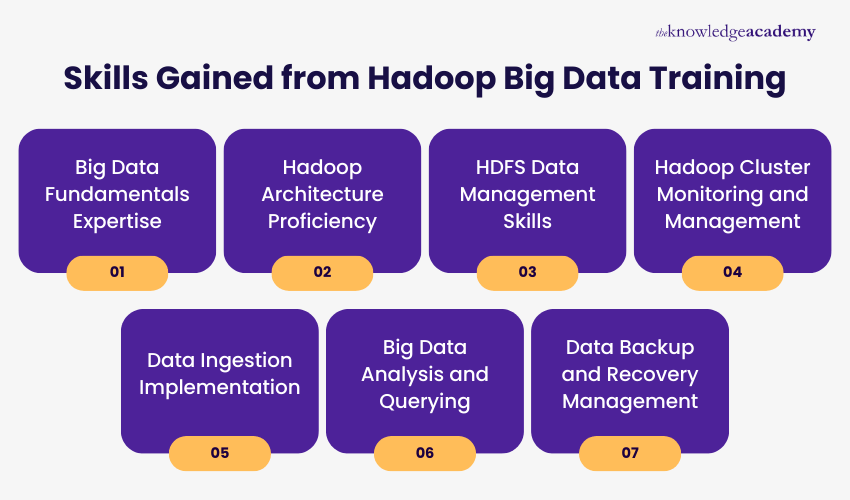
Professionals can develop the following skills through this course:
- Big Data Fundamentals Expertise: Build proficiency in Big Data concepts, its sources, storage architecture, and the role Hadoop plays in enterprise data processing systems.
- Hadoop Architecture Proficiency: Understand the core components of Hadoop, such as Hadoop Distributed File System (HDFS), NameNode, DataNode, and cluster structure, and how they work together to store and process massive datasets.
- HDFS Data Management Skills: Develop the ability to store, retrieve, and manage large volumes of data using the Hadoop Distributed File System.
- Hadoop Cluster Monitoring and Management: Acquire skills to monitor Hadoop clusters, manage storage resources, and maintain system performance and reliability.
- Data Ingestion Implementation: Learn to ingest data into Hadoop from databases, applications, and streaming sources using suitable ingress and egress tools.
- Big Data Analysis and Querying: Hadoop Big Data Training by The Knowledge Academy in Dublin helps you become familiar with Hadoop tools such as Hive, NoSQL, PolyBase, Presto, and Sqoop to query datasets and generate insights for reporting and decision-making.
- Data Backup and Recovery Management: Protect Hadoop data through replication, backup strategies, and recovery techniques to maintain data availability and system reliability.





 If you miss out, enquire to get yourself on the waiting list for the next day!













 If you wish to make any changes to your course, please


