Who should attend this Hadoop Administration Training Course?
This Hadoop Administration Course is suitable for individuals who aim to develop expertise in managing Hadoop clusters and the associated ecosystem components. This course can be beneficial for a wide range of professionals, including:
- System Administrators
- IT Professionals
- Database Administrators
- Network Engineers
- Software Engineers
- Data Engineers
- Technical Managers
Prerequisites of the Hadoop Administration Training Course
There are no formal prerequisites for this Hadoop Administration Training Course. However, a basic understanding of Hadoop and a prior knowledge of large data fields would be beneficial for the delegates.
Hadoop Administration Training Course Overview
The Hadoop Administration Training Course stands as a cornerstone for professionals seeking to harness the power of large-scale data management and processing. The organisations rely heavily on Big Data and Analytics, so mastering Hadoop Administration is paramount. This course equips individuals with the knowledge and skills needed to manage and optimise Hadoop clusters efficiently, ensuring the seamless flow of data.
Proficiency in Hadoop Administration is of utmost importance for professionals engaged in the management of Big Data and Analytics. Data Engineers, System Administrators, and IT professionals responsible for maintaining and scaling data infrastructure should aim to master this subject. Hadoop Administration skills enable them to configure, monitor, and troubleshoot Hadoop clusters, ensuring data availability, reliability, and performance.
This 1-day training by The Knowledge Academy empowers delegates with practical insights and hands-on experience in Hadoop Administration. Delegates will learn essential concepts, best practices, and tools for efficiently managing Hadoop clusters, from installation and configuration to security and performance optimisation. The course combines theory and practical knowledge, ensuring that delegates are well-prepared to tackle the challenges of the Hadoop Administration.
Course Objectives
- To understand the fundamentals of Hadoop and its role in Big Data and Analytics
- To learn cluster installation, configuration, and maintenance techniques
- To implement robust security measures to safeguard data integrity
- To optimise Hadoop cluster performance for efficient data processing
- To acquire hands-on experience with Hadoop ecosystem components
- To develop best practices for data management and storage
After completing this Hadoop Administration Training, delegates will receive a prestigious certification recognised within the realm of Big Data and Analytics. This certification validates their expertise in Hadoop Administration, making them valuable assets to organisations in need of efficient data management.
Benefits of Hadoop Administration Training
The Knowledge Academy, a global training provider, offers Hadoop Administration Training in Doncaster that prepares learners to install, configure, and manage Hadoop clusters. The course focuses on monitoring systems, maintaining performance, and ensuring reliable data processing operations.
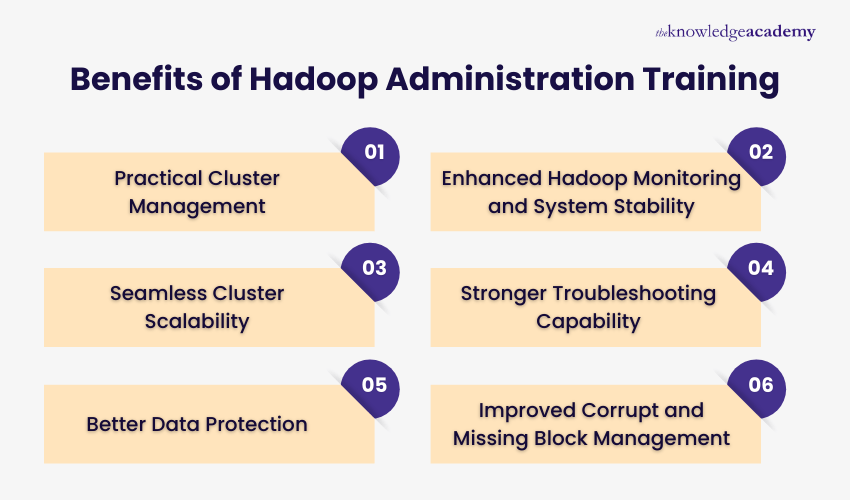
Professionals can gain the key benefits such as:
- Practical Cluster Management: Gain hands-on exposure to configuring and maintaining Hadoop clusters using nodes in real-world environments.
- Enhanced Hadoop Monitoring and System Stability: Learn to monitor HDFS cluster health, track resource usage, and manage logs to ensure stable Hadoop operations.
- Seamless Cluster Scalability: Add and remove DataNodes safely to maintain cluster availability and support infrastructure changes.
- Stronger Troubleshooting Capability: Develop the ability to diagnose system errors, resolve performance issues, and manage operational failures effectively.
- Better Data Protection: Apply backup and recovery techniques to safeguard distributed data and maintain system stability.
- Improved Corrupt and Missing Block Management: Identify and resolve corrupt or missing data blocks within HDFS to maintain data integrity and reliable cluster performance.





 If you miss out, enquire to get yourself on the waiting list for the next day!













 If you wish to make any changes to your course, please


