


We may not have the course you’re looking for. If you enquire or give us a call on 01344203999 and speak to our training experts, we may still be able to help with your training requirements.
Software Tester Roles and Their Key Responsibilities
ByThe Knowledge AcademyLast updated on: 16 November 2026
Different Software Tester roles focus on different aspects of software quality, from identifying defects to managing testing processes. Explore various roles, their responsibilities and the skills needed for each position.

The Gist
1. Software Testers evaluate applications to identify defects and verify that requirements are met.2. Their responsibilities include test planning, test execution, defect reporting, retesting and documenting results.3. Junior Test Engineers, Test Analysts, Test Automation Engineers and Test Managers contribute at different levels.4. Critical thinking, technical knowledge, communication and attention to detail support effective testing.5. Software Testers can develop expertise in manual testing, automation, technical testing or test management.
What happens when an application looks perfect but fails the moment a user tries something unexpected? A payment might not go through, a login might stop working, or a small error could disrupt an entire system. This is where Software Testers step in.
Software Tester roles and responsibilities go far beyond finding bugs. These professionals examine how applications behave, identify potential problems and work closely with development teams to improve software quality. From Junior Test Engineers to experienced Test Managers, each role contributes to the testing process. In this blog, we'll explore their key responsibilities, essential skills and different career opportunities.
Different Software Tester Roles and Their Responsibilities
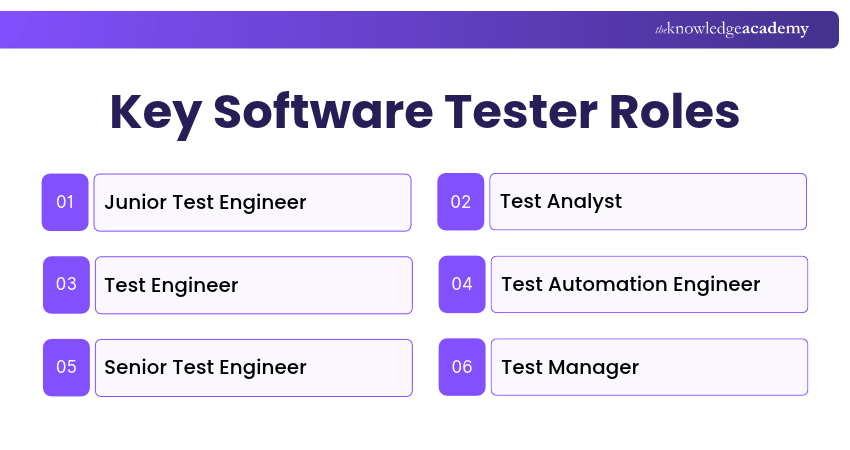
Software testing involves various specialised roles, each contributing to different aspects of software quality, functionality and performance. While their responsibilities may differ, these professionals work towards a common goal of identifying defects and verifying that software meets specified requirements. Here are six common roles within software testing:
1) Junior Test Engineer
Junior Test Engineers typically work under the guidance of experienced testing professionals. They assist with executing test cases, recording results and reporting defects identified during testing. They may also help prepare test data, maintain testing documentation and participate in test reviews.
The position helps beginners develop hands-on experience with testing techniques, tools and defect management processes. As they gain experience, Junior Test Engineers can handle more complex testing tasks and take greater responsibility for designing test cases.

2) Test Analyst
Test Analysts focus on understanding software requirements and identifying what needs to be tested. They analyse specifications, determine test conditions and develop test cases to ensure adequate coverage of functional requirements.
They also evaluate test results, identify coverage gaps and work with developers and Business Analysts to clarify expected system behaviour. This helps ensure that testing addresses business requirements and important user scenarios.
3) Test Engineer
Test Engineers are responsible for designing, implementing and executing tests to evaluate software applications. Depending on their specialisation, they may perform functional, integration, regression or technical testing to assess software behaviour and identify defects.
They work closely with developers to understand application functionality and use testing tools, scripts or specialised methods to carry out tests. Their findings help teams detect technical issues and determine whether software meets defined quality requirements.
4) Test Automation Engineer
Test Automation Engineers specialise in designing, developing and maintaining test automation solutions that support efficient and repeatable software testing. They use programming languages, testing frameworks and automation tools to create scripts for suitable testing activities.
Their responsibilities may include selecting automation approaches, maintaining test frameworks, investigating automated test failures and integrating automated checks into Continuous Integration and Continuous Delivery (CI/CD) pipelines.
Key Insight
An Automation Engineer in the United Kingdom can earn an average yearly salary of £48K, although salaries can vary depending on experience, location, programming expertise and the automation technologies used.
5) Senior Test Engineer
Senior Test Engineers handle complex testing activities and provide technical guidance to other members of the testing team. They may contribute to test strategy, assess testing risks and help determine effective approaches for challenging software requirements.
Beyond test execution, they review testing practices, investigate complex defects and mentor junior engineers. Their expertise helps teams strengthen testing processes, resolve technical challenges and maintain consistent quality standards.
Build the foundation for a successful software testing career with the ISTQB Software Testing Foundation Training – Sign up now!
6) Test Manager
Test Managers oversee testing activities and coordinate the resources needed to meet project objectives. Their responsibilities include developing test strategies, managing schedules, monitoring progress and communicating testing risks.
They work with project stakeholders to establish testing priorities, allocate responsibilities and ensure testing activities align with organisational and project requirements. Rather than focusing primarily on individual test execution, Test Managers oversee the overall testing process and support informed project decisions.
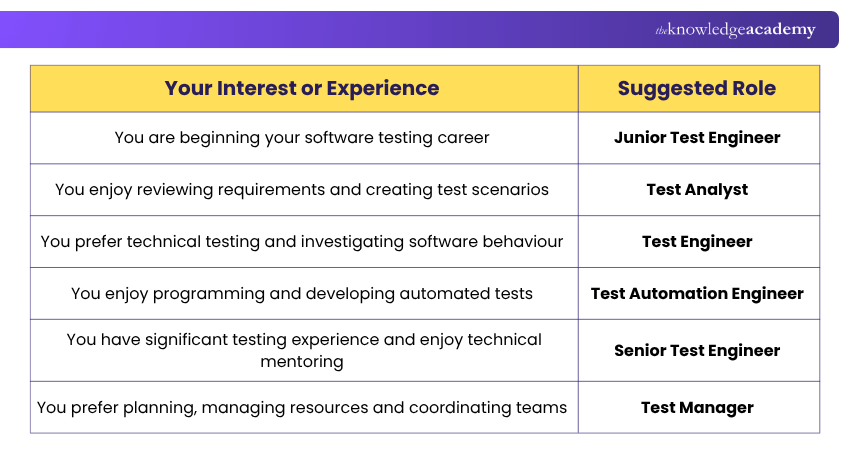
Use the following table to identify a suitable career path in software testing:
Key Skills of a Software Tester
A Software Tester needs a combination of technical expertise and interpersonal skills to identify problems, evaluate applications and communicate findings effectively. Here are five essential skills that support successful software testing:
1) Programming and Scripting Knowledge
Knowledge of programming and scripting languages helps Software Testers understand application behaviour, investigate technical issues and create automated tests. Languages such as Java, Python and JavaScript are commonly used in testing activities, while SQL helps testers examine and validate database information.
Although advanced programming skills are not required for every testing position, coding knowledge is particularly valuable for Test Automation Engineers and technically focused roles.
2) Understanding of Software Testing Tools
Software Testers should understand the tools used to manage testing activities, execute tests and track defects. For example, Selenium supports browser automation, Jira is commonly used for issue tracking, TestNG provides a testing framework for Java applications, and OpenText Professional Performance Engineering supports performance testing.
Familiarity with appropriate tools helps testers work efficiently, manage testing information and support consistent test execution.
3) Critical Thinking and Problem-solving
Critical thinking enables Software Testers to examine applications from different perspectives and identify situations that may lead to unexpected behaviour. They must consider user actions, system conditions and possible failure scenarios rather than relying only on predefined testing steps.
Problem-solving skills also help them investigate defects, interpret test results and work with developers to understand the causes of software issues.
4) Communication Skills
Software Testers regularly share information with developers, managers, Business Analysts and other stakeholders. Strong communication skills help them describe defects, explain testing outcomes and raise concerns clearly.
They must be able to present technical information in a way that different audiences can understand. Effective communication supports collaboration, reduces misunderstandings and helps teams respond to testing findings appropriately.
5) Attention to Detail
Attention to detail helps Software Testers recognise small inconsistencies, unexpected outputs and unusual application behaviour that might otherwise be overlooked. This skill is especially important when comparing actual results against expected outcomes, reviewing requirements and documenting defects.
Careful observation allows testers to identify issues accurately and provide reliable information during testing.
Deliver reliable and high-performing software applications with Certified Software Testing Professional (CSTP) Training – Join now!

The Knowledge Academy develops accessible learning content across Project Management, IT, Cybersecurity, Data Science, Business Analysis, HR, Accounting and Finance, Leadership and Health and Safety. Its resources combine subject research with clear explanations to help professionals build practical knowledge across a wide range of disciplines.
View Detail

 If you wish to make any changes to your course, please


