


We may not have the course you’re looking for. If you enquire or give us a call on 01344203999 and speak to our training experts, we may still be able to help with your training requirements.
Kanban Roles and Responsibilities: An Overview
ByThe Knowledge AcademyLast updated on: 19 November 2026
Learn about the key roles associated with Kanban, their responsibilities and how they work together to manage demand, improve workflow performance and support team collaboration.
What's in This Blog?
1. Key Kanban roles, including Service Delivery Manager, Service Request Manager, Kanban Sponsor and Enterprise Delivery Manager.2. Responsibilities of each role in managing demand, workflow and service delivery.3. How Kanban roles work together to address challenges and coordinate activities.4. Benefits of clearly defined responsibilities for accountability, collaboration and delivery performance.
Tasks are assigned. Deadlines are approaching. Everyone is working. But who's making sure the right work gets done at the right time? A Kanban board can show where tasks stand, but it cannot decide priorities or resolve delays on its own. That requires clear responsibilities and effective coordination.
Kanban builds on existing team roles rather than prescribing a fixed structure. So, who manages demand, oversees delivery and keeps work flowing? Let's explore the key Kanban roles and their responsibilities in supporting effective work delivery.
Kanban Roles and Their Responsibilities
Kanban is a workflow management method that helps organisations visualise work, improve delivery and manage tasks more effectively. Unlike Scrum, Kanban does not prescribe mandatory roles or require teams to change their existing organisational structure.
However, certain management roles and responsibilities can help teams coordinate activities, manage demand and maintain a consistent flow of work. Here are the most common roles involved in Kanban along with their key responsibilities:
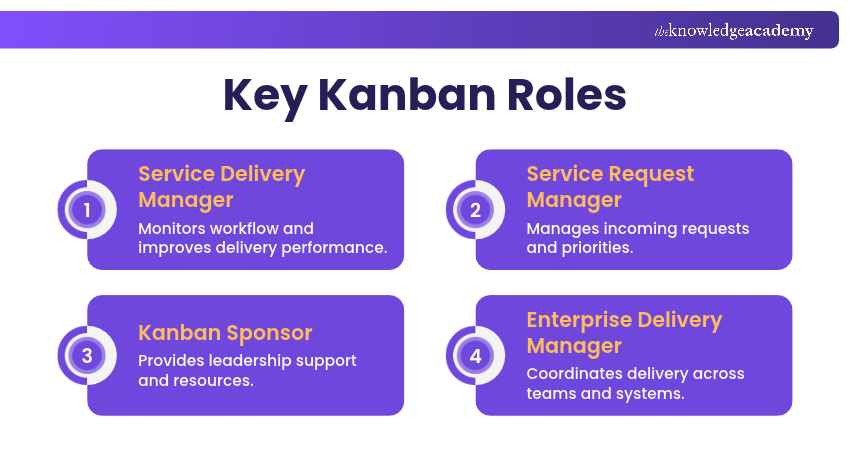
1) Service Delivery Manager (SDM)
A Service Delivery Manager (SDM) is responsible for overseeing the flow of work and ensuring that services are delivered according to customer expectations. This role focuses on improving delivery performance, identifying workflow problems and supporting coordination between the teams involved in providing a service.
Key Responsibilities of a Service Delivery Manager
a) Monitor Workflow Performance: Track the progress of work using Kanban metrics such as lead time, cycle time and throughput to assess delivery speed and predictability.
b) Identify and Resolve Bottlenecks: Recognise workflow delays, blocked tasks and process inefficiencies, and coordinate with teams to address them.
c) Facilitate Kanban Meetings: Support daily Kanban meetings and service delivery reviews to discuss workflow performance, delivery challenges and improvement opportunities.
d) Manage Delivery Expectations: Coordinate with stakeholders to communicate delivery progress, address concerns and support realistic service delivery commitments.
e) Support Work in Progress (WIP) Management: Help teams maintain appropriate WIP limits to prevent overloading the workflow and improve the flow of work.
f) Drive Continuous Improvement: Analyse delivery trends, encourage team feedback and support process improvements that enhance service reliability and predictability.

2) Service Request Manager (SRM)
A Service Request Manager (SRM) focuses on managing incoming work requests while representing customer needs and expectations within the Kanban system. This role acts as a link between customers and delivery teams, helping clarify requirements and ensuring that customer priorities are considered before work is accepted for delivery.
Key Responsibilities of a Service Request Manager
a) Represent Customer Needs: Understand customer requirements, communicate their expectations and ensure their priorities are considered during work selection.
b) Manage Incoming Requests: Review and organise new work requests to ensure they are clearly defined and ready for evaluation.
c) Facilitate Work Prioritisation: Support decisions on which requests should be prioritised based on customer value, urgency, risk and available capacity.
d) Coordinate Replenishment Meetings: Facilitate discussions with stakeholders and delivery teams to select and commit to work based on agreed policies, priorities and available capacity.
e) Balance Demand and Capacity: Help align incoming customer requests with the team's available capacity to prevent excessive workloads and unrealistic commitments.
f) Maintain Stakeholder Communication: Keep customers and stakeholders informed about request status, priorities and potential delivery expectations.
3) Kanban Sponsor
A Kanban Sponsor is typically a senior leader or stakeholder who supports the adoption and implementation of Kanban within an organisation. This role focuses on providing strategic direction, securing necessary resources and ensuring that Kanban initiatives receive appropriate management support.
Key Responsibilities of a Kanban Sponsor
a) Provide Leadership Support: Promote Kanban adoption and encourage senior management to support workflow improvement initiatives.
b) Secure Necessary Resources: Help arrange the funding, training and organisational support required for successful implementation.
c) Remove Organisational Barriers: Address management-level conflicts, resistance to change and structural challenges affecting Kanban adoption.
d) Align with Business Objectives: Ensure Kanban improvement initiatives support organisational priorities and long-term business goals.
e) Support Evolutionary Change: Encourage collaboration, leadership involvement and incremental improvements to existing ways of working.
f) Support Long-term Adoption: Review implementation progress and help sustain management commitment to Kanban practices.
Trainer’s Insight
Kanban does not require organisations to create new positions or hire separate individuals for every responsibility. An existing manager may handle service delivery, while another team member coordinates customer requests. What matters is that responsibilities are clearly understood and consistently fulfilled.
4) Enterprise Delivery Manager
An Enterprise Delivery Manager oversees delivery coordination across multiple interconnected Kanban systems, teams or organisational services. Rather than focusing on a single workflow, this role considers how dependencies, shared resources and decisions across different areas influence overall delivery performance.
Key Responsibilities of an Enterprise Delivery Manager
a) Coordinate Enterprise-wide Delivery: Support delivery across interconnected Kanban systems, teams and business units.
b) Manage Cross-team Dependencies: Identify dependencies between teams and services, coordinate activities and resolve issues affecting delivery.
c) Monitor Organisational Performance: Analyse delivery metrics to identify challenges and improvement opportunities across Kanban systems.
d) Support Strategic Alignment: Ensure delivery activities align with organisational priorities and business objectives.
e) Provide Executive-level Reporting: Consolidate delivery data to inform senior leadership about performance, risks and dependencies.
f) Strengthen Organisational Maturity: Identify opportunities to improve management practices, coordination and performance across interconnected Kanban systems.
Apply proven Kanban techniques to improve productivity with Certified Kanban Foundation Training – Sign up soon!
How do Kanban Roles Work Together?
Kanban roles can complement one another throughout the delivery process, from understanding customer needs to improving organisational performance. Here's how they work together:
a) Align Customer Needs with Delivery: The Service Request Manager coordinates with the Service Delivery Manager to ensure incoming requests align with delivery capacity and customer expectations.
b) Address Delivery Challenges: The Service Delivery Manager identifies operational issues and works with the Kanban Sponsor to resolve barriers requiring leadership support.
c) Coordinate Across Teams: The Enterprise Delivery Manager collaborates with delivery managers to address cross-team dependencies and improve overall delivery performance.
d) Drive Continuous Improvement: All four roles share feedback, review performance and support improvements across Kanban systems.
Together, these responsibilities create a coordinated approach to managing demand, delivering services and improving workflows.
Remember
Different Kanban roles may share responsibilities, particularly in workflow management and service delivery. Rather than creating unnecessary positions, organisations should clarify who makes decisions, who coordinates activities and who is accountable for outcomes.
Benefits of Clearly Defined Responsibilities in Kanban
Clearly defined responsibilities help Kanban teams manage workflows, coordinate activities and improve delivery performance. Although Kanban does not prescribe fixed roles, assigning responsibilities offers several benefits:
1) Improved Accountability: Ensures team members understand their duties and take ownership of assigned responsibilities.
2) Better Workflow Coordination: Improves communication, reduces delays and helps resolve bottlenecks.
3) Effective Work Prioritisation: Helps teams prioritise requests based on customer needs, urgency and available capacity.
4) Greater Delivery Predictability: Supports the early identification of delays and more informed delivery commitments.
5) Stronger Team Collaboration: Reduces uncertainty about responsibilities and encourages effective coordination across teams.
Unlock the power of Kanban practices to optimise work delivery with Certified Kanban Foundation and Practitioner Training – Join now!

The Knowledge Academy develops accessible learning content across Project Management, IT, Cybersecurity, Data Science, Business Analysis, HR, Accounting and Finance, Leadership and Health and Safety. Its resources combine subject research with clear explanations to help professionals build practical knowledge across a wide range of disciplines.
View Detail

 If you wish to make any changes to your course, please


