


 Top Rated Course

We may not have the course you’re looking for. If you enquire or give us a call on 01344203999 and speak to our training experts, we may still be able to help with your training requirements.
DevOps Engineer Roles and Responsibilities: A Complete Guide
Lily Turner 04 September 2026DevOps Engineer Roles and Responsibilities involve connecting development and operations, automating software delivery and maintaining reliable infrastructure.

Training Outcomes Within Your Budget!
We ensure quality, budget-alignment, and timely delivery by our expert instructors.
Table of Contents
Key Takeaways
1. DevOps Engineers help development and operations teams work together to deliver software efficiently.2. Their responsibilities commonly include automation, CI/CD, infrastructure management, monitoring and troubleshooting.3. DevOps Engineers use cloud platforms, containers, configuration management and Infrastructure as Code (IaC) to support modern software environments.4. Technical expertise must be supported by communication, collaboration and problem-solving skills.5. The exact responsibilities of a DevOps Engineer can vary depending on the organisation, technology stack and delivery environment.
A development team may finish a new application feature with the code working perfectly on a developer's machine but deploying it to production is a whole different story. It involves manual configuration, inconsistent environments and several teams trying to coordinate the release.
So who helps turn that complicated process into a faster and more reliable workflow?
That is where a DevOps Engineer comes in. DevOps Engineers work across development and operations to automate processes and support reliable software delivery. In this blog, we explore the key DevOps Engineer Roles and Responsibilities, along with the skills associated with the profession.
What is DevOps?
DevOps combines practices, tools and cultural approaches that improve collaboration between IT operations and software development. Its aim is to make software development and delivery faster, more efficient and reliable.
DevOps commonly incorporates practices such as automation, Continuous Integration and Continuous Delivery or Deployment (CI/CD), configuration management, Cloud Computing and continuous monitoring. Rather than treating development and operations as completely separate functions, DevOps encourages teams to collaborate throughout the software lifecycle.

Who is a DevOps Engineer?
A DevOps Engineer is a technology professional who helps organisations implement and maintain DevOps practices. They work across development and operations to improve collaboration, automate workflows and support efficient software delivery.
Their work often combines knowledge of Software Development, system administration, automation, Cloud Computing, infrastructure and operations. Depending on the organisation, a DevOps Engineer may build deployment pipelines, automate infrastructure, manage cloud resources, monitor applications and troubleshoot technical problems.
Key DevOps Engineer Roles and Responsibilities
The responsibilities of a DevOps Engineer can vary according to the organisation and technology environment. However, their work generally focuses on improving how software is built, tested, deployed and operated.
Here are the DevOps Engineer responsibilities at a glance:
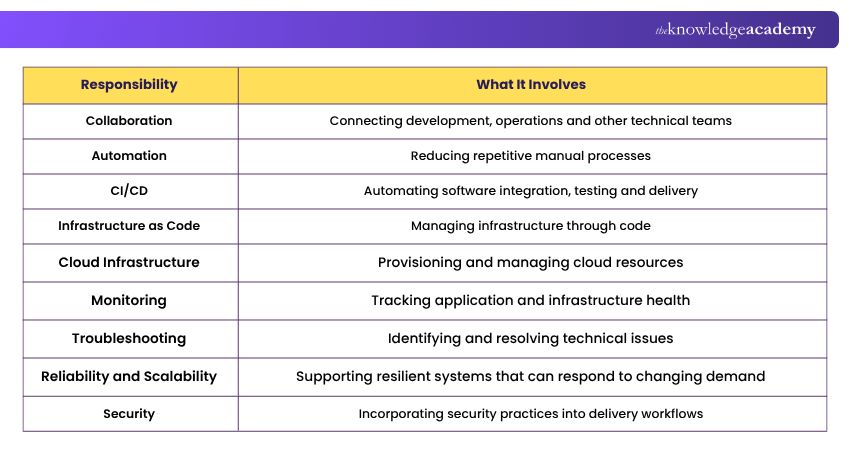
Let’s explore these roles and responsibilities in detail:
1) Collaborating Across Development and Operations
One of the fundamental DevOps Engineer roles is connecting development and operations teams. DevOps Engineers help reduce organisational silos by supporting communication, knowledge sharing and collaboration between people involved in building and operating software. They may work with developers, operations teams, security specialists and Quality Assurance (QA) professionals to coordinate releases and resolve issues.
2) Automating Software Delivery Processes
Automation is central to DevOps Engineering. DevOps Engineers identify repetitive or error-prone manual processes and develop automated workflows to improve their consistency and efficiency. Automation can be applied to:
a) Software builds
b) Testing
c) Deployment
d) Infrastructure provisioning
e) Configuration management
f) Routine operational tasks
Learn how to build resilient systems and reduce downtime with our Site Reliability Engineering Practitioner Training - Sign up now!
3) Building and Maintaining CI/CD Pipelines
CI/CD are important areas of DevOps Engineering. DevOps Engineers establish and maintain pipelines that automate stages of the software delivery process. These can connect code changes with automated builds, testing and deployment workflows. A simplified pipeline may look like:
Code → Build → Test → Release → Deploy → Monitor
CI/CD enables teams to receive feedback on software changes earlier and deliver updates through repeatable processes.
4) Managing Infrastructure as Code (IaC)
Infrastructure as Code involves defining and managing infrastructure through machine-readable configuration or code rather than relying solely on manual configuration. DevOps Engineers can use IaC approaches to provision and manage servers, networks, databases and other infrastructure resources.
Treating infrastructure definitions as code also supports practices such as version control, peer review and automated deployment.
5) Managing Cloud Infrastructure
DevOps Engineers may deploy and manage applications and infrastructure within cloud environments. Their responsibilities can include:
a) Provisioning cloud resources
b) Managing networking and storage
c) Configuring application environments
d) Supporting infrastructure scalability
e) Optimising resource allocation
The role may therefore require knowledge of cloud platforms alongside automation and infrastructure management skills.
6) Monitoring Applications and Infrastructure
DevOps Engineers monitor the health, availability and performance of applications and infrastructure. They configure monitoring solutions, alerts, dashboards and visualisations to help teams identify performance bottlenecks, resource constraints and other potential problems.
Common areas monitored include:
a) Response times
b) Error rates
c) Resource utilisation
d) Application availability
e) Infrastructure health
Pro Tip
Focus monitoring on indicators that reveal service health, reliability and user impact rather than collecting metrics simply because they are available.
7) Troubleshooting and Incident Resolution
Technical problems can occur during development, testing and production. DevOps Engineers help investigate these issues, identify root causes and implement appropriate solutions. They frequently work with cross-functional teams to minimise disruption and restore normal operations. Troubleshooting can involve examining logs, monitoring information, infrastructure configurations, application behaviour and deployment processes.
8) Supporting Scalability and Reliability
DevOps Engineers help design and maintain infrastructure capable of supporting application requirements. This can involve cloud technologies and automation tools that enable infrastructure resources to be provisioned and managed according to demand. Their work can support:
a) Application availability
b) Infrastructure scalability
c) Consistent environments
d) Reliable deployments
e) Efficient resource management
9) Integrating Security Into Delivery Workflows
Security is another important consideration within DevOps environments. DevOps Engineers may contribute to implementing security controls throughout the software lifecycle, supporting security policies and incorporating appropriate security activities into development and delivery workflows.
Essential Skills for a DevOps Engineer
DevOps Engineers need a combination of technical and interpersonal skills because their work spans software, infrastructure, automation and collaboration.
1) Technical Skills
Here are the key technical skills required:
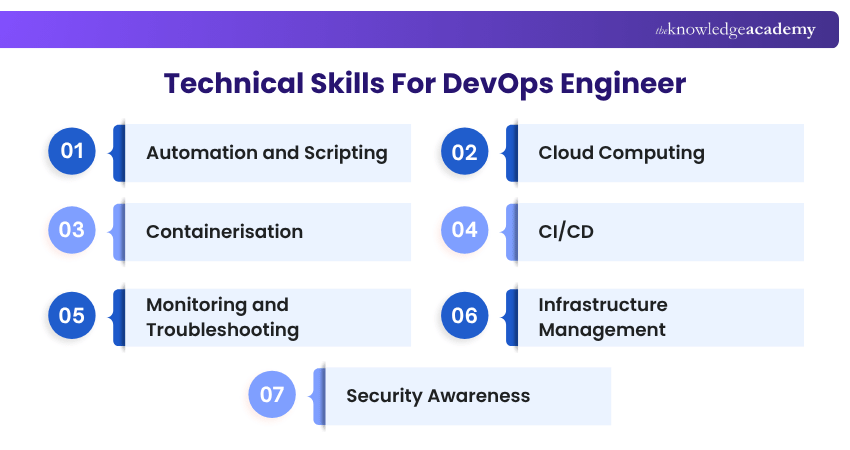
Automation and Scripting: Knowledge of scripting can help DevOps Engineers automate repetitive processes. Languages such as Python, Ruby and Bash alongside automation technologies such as Ansible, Puppet and Chef are vital.
a) Cloud Computing: DevOps Engineers may need knowledge of cloud platforms and cloud infrastructure, including areas such as networking, storage and security.
b) Containerisation: Understanding container technologies helps engineers package and operate applications consistently across environments. The role may also involve managing container-based deployments and troubleshooting associated issues.
c) CI/CD: DevOps Engineers should understand how to build and maintain CI/CD pipelines that automate software testing, building and deployment.
d) Monitoring and Troubleshooting: Monitoring skills help engineers identify problems, analyse system behaviour and respond to technical issues.
e) Infrastructure Management: Knowledge of configuration management, cloud infrastructure, orchestration and Infrastructure as Code helps engineers manage modern environments efficiently.
f) Security Awareness: DevOps Engineers should understand how security requirements and controls can be incorporated into software delivery and infrastructure management.
EXTRA INSIGHT
A DevOps Engineer in the United Kingdom can command an average annual salary of £59K.
2) Soft Skills
Technical knowledge alone is not enough. Important soft skills include:
a) Communication: Explaining technical issues clearly across teams is a key skill.
b) Collaboration: Working effectively with development, operations, security and QA is important.
c) Problem-solving: Diagnosing issues and identifying practical solutions is key.
d) Adaptability: Learning new tools and responding to changing requirements is a crucial skill.
e) Continuous Improvement: Identifying opportunities to make processes more efficient and reliable can elevate a DevOps Engineer’s stature.
Conclusion
Understanding the DevOps Engineer Roles and Responsibilities helps clarify how these professionals contribute to modern software delivery. From automation and CI/CD to infrastructure, monitoring, troubleshooting and collaboration, DevOps Engineers work across the software lifecycle. Developing both technical expertise and strong collaboration skills can prepare professionals for the varied demands of DevOps Engineering.
Give your dream software career the perfect start with our DevOps Foundation Certification Training – Sign up now!
Frequently Asked Questions
Do DevOps Engineers Have to Work On-call?

Some DevOps positions involve on-call rotations because engineers may help maintain production systems and respond to incidents. However, the frequency and structure depend heavily on the organisation, team size, system reliability and how operational responsibilities are divided.
What Does a Typical Day Look Like for a DevOps Engineer?
There is no universal daily routine. A DevOps Engineer might maintain pipelines, troubleshoot deployment problems, review infrastructure changes, improve automation, monitor systems or collaborate with development teams. Day-to-day responsibilities can vary considerably between companies.
Can You Become a DevOps Engineer Without Previous DevOps Experience?
It is possible to move into DevOps from related areas such as Software Development, system administration, Cloud Computing or technical support. Practical experience with areas like Linux, version control, automation, cloud platforms, CI/CD and containers can help showcase relevant capability when pursuing junior opportunities.
Is DevOps Beginner-friendly?
Yes, but it does come with a learning curve. DevOps can be challenging for beginners since it involves multiple areas like Cloud Computing, networking, automation, and security. However, many learners find it accessible since much of DevOps focuses on using and integrating existing tools.

Lily Turner


Senior AI/ML Engineer and Data Science Author
Lily Turner is a data science professional with over 10 years of experience in artificial intelligence, machine learning, and big data analytics. Her work bridges academic research and industry innovation, with a focus on solving real-world problems using data-driven approaches. Lily’s content empowers aspiring data scientists to build practical, scalable models using the latest tools and techniques.
View Detail

 If you wish to make any changes to your course, please


