


We may not have the course you’re looking for. If you enquire or give us a call on 01344203999 and speak to our training experts, we may still be able to help with your training requirements.
DevOps Engineer Job Description
ByThe Knowledge AcademyLast updated on: 04 November 2026
Interested in becoming a DevOps Engineer? Understand the technical expertise, professional responsibilities and qualifications employers commonly look for.

DevOps Role Snapshot
1. DevOps Engineers combine software development, infrastructure management and automation to support efficient software delivery.2. Their responsibilities include building CI/CD pipelines, managing Cloud infrastructure, monitoring systems and improving deployment reliability.3. Essential skills include scripting, version control, cloud computing, containerisation and IaC.4. Relevant degrees, technical certifications and hands-on experience can support career development in DevOps engineering.5. DevOps Engineers collaborate with development, operations and security teams to improve system reliability and streamline software releases.
One click. A new software update goes live. Thousands of users can access it. Sounds simple, doesn't it?
Behind that release are automated pipelines, infrastructure configurations, testing processes and monitoring systems working together. But who builds and maintains these systems?
That's where DevOps Engineers come in. They help bridge the gap between development and operations, ensuring software moves from code to production through reliable processes. But what does this role involve on a day-to-day basis? Let's explore the DevOps Engineer job description to understand the responsibilities, skills and expertise behind it.
Who is a DevOps Engineer?
A DevOps Engineer is an IT professional who combines knowledge of software development, infrastructure and operations to improve how applications are built, tested, deployed and maintained. They use automation, tools and established DevOps practices to streamline software delivery and improve system reliability.
DevOps Engineers also encourage collaboration between developers, operations teams, testers and security professionals throughout the Software Development Life Cycle (SDLC). Their exact responsibilities vary according to the organisation, technology stack and team structure.

Responsibilities of a DevOps Engineer
DevOps Engineers handle responsibilities across automation, software delivery, infrastructure and system reliability. Their work helps teams release applications more consistently while maintaining operational stability. Here are their key responsibilities:
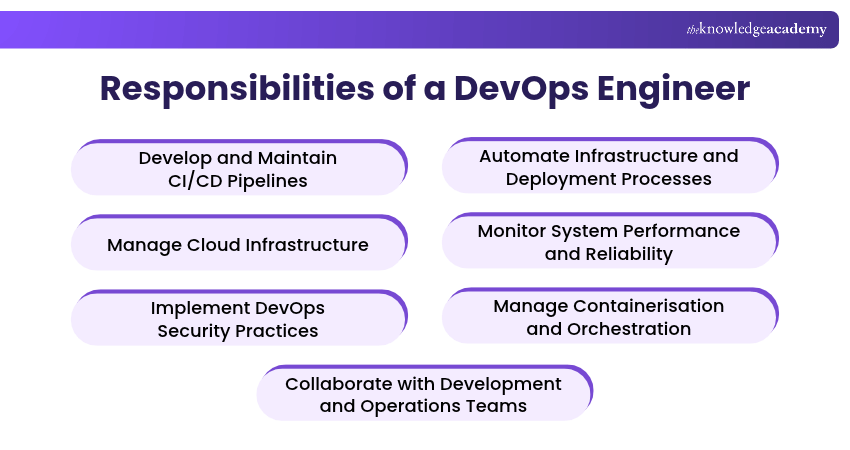
1) Develop and Maintain CI/CD Pipelines
DevOps Engineers create and maintain Continuous Integration and Continuous Delivery (CI/CD) pipelines to automate software builds, testing and release preparation. These pipelines help teams detect problems earlier and deliver software changes more consistently.
Common tools include Jenkins, GitHub Actions, GitLab CI/CD and Azure Pipelines. Continuous deployment may also be implemented to automatically release changes to production after they pass the required checks, without requiring manual approval for each release.
2) Automate Infrastructure and Deployment Processes
Infrastructure automation helps organisations reduce repetitive manual work and maintain consistent environments. DevOps Engineers use Infrastructure as Code (IaC) tools such as Terraform or AWS CloudFormation to define and provision infrastructure through configuration files.
They may also use Ansible to automate software configuration and operational tasks, helping teams manage infrastructure changes more efficiently. Combining infrastructure provisioning with configuration management enables teams to maintain consistent environments and apply changes through repeatable processes.
3) Manage Cloud Infrastructure
DevOps Engineers help configure, deploy and maintain infrastructure on cloud platforms such as AWS and Google Cloud. Their responsibilities may include managing compute resources, networking, storage, access controls and infrastructure configurations.
They also work to improve scalability, availability and cost efficiency according to application and organisational requirements.
4) Monitor System Performance and Reliability
Monitoring systems allow DevOps Engineers to identify performance problems and respond to operational incidents. They use metrics, logs, traces and alerts to understand application behaviour and investigate failures.
Tools such as Prometheus, Grafana and cloud-native monitoring services can help teams observe system health. DevOps Engineers also support incident resolution and improvements that reduce the likelihood of recurring problems.
5) Implement DevOps Security Practices
Security management is an important DevOps responsibility. Engineers work with security teams to integrate security practices throughout software development and deployment.
This can include vulnerability scanning, secrets management, access controls, dependency checks and automated security testing within CI/CD pipelines. These activities support DevSecOps, where security becomes a shared responsibility across teams.
6) Manage Containerisation and Orchestration
Containers package applications and their dependencies to support consistent execution across compatible environments. DevOps Engineers may use Docker to build and manage container images and Kubernetes to deploy, scale and manage containerised workloads.
Their responsibilities can include maintaining container configurations, supporting application deployments and troubleshooting orchestration issues.
7) Collaborate with Development and Operations Teams
Collaboration and communication help development, operations, testing and security teams coordinate software delivery.
DevOps Engineers work with colleagues to resolve deployment problems, improve workflows, document procedures and share operational knowledge. They may also participate in incident reviews to identify improvements and reduce repeated failures.
Build smarter pipelines and deliver stronger Cloud solutions with the AWS Professional DevOps Engineer Training – Join today!
Essential Skills for DevOps Engineers
DevOps Engineers need technical and interpersonal skills to automate workflows, manage infrastructure and support reliable software delivery. Here are the essential skills:
a) Programming and Scripting: Knowledge of Python, Bash or PowerShell helps DevOps Engineers automate tasks, manage infrastructure and maintain deployment scripts.
b) CI/CD Tools and Version Control: Proficiency in version control tools such as Git and CI/CD platforms such as Jenkins, GitHub Actions or GitLab CI/CD helps engineers manage code changes and automate builds, testing and deployments.
c) Cloud Computing and Infrastructure as Code: Experience with AWS, Azure or Google Cloud helps engineers manage Cloud infrastructure. Knowledge of Terraform or AWS CloudFormation supports automated provisioning and consistent infrastructure configurations.
d) Containerisation and Orchestration: Knowledge of Docker and Kubernetes helps engineers package, deploy and manage containerised applications. Understanding container images, networking and workload scaling supports reliable deployments.
e) Monitoring and Troubleshooting: Skills in Linux administration, system monitoring and incident management help engineers identify and resolve technical issues. Tools such as Prometheus and Grafana support performance monitoring and troubleshooting.
f) Communication and Collaboration: Strong communication, teamwork and problem-solving skills help DevOps Engineers coordinate with development, operations and security teams. These skills support effective incident resolution, knowledge sharing and continuous improvement.
Pro Tip
Build a small application deployment project using Git, a CI/CD pipeline and infrastructure automation. Add monitoring and document how you resolved deployment issues. A working project can demonstrate your technical abilities more effectively than simply listing tools on your CV.
Qualifications and Training Required for DevOps Engineers
Becoming a DevOps Engineer requires a combination of technical knowledge, practical experience and continuous learning. While formal qualifications can provide a strong foundation, employers also value hands-on expertise and problem-solving abilities. Here are the key requirements:
1) Educational Qualifications
A bachelor's degree in computer science, information technology, software engineering or a related field can provide foundational knowledge of programming, operating systems and networking. However, a degree is not always mandatory, as some employers accept equivalent technical training and practical experience.
2) Technical Training
Training in DevOps helps professionals develop skills in software delivery, infrastructure automation and cloud operations. Important areas include CI/CD pipelines, Linux administration, Git, cloud computing, Docker, Kubernetes and IaC using tools such as Terraform.
3) Professional Certifications
Professional certifications can help DevOps Engineers demonstrate their technical knowledge and strengthen their career prospects. Relevant certifications include AWS Professional Certified DevOps Engineer, which focuses on continuous delivery, infrastructure automation, monitoring and security within AWS environments.
4) Practical Experience
Hands-on experience is essential for applying DevOps concepts in real-world environments. Professionals can gain relevant experience through internships, software development, IT operations, cloud administration or personal projects involving automation, deployments and monitoring.
Building CI/CD pipelines, deploying containerised applications and managing cloud infrastructure can help demonstrate practical capabilities to employers.
Trainer's Insight
DevOps employers often look for evidence of practical problem-solving alongside qualifications. Being able to explain a deployment failure, demonstrate how you investigated it and describe the improvements you made can help show your understanding of real operational challenges.
Take control of containers and keep applications moving with the Kubernetes Training now!
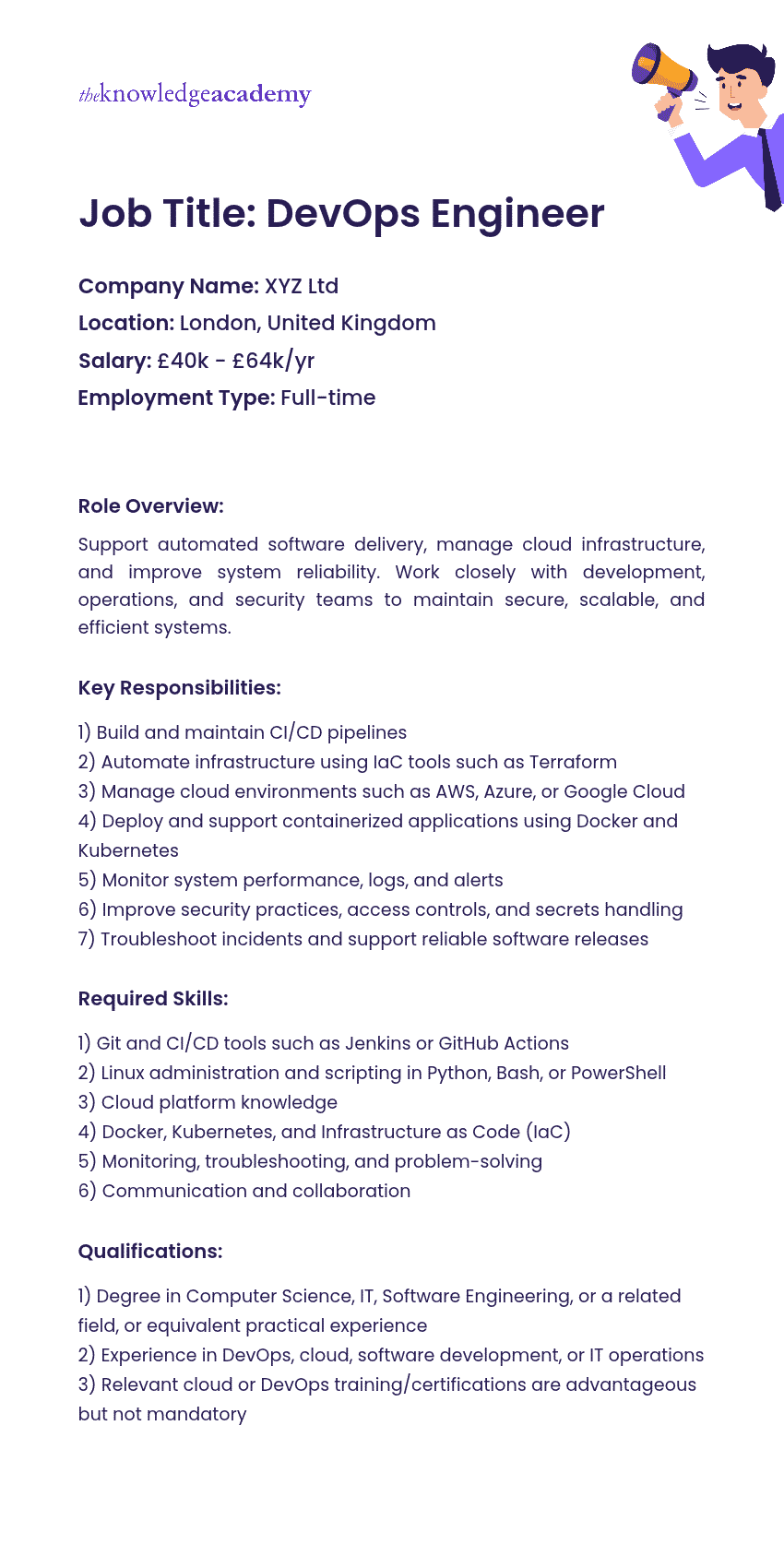
DevOps Engineer Job Description Example
A DevOps Engineer job description outlines the technical responsibilities, skills and qualifications required to support automated software delivery and reliable infrastructure operations. Let's look at the example below:

The Knowledge Academy develops accessible learning content across Project Management, IT, Cybersecurity, Data Science, Business Analysis, HR, Accounting and Finance, Leadership and Health and Safety. Its resources combine subject research with clear explanations to help professionals build practical knowledge across a wide range of disciplines.
View Detail

 If you wish to make any changes to your course, please


