




We may not have the course you’re looking for. If you enquire or give us a call on 01344203999 and speak to our training experts, we may still be able to help with your training requirements.
What is Statistics: Definition, Types, Techniques and Limitations
ByAkhil KLast updated on: 02 October 2026
Statistics is a branch of mathematics that focuses on collecting, analysing, interpreting, and presenting data to help make informed decisions. By understanding statistical methods, we can identify patterns, make informed predictions, and gain valuable insights into various fields like business, healthcare, and economics.
Have you ever looked at a weather forecast and wondered how those predictions are made? Or questioned how businesses seem to know customer needs before being asked? The answer lies in statistics. But exactly what is statistics? It’s the science of turning raw data into meaningful insights, revealing patterns and relationships that might otherwise be difficult to spot. In this blog, we’ll explore its meaning, importance, formulas, types, and much more.
Understanding Statistics
Statistics helps us make sense of numbers and data. It allows us to organise large amounts of information, spot trends, draw conclusions, and support predictions. For example, when you check a weather forecast, statistical methods can help analyse data, quantify uncertainty, and improve predictions produced by weather forecasting models.
Statistics turn complex data into clear insights, making it easier to understand and use. Without it, handling vast amounts of information in business, healthcare, economics, or science would be extremely difficult. In short, statistics supports better decision-making by transforming data into useful insights.

Importance of Statistics
Statistics is important in almost every field. It is mainly used in these areas:
1) Make Decisions: Statistics helps individuals and organisations to make informed decisions. For example, businesses use statistics to understand customer preferences and healthcare professionals use statistical evidence to evaluate treatments, assess risks and improve patient care.
2) Understand Trends: By analysing statistical data, we can understand trends and patterns that can help make informed predictions about future outcomes.
3) Improve Accuracy: With appropriate statistical techniques, data can be analysed systematically, helping to produce more reliable insights for decision-making.
4) Risk Management: Statistics helps in evaluating risks, which is important in areas like finance and insurance. By analysing historical and relevant current data, businesses can assess potential risks and prepare for uncertain outcomes.
Scope of Statistics
The scope of statistics is vast. It extends to various fields, such as:
1) Business: In business, statistics is used for market research, improving product quality, and predicting sales. It helps businesses understand their customers and competitors.
2) Healthcare: In healthcare, statistics is used for clinical trials, studying the spread of diseases, and improving patient care.
3) Sports: Athletes and coaches use statistics to improve performance and analyse competitors.
4) Economics: Statistics is used to measure and analyse economic indicators such as inflation, GDP and employment rates.
In fact, statistics play a role in almost every industry by turning raw data into insights for smarter decisions.
Major Types of Statistics
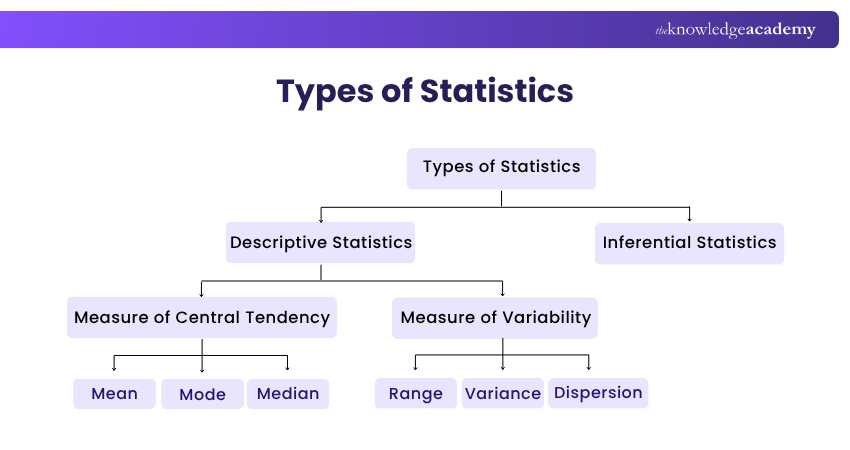
Statistics can be generally divided into two main types: descriptive statistics and Inferential statistics.
Quick Insight
Descriptive statistics explains what the data shows, while inferential statistics helps make broader conclusions from a sample.
1) Descriptive Statistics
Descriptive statistics summarise and organise characteristics of a data set. This includes:
1) Measures of central tendency, such as mean, median and mode
2) Measures of variability, such as range, variance, and standard deviation
3) Graphical representations (histograms, pie charts, box plots)
2) Inferential Statistics
Inferential statistics uses sample data to make estimates or draw conclusions about a wider population. This includes:
1) Hypothesis testing
2) Confidence intervals
3) Regression analysis
4) ANOVA (Analysis of Variance)
Key Statistical Formulas
There are several important formulas in statistics that are frequently used:
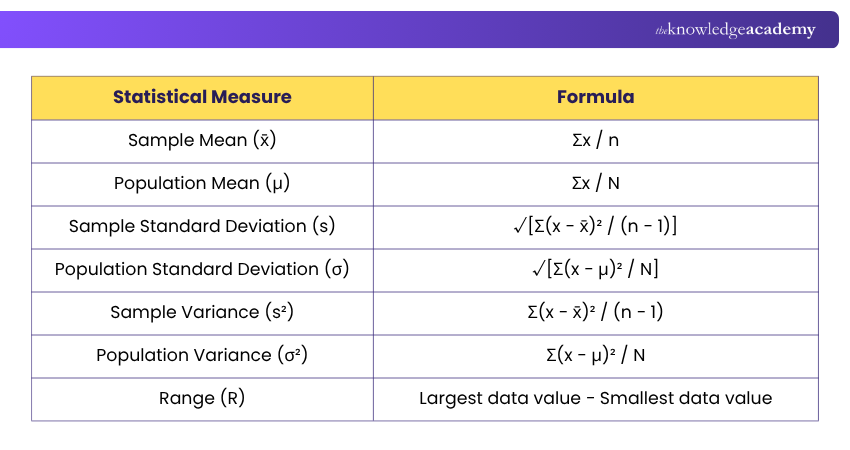
1) Mean (Average): Mean is the sum of all data points divided by the number of points. It shows the central value of the data.
2) Standard Deviation: This measures how spread out the data is around the mean. A larger standard deviation means more spread.
3) Variance: It is the square of the standard deviation and shows how much the data points vary from the mean.
4) Z-score: The Z-score tells how far a data point is from the mean in terms of standard deviations, helping to assess how unusual a value may be.
These equations help in summarise and analyse data accurately, helping with better decision-making.
Who Uses Statistics?
Statistics is used by several professionals across different fields, including:
1) Researchers: In seveveral fields like medicine, social science, and economics, researchers rely on statistics to analyse data and draw conclusions from experiments and surveys.
2) Business Analysts: They use statistics to track business performance, predict trends, and make decisions about strategies.
3) Engineers: They use statistics in quality control, designing products, and analysing manufacturing processes.
4) Government Agencies: Governments use statistics to measure things like population growth, employment, and health statistics.
However, statistics is an important tool for many professionals to analyse and make informed decisions.
Solve complex business problems with our Mathematical Optimisation for Business Problems Course – Register now!
Levels of Statistical Measurement
Statistics also involves different levels of measurement, which decide how data is classified and analysed. Here are the levels of statistical measurement:
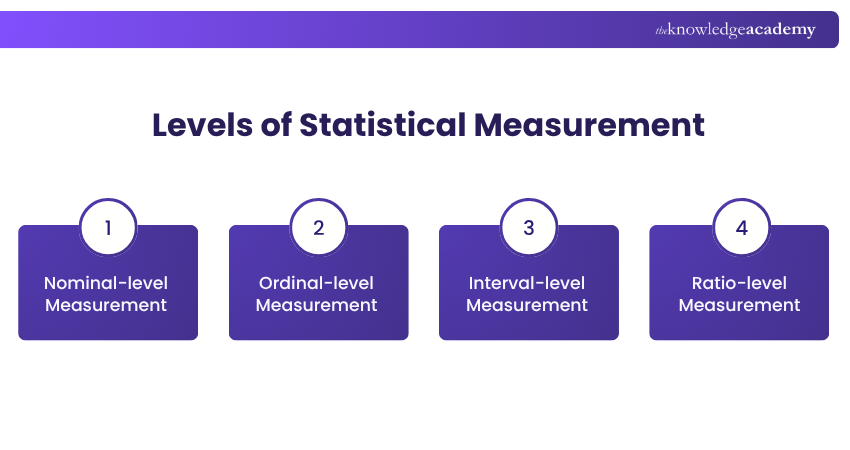
1) Nominal-level Measurement
This is the most basic level of measurement. It categorises data without any order or ranking.
Characteristics:
a) Labels or names only
b) No meaningful numerical order or arithmetic operations between categories
Examples:
a) Gender (Male, Female, Other)
b) Blood type (A, B, AB, O)
c) Marital status (Single, Married, Divorced)
2) Ordinal-level Measurement
Data is categorised and ranked, but the intervals between ranks are not equal or known.
Characteristics:
a) Order matters
b) Differences between ranks are not necessarily equal or quantitatively meaningful
Examples:
a) Customer satisfaction (Satisfied, Neutral, Dissatisfied)
b) Education level (High School, Bachelor’s, Master’s, PhD)
c) Class rankings (1st, 2nd, 3rd)
3) Interval-level Measurement
Data is ordered, and the difference between values is meaningful, but there is no true zero.
Characteristics:
a) Equal intervals between values
b) No absolute zero point
Examples:
a) Temperature in Celsius or Fahrenheit
b) IQ scores
c) Calendar years (e.g., 1990, 2000)
4) Ratio-level Measurement
Ratio-level measurement includes all the properties of interval data, along with a true zero point.
Characteristics:
a) Equal intervals
b) True zero allows for meaningful ratios
Examples:
a) Height, weight, age
b) Income
c) Distance travelled
Data Quality Characteristics
Data Quality Characteristics help determine the quality of a dataset and the results drawn from it. Below are the Data Quality Characteristics:
1) Completeness
All necessary data must be collected for accurate analysis. Missing information can lead to gaps and incorrect conclusions. A complete dataset gives a fuller picture and supports stronger decisions.
2) Consistency
Consistent data follows the same formats, definitions, and values across datasets and systems. This reduces discrepancies and helps ensure reliable analysis and reporting.
3) Sufficiency
The dataset should contain enough relevant and representative observations to support conclusions. An insufficient sample size can increase uncertainty and make reliable conclusions more difficult.
4) Unbiasedness
Potential sources of bias should be recognised and reduced where possible. Reducing bias improves the trustworthiness of statistical results.
Boost your career in Business Analysis with our Certified Business Analyst Professional Training (CBA-PRO) - Join today!
Sampling Techniques in Statistics
Sampling is the process of selecting a subset of individuals or data points from a larger population for analysis. Here are the points for sampling techniques in statistics:
Did You Know?
A good sampling method can improve the reliability of statistical conclusions by reducing bias and improving representation.
1) Simple Random Sampling
a) Every member of the population has an equal chance of being selected.
b) Selection is made randomly so that each member has an equal chance of being selected, often using a random number generator
c) Helps reduce selection bias and is easy to understand.
d) Works well when a complete population list is available and random selection is practical.
2) Systematic Sampling
a) Selects every k-th individual from a list after a random starting point
b) Easier and quicker than simple random sampling
c) Can introduce bias if there’s a hidden pattern in the population
d) Useful when a complete list of the population is available
3) Stratified Sampling
a) Divides the population into subgroups (strata) based on shared characteristics
b) Random samples are taken from each stratum
c) Ensures representation of all key subgroups
d) Ideal for heterogeneous populations
4) Cluster Sampling
a) Population is divided into clusters, often based on geography or institutions.
b) Clusters are randomly selected, after which all members or a further sample of members within those clusters may be studied.
c) Cost-effective and practical for large, dispersed populations.
d) May lead to higher sampling error compared to other methods.
Limitations of Statistics
Even though statistics is a powerful tool, it has its limitations:
1) Data Quality Issues
a) Inaccurate, incomplete, or outdated data can produce misleading statistical results.
b) Poor data collection methods or measurement errors can reduce the reliability of the analysis.
2) Sampling Challenges
a) Selecting the right sample is crucial for accurate conclusions.
b) A poorly selected sample can result in biased conclusions that do not represent the population accurately.
3) Causation vs Correlation
a) Distinguishing between causation and correlation is a key challenge in statistics.
b) Correlation does not establish causation. An association between two variables does not necessarily mean that one causes the other.
4) Risk of Misinterpretation
a) Statistics can be easily misinterpreted.
b) People may make incorrect conclusions from incomplete or misleading data.
5) Underlying Assumptions
a) Many statistical methods rely on assumptions about the data or model, such as independence, distributional conditions or equal variances.
b) Incorrect assumptions can lead to misleading results.
Models of Statistics
Statistics uses different analytical and modelling approaches depending on whether the goal is to describe data, draw conclusions, make predictions, recommend actions or investigate causal relationships. Here are some common approaches:
1) Descriptive Models
a) Used to summarise and present data clearly.
b) They show averages, distributions, and patterns without predicting future outcomes.
Examples: Frequency tables, measures of central tendency, measures of variability.
2) Inferential Models
a) Used to draw conclusions about a population from a sample.
b) They estimate parameters, test hypotheses, and measure the likelihood of outcomes.
Examples: Hypothesis testing, confidence intervals, ANOVA.
3) Predictive Models
a) Aim to forecast future outcomes based on existing data.
b) Widely applied in business, healthcare, and finance for decision-making.
Examples: Linear regression, logistic regression, time-series forecasting.
4) Prescriptive Models
a) Suggest the best decision or action to take.
b) Combine statistical analysis with optimisation and simulation.
Examples: Optimisation models, simulation-based decision models and decision analysis techniques.
5) Causal Models
a) Focus on identifying cause-and-effect relationships between variables.
b) They explain how one factor influences another.
Examples: Structural equation modelling, experimental designs, path analysis.
Real-world Examples of Statistics
Statistics is used in many real-world applications. For example:
1) Healthcare: Healthcare professionals use statistical models to estimate patient outcomes and evaluate treatment effectiveness.
2) Business: Companies use statistics to understand customer preferences and improve marketing strategies.
3) Sports: Coaches use statistics to analyse player performance and devise winning strategies.
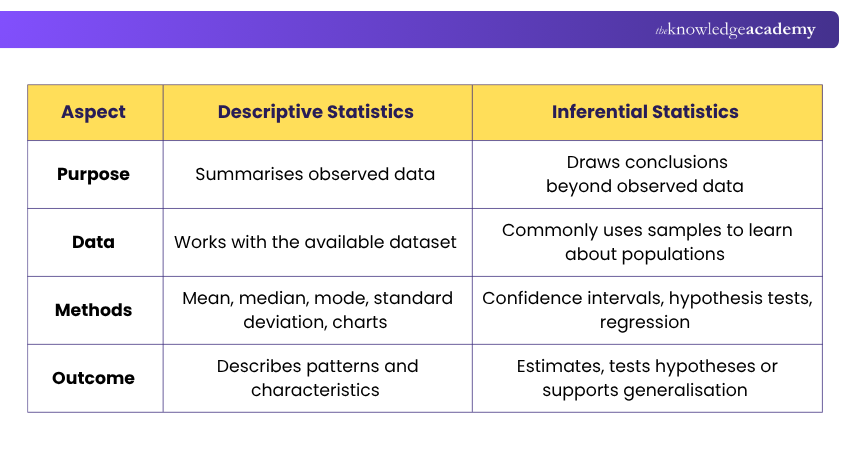
Difference Between Descriptive and Inferential Statistics
These are the main differences between descriptive and inferential statistics:
Statistical Thinking Tip
Always check the data source, sample quality, assumptions, and context before interpreting a statistical result.
Boost your career with practical SPC and real-world applications with our Statistical Process Control Training – Join now!

Akhil K is a Copywriter and Video Editor with experience in content creation, visual storytelling, advertising and brand communication. His background in journalism, research and audience-focused communication strengthens his ability to create clear and engaging Business Skills content.
View Detail

 If you wish to make any changes to your course, please


