




We may not have the course you’re looking for. If you enquire or give us a call on 01344203999 and speak to our training experts, we may still be able to help with your training requirements.
What is R Programming: Features, Uses and Benefits
ByThe Knowledge AcademyLast updated on: 24 September 2026
R is a free, open-source language for statistical computing, data analysis, and visualisation, widely used by data scientists, statisticians, and researchers. It supports advanced modelling, data cleaning, and machine learning. With a strong package ecosystem, R Programming helps turn complex data into clear, actionable insights.

Opening a spreadsheet full of data can feel overwhelming, especially if you're not sure where to begin. Whether you're a student, a professional, or a researcher, this is a challenge many people face. R Programming helps you tackle the complexities of data, guiding you step by step, uncovering meaningful patterns, and presenting the results in a clear and easy-to-understand way.
In this blog, you will learn What is R Programming and explore its key features and benefits. You will also see how R differs from other programming languages and where it works best. Let’s dive in and get started.
What is R Programming?
R Programming is an open-source language and software field used for statistical computing, Data Analysis, and graphical representation. It is widely adopted by Data Scientists, statisticians, and researchers for tasks like data manipulation, statistical modelling, Machine Learning (ML), and visualisation.
R gives a wide range of packages and tools that simplify complex data tasks and generate insightful results. Its strong community support and flexibility make it a better choice for both academic and industrial data-driven projects.

Brief History and Evolution of R
This explains the origins of R and how it evolved into a widely used language for data analysis and statistics.
1) Origins in S Programming Language: R is an open-source implementation of the S language developed by John Chambers and his team at Bell Laboratories.
2) Open-source Development: Being open-source allowed developers worldwide to contribute, improving features and performance over time.
3) Community-driven Growth: A strong global community helped R grow quickly through continuous updates, packages, and enhancements.
Importance of R Programming
R Programming is important today as it enables efficient data analysis and informed decision-making across many fields. Some of the benefits include:
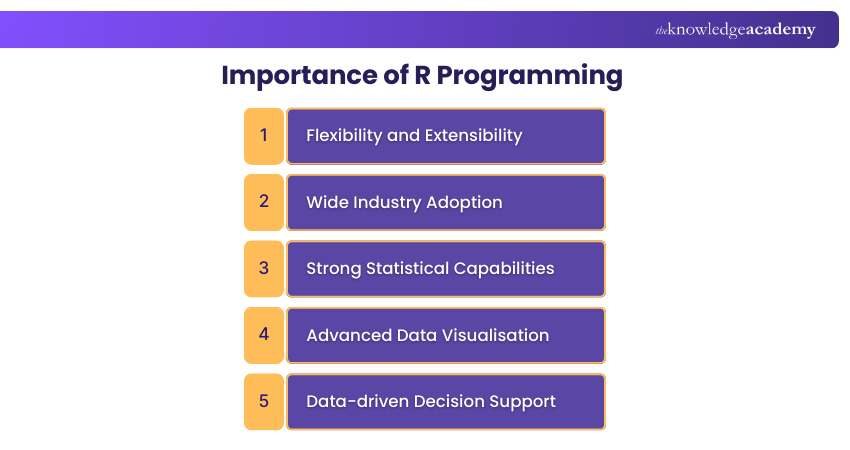
1) Flexibility and Extensibility: R supports a wide range of tasks through thousands of packages, including tools like Updating Rlang.
2) Wide Industry Adoption: R is widely used in academia, research, finance, healthcare, marketing, and social sciences.
3) Strong Statistical Capabilities: R is designed for statistics, making complex data analysis accurate and efficient.
4) Advanced Data Visualisation: Built-in and package-based tools help create clear charts and graphs for insights.
5) Data-driven Decision Support: R enables organisations to analyse data and make informed, evidence-based decisions.
Why Learn R Programming?
R Programming stands out as a powerful tool in today’s data-driven world. It is designed to help people not just collect data, but truly understand it and turn it into meaningful insights across different fields.
1) Designed for Data Analysis: R is built specifically to analyse, interpret, and work with complex datasets effectively.
2) Used Across Multiple Industries: It is widely applied in research, finance, healthcare, academia, and Marketing.
3) End-to-end Data Handling: R supports data cleaning, analysis, visualisation, and modelling in one environment.
4) Extensive Package Support: Thousands of packages enable advanced statistics, Machine Learning, automated reports, and rich visualisations.
5) Active Global Community: A strong user community continuously develops tools, resources, and best practices.
Gain hands-on experience working with real-world projects and technologies with our Programming Training – Join now!
Features of the R Programming
The R Programming offers powerful features for Data Analysis and statistical work. It helps users analyse, visualise, and share insights with ease. Key features include:
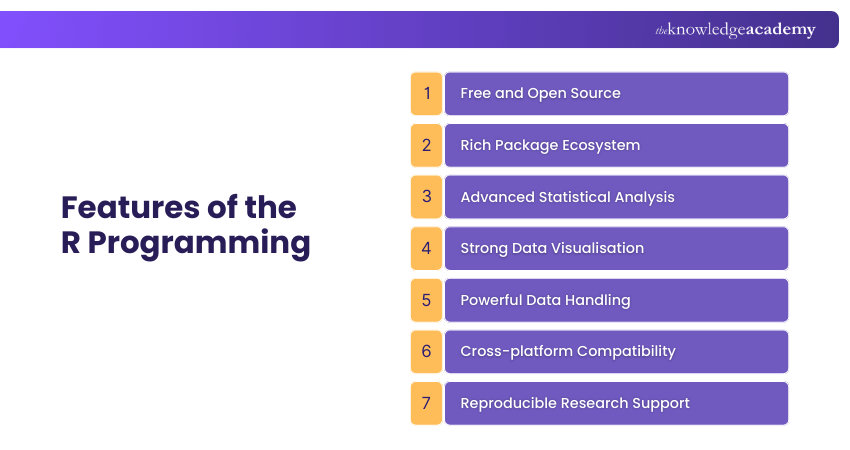
1) Free and Open Source: R is freely available, allowing users to use, modify, and share it without licensing costs.
2) Rich Package Ecosystem: Thousands of CRAN packages extend R’s capabilities in Data Analysis, Machine Learning, finance, and research.
3) Advanced Statistical Analysis: R supports a wide range of statistical techniques, including regression, time series analysis, clustering, and modelling.
4) Strong Data Visualisation: R creates high-quality, customisable, and interactive charts using packages like ggplot2 and plotly.
5) Powerful Data Handling: Flexible data structures and tools such as dplyr and tidyr simplify data cleaning and transformation.
6) Cross-platform Compatibility: R runs smoothly on Windows, macOS, and Linux environments.
7) Reproducible Research Support: R Markdown combines code, results, and explanations into one document, ensuring analyses can be easily repeated and shared.
R vs Other Programming Languages
R isn’t the only player in the data game, but it brings its own unique strengths to the table. Let’s see how R stacks up against other popular programming languages:
R vs Python
Here is a clear differentiation between R and Python:

R vs Java
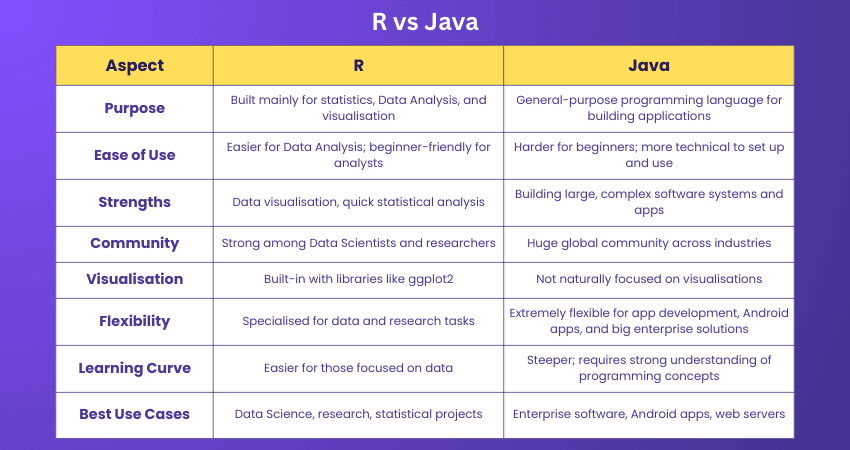
Here is the differentiation between R and Java:
R and S and Scheme
R is not a language that appeared in isolation. It’s the result of years of evolution in statistical computing and programming language design. To understand R’s true power and elegance, it helps to look at its roots in the S programming language and Scheme, a dialect of Lisp.
The S Programming Language
The S Programming Language shaped modern statistical computing and introduced core ideas that later became central to R.
1) Origin and Purpose: Developed in the 1970s at Bell Laboratories by John Chambers and his team to make statistical computing easier and more interactive.
2) Core Concepts Introduced: S introduced ideas such as applying functions to data structures, object-oriented features, and dynamic typing.
3) Foundation for R: These concepts later became the base of R, shaping how data analysis and statistical tasks are performed.
4) Transition to R: R was created as an open-source implementation of S, adding strong community support and an extensive package ecosystem.
5) Open vs Proprietary: While S remained largely proprietary, R’s open nature helped it gain global adoption among statisticians, data scientists, and researchers.
Syntax and Semantics
S was designed to make statistical programming simple and intuitive, reducing complexity and helping users work more naturally with data.
1) Readable Syntax: S used clear and expressive syntax designed specifically for statistical work.
2) Intuitive Operations: This made complex mathematical and data operations easier to understand and apply.
3) Influence on R Semantics: Features like lazy evaluation and treating functions as first-class objects became key strengths of R.
Scheme’s Role in R’s Evolution
Scheme also influenced how R handles programming logic and structure. Its focus on simplicity and functional programming helped R become flexible and powerful for building data analysis solutions.
1) Functional Programming Influence: Scheme shaped R’s functional programming style and emphasis on clean, flexible code.
2) First-class Functions: Functions in R can be created, passed, and modified easily, inspired by Scheme’s design.
3) Composable Functions: Scheme encouraged small, reusable functions, helping R support modular and custom data analysis workflows.
Gain in-depth knowledge of Python for Machine Learning and the relevant libraries with our Python with Machine Learning Training – Join now!
Is R a Low or High-Level Language?
R is a high-level language, meaning it abstracts away system-level details and lets users focus on Statistical Analysis. Whether running a regression model or creating a data visualisation, R allows you to perform complex tasks with simple, readable code.
Its high-level nature, combined with strong statistical depth and functional capabilities, makes R ideal for professionals seeking deep insights from data. They can focus on analysis without worrying about the underlying mechanics of programming.
Getting Started with R
In order to get started with R, you need to install R and RStudio, an Integrated Development Environment (IDE) that simplifies coding in R. RStudio provides a user-friendly interface, making it easier for beginners to write and execute R scripts.
Basic Syntax and Data Structures in R
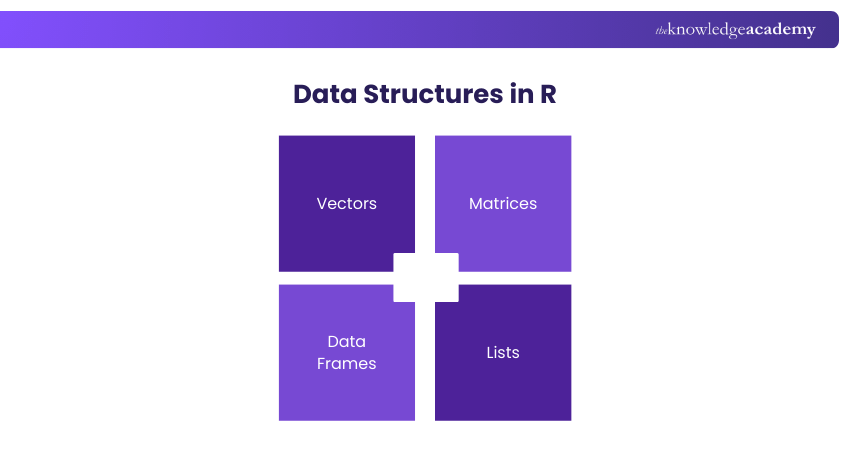
R follows a straightforward syntax, allowing users to perform operations on data efficiently. It supports various data structures such as vectors, matrices, data frames, and lists, enabling users to manipulate data effectively, including handling Number Series for analytical computations.
R Packages and Libraries
One of R's greatest strengths lies in its vast collection of packages and libraries. These packages extend R's functionality, offering specialised tools for Data Analysis, Machine Learning, data visualisation, and more.
Statistical Analysis with R
R is a powerful tool for conducting Statistical Analysis, providing a wide range of functions and packages to explore data and derive meaningful insights. Let's take a look at various statistical techniques that can be performed using R:
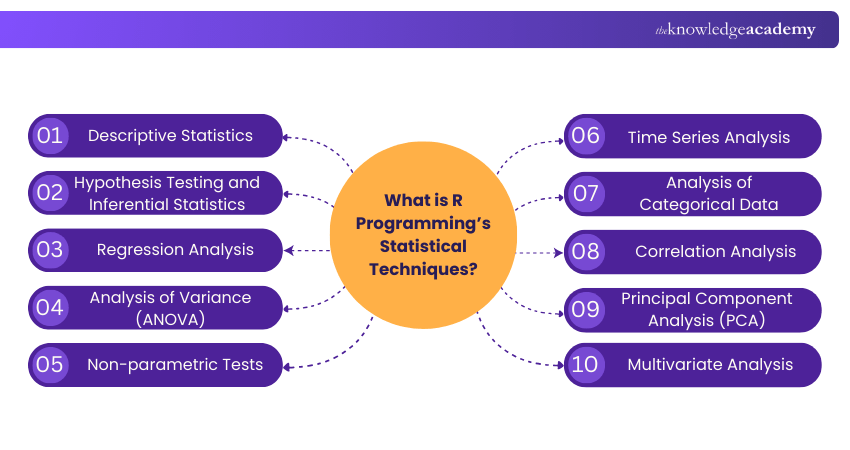
1) Descriptive Statistics: Descriptive Statistics offer a summary of data, providing measures such as Mean, Median, Mode, variance, and standard deviation. R's summary() function and other descriptive statistics functions aid in understanding data distributions and central tendencies.
2) Hypothesis Testing and Inferential Statistics: This is a fundamental aspect of Statistical Analysis. R offers functions like t.test(), wilcox.test(), and chisq.test() for conducting various hypothesis tests based on different types of data and assumptions.
3) Regression Analysis: Regression Analysis helps establish relationships between variables. R provides functions for simple linear regression (lm()) and multiple linear regression (glm()), enabling users to build predictive models.
4) Analysis of Variance (ANOVA): ANOVA is used to compare means between multiple groups. R's aov() function allows users to conduct ANOVA and assess the importance of differences between groups.
5) Non-parametric Tests: R supports non-parametric tests like the Wilcoxon rank-sum test, Kruskal-Wallis test, and Mann-Whitney U test. These tests are useful when the data does not follow a normal distribution or when assumptions for parametric tests are not met.
6) Time Series Analysis: Time series data requires specialised techniques for analysis. R offers packages like ts class and forecast to handle time series data and execute forecasting.
7) Analysis of Categorical Data: For categorical Data Analysis, R provides functions for creating and interpreting contingency tables and performing Chi-Square Tests.
8) Correlation Analysis: Correlation analysis helps measure the relationship between Variables in R Programming. R's cor () function computes correlation coefficients, while functions like cor.test() perform significance tests on correlations.
9) Principal Component Analysis (PCA): PCA is used for dimensionality reduction and data visualisation. R's prcomp() function is commonly used for PCA.
10) Multivariate Analysis: Multivariate analysis techniques, such as cluster analysis and factor analysis, can be conducted using R packages like stats and FactoMineR.
Statistical Analysis is at the core of data-driven decision-making. R's extensive statistical functions and packages empower Data Analysts to explore data, test hypotheses, and draw conclusions. By harnessing the power of R, analysts can unlock valuable insights from their datasets and make informed business decisions.
Benefits of the R Programming Language
R Programming Language is a versatile and powerful tool widely used for statistical computing, Data Analysis, and graphical representation. Its popularity stems from a range of advantages, discussed as part of the broader Advantages of R Programming, that cater to the needs of Data Scientists, statisticians, and analysts. Let's explore some key benefits.

1) Open-source and Free: R is freely available for all, fostering a vibrant community of developers and users who continuously enhance the language.
2) Extensive Package Ecosystem: R boasts numerous packages covering data manipulation, Statistical Analysis, Machine Learning, data visualisation, and more.
3) Statistical Computing Power: R is purpose-built for rigorous Statistical Analysis, making it a go-to language for researchers and statisticians.
4) Data Visualisation Capabilities: R Programming Tools offer powerful data visualisation libraries like ggplot2 and plotly, facilitating clear communication of insights.
5) Community Support: The active R community provides abundant resources and a positive learning environment.
6) Compatibility and Integration: R seamlessly integrates with Python and other languages, as well as databases and data sources. The R Programming Language and Python are both popular choices for Data Analysis, each offering unique features and strengths.
7) Reproducibility and Scripting: R encourages reproducible research through scripts and markdown documents.
Enhance your coding skills with our specialised Python Course. Sign up now!
Who Uses R?
R is widely used by people and industries that work with large amounts of data and need deep analysis or visualisation. It’s a favourite tool for anyone who needs to turn raw numbers into meaningful insights. Here’s who typically uses R:
1) Data Scientists: Analyse big data, build Machine Learning models, and visualise patterns.
2) Statisticians: Perform statistical tests, create reports, and validate research findings.
3) Researchers and Academics: Use R for experiments, academic studies, and publishing scientific results.
4) Business Analysts: Analyse sales, marketing, and operational data to guide decision-making.
5) Healthcare Professionals: Study medical data, public health trends, and clinical trials.
6) Financial Analysts: Predict market trends, assess risks, and analyse investments.
7) Government Agencies: Analyse public policy data, census information, and economic reports.
8) Marketers: Understand customer behaviour, segment audiences, and optimise campaigns using Data Analysis.
What is CRAN in R Programming?
CRAN (Comprehensive R Archive Network) is the official repository for R Programming. It stores packages, updates, and documentation in one place, making it easy to extend R for Data Analysis, visualisation, and statistical tasks. Key reasons why CRAN matters include:
1) Central Repository: Hosts thousands of trusted R packages in one place
2) Easy Installation: Packages can be installed directly within R using simple commands
3) Quality Standards: Packages follow guidelines to ensure stability and compatibility
4) Regular Updates: Developers frequently add improvements and fixes
5) Wide Usage: Supports Data Science, finance, healthcare, and research
6) Free Access: All CRAN resources are available at no cost
What Operating Systems Support R Programming?
The R Programming supports all major operating systems, making it flexible to use across different environments. It runs smoothly on Windows, macOS, and Linux, allowing users to work with data on any system. Additionally, the installation process is straightforward on each platform, ensuring that users can get started quickly without complications.
Transform your data into captivating visuals and elevate your storytelling with our Data Visualisation Training With D3. Sign up now!

The Knowledge Academy develops accessible learning content across Project Management, IT, Cybersecurity, Data Science, Business Analysis, HR, Accounting and Finance, Leadership and Health and Safety. Its resources combine subject research with clear explanations to help professionals build practical knowledge across a wide range of disciplines.
View Detail

 If you wish to make any changes to your course, please


